
3 minutes ago, Pam Bondi was facing off with a constitutional law professor. Jamie Raskin. Harvard Law graduate. He taught constitutional law at Georgetown for 25 years. The lead manager of Trump's second impeachment trial. A legal scholar who has researched the men who wrote the Constitution, written books, and trained generations. And today, he taught Bondi the rules. Word for word: "I will teach you the rules." To the United States Attorney General. Live on air. While all of America is watching. Bondi's response? "You are experiencing Trump syndrome." "This is a moment that will go down in history." A law professor has to explain the Congressional rules to the Attorney General. Because the Attorney General either doesn't know the rules or doesn't want to know them. Which one is worse? You decide. Raskin started with a simple question. About the rights of the victims. About compensation rights. "How valuable do you think the demands of those who survived are?" He stopped. He looked at Bondi. He waited for an answer. "As the honorable congressman from Kentucky just mentioned, many survivors have decided never to reveal their names for their own reasons." This is an important point. These women made a conscious choice. They wanted to remain hidden. They were even hiding their experiences from their families. They had carried this secret for years. They hadn't told anyone. "This decision was communicated to Congress." And we included it in federal law. That the names cannot be disclosed. This is a law. Federal law. A law passed by Congress and signed by the President. The victims' names will be protected. Raskin's voice hardened. "And you published their names." Their phone numbers. Their addresses. Their personally identifiable information. What does the law say? Protect the names. What did Bondi do? He published the names. It's that simple. So clear. And this illegal. Then Raskin asked the bomb question. The question on everyone's mind. "If Donald Trump can theoretically get 0 billion from the Justice Department, how much should these people get?" He paused. He wanted everyone to hear. She wanted it to reach every corner of the hall. "For a much worse violation of their privacy rights." For a much greater danger created in their lives. "This question is very important." Trump can demand 10 billion dollars. In theory, he could get money from the Justice Department. What about these women? Their names were revealed. Their addresses were published. Their phone numbers were leaked on the internet. Their lives were put in danger. The harasser, an old acquaintance, can find them. They can threaten them. They can cause harm. What will they get? Nothing? While Trump gets billions, do they get nothing? And that's when Bondi exploded. In an unexpected way. Instead of answering the question, he attacked. He jumped to a completely unrelated topic. "Do you know who Chase Mulligan is?" You're very obsessed... Raskin was surprised. What's the relevance? We were talking about Epstein's victims. We were talking about compensation rights. Who is Chase Mulligan? "You don't even know, do you?" Raskin tried to intervene, but Bondi continued. He didn't stop. He didn't listen. "I will teach you the rules again," Raskin said. His voice was calm, but its firmness was evident. "You are the Attorney General of the United States." There are rules here. Bondi interrupted. He shouted: "You are the Attorney General of the United States..." You are obsessed with Donald Trump. You're experiencing Trump Syndrome! The hall froze. Everyone was trying to understand what was happening. Why do you think Bondi talks about Trump every time? Why does he answer every question with "Trump syndrome"? Share your thoughts in the comments. Raskin tried to stay calm. He tried to maintain his professionalism. But the anger was evident. On his face, in his voice, in his stance. "Mr. President, I want my time back." The president approved. He gave back the time Bondi stole. Raskin turned to the whole country. He looked at the cameras. "I want the whole country to look at this." Because this is the United States Attorney General, whose job is to enforce the law. He paused. He made each word feel heavy. "We have never had a witness who so completely misunderstood our rules and could not conform their behavior to them." This sentence is harsh. Raskin has been in Congress for years. He has seen hundreds of witnesses. Ministers, directors, CEOs, generals. And none of them have acted like Bondi. None of them have broken the rules so openly. Raskin explained the rules. Like a professor teaching a student. With patience. Step by step. "Ms. Bondi, here's how it works: We ask you questions, and you answer them." Simple. Understandable. A rule that even an elementary school child can understand. A question is asked, an answer is given. "And if you delve into an unrelated topic, switch to another subject, start reading statistics, or begin talking about what's happening in our regions..." He paused. He wanted to make sure Bondi was listening. "Then we have the right to say 'I take my time back.'" At that point, you need to be quiet. You have no choice. You need to be quiet. Bondi's face was expressionless. Was he listening? Did he understand? It was unclear. Did he care? It was never clear. "I hope you understand the rule now." A 25-year veteran professor is explaining the rules to the Chief Prosecutor at a primary school level. This image summarizes everything. Raskin moved on to the main question. The important question. To the question that awaits an answer. "You are the law enforcers." We saw all kinds of evidence of wrongdoing. And when we went to the Department of Justice, we saw more evidence of crimes on the four computers belonging to each congress member. "This is important." Congress members can review the Epstein files. On computers at the Justice Department. And what they saw was serious. Evidence of the crime. Documents. Names. "Will you establish a joint task force consisting of the Department of Justice, governors, state attorneys general, and prosecutors across the country?" Raskin's request was clear. It was reasonable. It could have been implemented. "To investigate the crimes committed against these victims and more than 1,000 others like them." The DOJ is not doing its job. Will you form a task force with state and local law enforcement? A simple question. Yes or no. Will you form a task force? One-word answer is enough. He gave President Bondi the floor. He gave her a chance to respond. And what did Bondi do? Guess. "Thank you, Mr. President." He called Chase Mulligan a 'non-issue' and didn't even know who he was. Again Chase Mulligan. Again with the changing the subject. Again the same tactic. "He's a suspect in your own district." Someone who attacks girls. Raskin interjected: "Mr. Chairman..." Bondi continued. He didn't stop. He didn't listen. "If you were part of the FBI investigation, you wouldn't do anything about it." Online chat rooms and sextortion... "In your tiny little district, you didn't even know who he was, President." It embarrasses you. This is your committee, and it embarrasses you. "This last sentence was very important." Bondi turned to the Committee Chair and said, "He is embarrassing you." Someone from his own party. To the Republican president. To his ally. If you want this type of content to continue, subscribe to the channel and turn on notifications. Wait a second. What just happened? Let's take a step back. Raskin called for a joint task force for Epstein's victims. Federal, state, and local law enforcement should come together. Investigate the crimes. Let them prosecute the perpetrators. Bondi mentioned a case in Raskin's district. Someone named Chase Mulligan. He has nothing to do with Epstein. What does it have to do with it? None. Zero. Completely changing the subject. This is a classic tactic. When you can't respond, attack. Change the subject. Put the other side on the defensive. Distract them. But Raskin didn't buy it. A 25-year professor. He knows these tactics. So, what really happened in this trial? Why is it so important? Let's look at the big picture. Raskin asked a very specific question. The victims' privacy rights were violated. Federal law was violated. Their names, addresses, and phone numbers were published. These women remained hidden for years. They even hid it from their families. They didn't tell anyone. And the Ministry of Justice disclosed all of them. In thousands of pages. It was leaked online. Everyone can see it. Bondi's answer? Chase Mulligan. Who is Chase Mulligan? A case in Raskin's district. Someone who attacks girls in online chat rooms. It has nothing to do with Epstein. It has nothing to do with the victims' right to privacy. What was he talking about? Because he couldn't answer the real question. Raskin's joint task force proposal was very sensible. Think about it. The DOJ is not doing its job. There are more than 1,000 victims. Not a single person has been prosecuted. The files are hidden. The perpetrators are being protected. State attorneys general can step in. Governors can provide support. Local prosecutors can open an investigation. They can work together. New York, Florida, New Mexico, Virgin Islands. An investigation can be opened in every state where Epstein committed a crime. They can work together. Did Bondi accept this? No. He didn't even reply. He ignored it. He mentioned Chase Mulligan. Now think about the numbers. Cold, hard numbers. 6 million files were requested. Congress ordered it. It was required by law. 3 million was given. Half of it is hidden. 3 million files are still classified. The names of the victims were disclosed. The law had ordered the opposite. The names of the perpetrators were protected. The law had ordered the opposite. Trump's name appears in the files more than 1 million times. More than 38,000 references. His name is in 5,000 files. And the Chief Prosecutor, when asked about this matter, says "Trump syndrome." Is this the answer? Why do you think Bondi didn't answer the joint task force question? Why did he mention Chase Mulligan? Mention it in the comments. Raskin's anger was justified. He was completely right. The guy has taught constitutional law for 25 years. He knows the rules of Congress by heart. He has handled the most complex cases. He handled Trump's impeachment trial. And he has to explain these rules to the Attorney General. The most basic rules. "You need to be quiet." You have no choice. "Does a professor need to say this sentence to the Chief Prosecutor?" Normally no. Absolutely not. But Bondi is not an ordinary witness. Not a normal Attorney General. The most striking moment of the trial was this. Read the dialog: Raskin: "How much compensation should these victims receive?" Bondi: "Do you know Chase Mulligan?" Raskin: "I'll teach you the rules." Bondi: "You are experiencing Trump syndrome." This dialog summarizes everything. A question is asked, but no answer is given. The subject is being changed. Attacked. Insults are being hurled. This is the person at the head of the Ministry of Justice. The person who is supposed to enforce the laws. And he can't answer the simplest questions. The results of this hearing are very clear: The victims' right to privacy was violated. Federal law was violated. No one was held accountable. Bondi did not respond to the joint task force proposal. He neither rejected nor accepted it. Ignored it. Bondi changed the subject at every opportunity. Chase Mulligan. Trump syndrome. Raskin's district. Tiny district. Raskin had to explain the Congressional rules to the Attorney General. "You need to be quiet." You have no choice. "More than 1,000 victims are still waiting for justice." Not a single perpetrator has been prosecuted. So, what will happen next? Raskin and the other Democrats will continue to apply pressure. They will request the complete files. They will request the 3 million stored files. Victims can file a lawsuit. Privacy rights were violated. Federal law was violated. They can claim compensation. Millions of dollars. And Congress can force Bondi to comply. The law requires it. All the files should be disclosed. But Bondi is resisting. Every time, the same tactic. Attack. Change the subject. Don't answer. It's the Trump syndrome too. Raskin made history today. "I will teach you the rules." "This sentence will not be forgotten." A constitutional law professor giving a lesson to the Chief Public Prosecutor. Ignorance in the face of 25 years of experience. Bondi's answer? "Trump syndrome." Who is right? You decide. But the numbers are clear. 1,000 victims. 3 million hidden files. Zero judgment. Subscribe to keep up with these developments. Watch the two videos on the screen.
.png "5399e494-06bc-414d-b53e-6887bc3d0d9e.cUdw8Ps24g0-thumbnail-by-nexlev (1)")
"There are perpetrators who rape these women." And you refuse to even acknowledge that they are here. "This sentence just echoed in the Congress hall." Jasmine Crockett. Democratic Congresswoman from Texas's 30th district. Former criminal defense attorney. Someone who has fought in courtrooms for years. A woman who has taken the toughest cases in Dallas and fought against the strongest opponents. And today she used that experience against Pam Bondi. But Crockett did something different. He didn't ask Bondi a single question. Why? Because he knew Bondi wouldn't answer. He had watched for hours. Every time a question was asked, Bondi either changed the subject, attacked, or talked about Merrick Garland. "I will not ask this witness any questions," Crockett said. "Because this witness prefers to ask questions instead of answering questions. I don't know which law school he went to. I don't know what kind of cases he/she has seen. But normally, witnesses sit and answer questions. They don't ask questions. These words had a bombshell effect in the hall. A lawyer was giving another lawyer a lesson. And he was right. And then he turned around, looked at the survivors behind him, and began his speech that would go down in history. Crockett's first move was unexpected. No one could have predicted it. He turned to his colleague Becca Balint. He asked simple questions. Questions that even children can answer. "True or false: Raping children?" Balint: "Wrong." "True or false: Killing random citizens?" Balint: "Absolutely wrong." "Right or wrong: Enriching yourself as president?" Balint: "Absolutely wrong." Crockett turned back to the living room. He looked at Bondi. "Thank you." Because I could never get these answers from our acquaintance. The hall did not quiet down. Everyone understood what was happening. Crockett had shown that Bondi could not even answer the most basic moral questions. Is it wrong to rape children? There is a Chief Prosecutor in front of us who cannot even give a clear answer to this question. Then Crockett turned to the survivors. To the women sitting behind him. To the women in white clothes, waiting silently. "I won't call them victims," she said. "Because they are the survivors." survivors. He stopped. His eyes were welling up, but he was controlling his voice. "I want to thank you." In your little finger, there is more courage and moral clarity than in the entire Department of Justice. "This sentence echoed in the hall." The cameras turned to the survivors. Some were crying. This was what they had been waiting for for years. Someone seeing them. Someone accepting them. "We're a laughingstock in the eyes of the world right now," Crockett said. "Partially because of the failed leadership at the Justice Department. While kings and queens fall everyplace in the world, we don't even know the foundations of right and wrong in this country. These words were not just about Bondi. It was a critique of the entire system. Crockett gave a name. An unexpected name. Everyone was surprised. "I applaud Thomas Massie," she said. "Because he's the only one on the Republican side with a spine. The only person who knows how to stand against corruption. "This is important." Crockett is a Democrat. Massie is a Republican. Different parties. Different views. But Crockett praised Massie's stance on the Epstein files. Because Massie had caught Bondi red-handed for hiding Les Wexner's name. Not partisanship. This is the right thing. And Crockett is honest enough to admit it. Why do you think only one Republican is speaking out on this issue? Where are the others? Share your thoughts in the comments. Crockett read Bondi's written statement. Bondi's own words. "This witness stated that he had two main objectives when he took office." The first: To put an end to the use of justice as a weapon. The second: To return the Ministry to its primary mission. He stopped. He looked at Bondi. He didn't look away. "You lied in both." And you did the exact opposite. Deliberately. Crockett's voice rose. The anger was controlled but palpable. "You are spending more taxpayer resources prosecuting journalists than you are prosecuting pedophiles and perverts." Read that sentence again. Journalists are being arrested. Pedophiles are being released. These are the priorities of the Ministry of Justice. This is the truth. "In fact, your boss, the President of the United States, said this administration 'took away freedom of speech.'" "Actually, your boss, the President of the United States, said that this administration 'took away freedom of speech.'" Crockett counted the names. One by one. Don Lemon was arrested. Georgia Ford was arrested. The journalists' homes were raided. Students were threatened. Protesters were targeted. "And a judge had previously rejected your attempt to arrest Don Lemon," Crockett said. "Just like the grand jury rejected your indictment against Senator Kelly. Just like it rejected your claim against Senator Slotkin. Just like the dismissal of the Tish James case. Just like the Comey case being dropped. He stopped. He looked into Bondi's eyes. "I don't understand how you sit at the head of the DOJ." Because you are not good at your job. This sentence was simple but devastating. Telling the Attorney General, "You don't know your job." Live on air. While all of America is watching. And then Crockett got to the main point. Trump and Epstein. The topic everyone is waiting for. "Let's talk about your protection of pedophiles and perverts," he said. "I want to talk about the possible relationship between the President and Jeffrey Epstein." "I don't know what the President did with Epstein." But unlike this administration, I believe that the facts matter. "And he listed the facts." Based on the documents. Based on FBI reports. Fact Number 1: "Donald Trump is one of the most mentioned people in the Epstein files." In at least 5,000 files. There are over 38,000 references to Trump, his wife, or Mar-a-Lago. 5,000 files. 38,000 references. Think about these numbers. Could this be a coincidence? Is it normal to have this many references? Fact Number 2: "Jeffrey Epstein and Ghislaine Maxwell presented Trump with multiple young girls." Crockett showed the documents. FBI records. "According to this file, Ghislaine Maxwell introduced a young girl to President Trump." Trump flirted with this girl for more than 20 minutes. 20 minutes. With a young girl. With a girl presented by Ghislaine Maxwell. Who is Maxwell? A convicted sex trafficker. Epstein's associate. He showed another document. FBI agents' notes. "This shows the notes of the FBI inspectors." It describes how one of Jeffrey Epstein's victims was taken to Mar-a-Lago to meet President Trump. And Epstein's words to Trump: "This is a good one." "Bu iyi bir tane." About a person. About a victim. About a little girl. "This is a good one." If this sentence doesn't make your stomach turn, there's a problem. Crockett made a statement. Careful and measured. "I'm not saying the president is a pedophile." But in these files, there is a lot of evidence showing that he is very close friends with many men who are pedophiles. "This is an important distinction." Crockett is not making an accusation. He's stating the facts. He is showing the documents. And he is asking questions. Questions that Bondi doesn't answer. If you want this content to continue, subscribe to the channel and turn on notifications. Crockett moved on to cover-up. And things got even worse. "The crazy part of all this is: This is a big cover-up." And this administration is complicit. This administration is an accomplice. Accomplice. He used that word. Live on air. He listed other cover-ups as well: DOJ is obstructing the investigation into rogue agents who killed American citizens. DOJ is requesting voter data from Fulton County to steal the 2026 midterm elections. There is a tape of federal agents recording Tom Homan accepting a bribe. And the DOJ closed the investigation. The DOJ is preparing to pay the president 230 million dollars. This is unconstitutional. The Constitution is clear: The President cannot receive any payment other than their salary while in office. All of this is documented. On record. As Crockett finished his speech, he uttered his historic words. Every word is heavy. "The truth is, you will be remembered as one of the worst attorneys general in history." He paused. He emphasized every word he said. "A chief prosecutor who prioritizes obstruction instead of justice." A prosecutor who prioritizes corruption over the law. A chief prosecutor who prioritizes loyalty to the president over loyalty to the Constitution. "And he handed over his time." He had said what he needed to say. Bondi wanted to respond. A Republican congressman gave her the floor. And what did Bondi do? Guess. "I find it interesting," Bondi said. "Congressman Crockett didn't even want to ask a question. Because he cannot defend his leader. Judge Jeffries took money from Epstein after he was convicted. Don't change the subject. As usual. When the Epstein question comes up, talk about something else. Then Bondi started talking about immigrant criminals. "In Texas, someone from Cuba, convicted of murder, arson, gun charges..." What does it have to do with the Epstein files? None. Zero. "From the Dominican Republic, Cecil Joseph is convicted of kidnapping and rape in Texas..." Again, irrelevant. "Khalid Khan from Afghanistan..." "That's why they want to talk about Epstein," Bondi said. "To not talk about what is happening in their own states." "To avoid talking about what is happening in their own states." Why do you think Bondi changes the subject every time? Why does he talk about immigrants when Epstein is asked? Mention it in the comments. So, what do the facts say? Cold, hard, documented facts. Trump's name appears in 5,000 files. This is a fact. There are 38,000 references. This is a fact. It has been documented that Ghislaine Maxwell presented young girls to Trump. This is a fact. There are FBI notes stating that Epstein took one of his victims to Mar-a-Lago and said, "This is a good one." This is a fact. And the Ministry of Justice is hiding these files. 3 million pages are still classified. This is a fact. Bondi does not respond to any of these facts. He talks about immigrants. Why is Crockett's speech important? Because he laid out the facts. He showed the documents. He provided the figures. And most importantly: He knew Bondi wouldn't be able to answer. That's why he didn't ask a question. "I will not ask this witness any questions." Because he doesn't answer. This tactic is brilliant. He dismantled Bondi's entire defense. He exposed without asking questions. There is also the issue of the survivors. The most painful part of this trial. Crockett turned to them. He thanked them. He praised their courage. "Your little finger has more courage than the entire Department of Justice." These women have been fighting for years. They want justice. They want to make their voices heard. And the Ministry of Justice is ignoring them. Bondi did not meet with them. He didn't even mention their names. They just sat behind him and were ignored. As if they weren't even there. More than 1,000 survivors. And not a single perpetrator was prosecuted. What happened after the hearing? Crockett's speech went viral. The phrase "the worst attorney general in history" was shared everyplace. Millions of people watched. But the really important numbers are: 5,000 files. 38,000 references. 1,000+ survivors. And still 3 million pages are being kept. What is in these files? Who is being protected? Why isn't it being disclosed? Crockett asked these questions. Bondi didn't answer. As always. This story isn't over. It's just beginning. The survivors are still waiting for justice. They have been waiting for years. The files are still hidden. And every day new questions arise. Crockett made history today. "You will be remembered as one of the worst attorneys general in history," he said. Can Bondi refute this? So far, all he has done is change the subject. He is talking about immigrants. He is talking about Judge Jeffries. He is not talking about Epstein. Because he can't talk about it. Because the facts are clear. 5,000 files. 38,000 references. "This is a good one." Crockett exposed Bondi today. "These women were raped." And you are protecting them," he said. Bondi's answer? Immigrants. As always. But the facts don't change. 5,000 files. 38,000 references. And 1,000+ survivors are still waiting for justice. Subscribe to follow these developments. Watch the two videos on the screen.
"While you sit here today, there are over 1,000 victims of sex trafficking." And you haven't held a single person accountable. Shame on you. If you have any honor, you should resign immediately after this hearing. Ted Lieu just said this sentence to the face of United States Attorney General Pam Bondi. Live on air. In front of the cameras. While all of America watches. And this was just the beginning. Because Lieu accused Bondi of lying under oath. With a document. Prove it. On the record. Ted Lieu is not an ordinary politician. He was a JAG officer in the Air Force. Military lawyer. For years, he interrogated war criminals, spies, and traitors. He is a guy who can smell a liar from miles away. And today he used that experience against Pam Bondi. The inquiry into Lieu began with two photographs. Photos of the former Prince Andrew. Taken with Jeffrey Epstein. At parties. While posing together. "I will show you two photos," Lieu said. "Prince Andrew attended various parties with Jeffrey Epstein." He put the photos on the screen. The audience was watching carefully. "Under the law enacted by Congress, you were allowed to redact faces in photos to protect the victims of Epstein's sex trafficking operation." You edited the face of this victim because you were complying with the Congressional law. Is that correct? Bondi replied, "I'm sorry for redacting the victims." "Because you complied with the congressional law, right?" "Yes." Lieu's voice sharpened. In a tone of military discipline. "Okay." Now show me the photos again. You just admitted that we are looking at a victim of sex trafficking here. He paused. He wanted everyone to hear the next sentence. He emphasized every word. "According to the Federal Victims of Trafficking Protection Act, it's not just Jeffrey Epstein who is guilty." Anyone who used Epstein's operation is also committing a crime. "This is a very important point." The law is clear. Anyone who used Epstein's "services" is considered an accomplice. This is not just a moral issue. A legal matter. Lieu's voice rose. The anger was controlled but palpable. "That's why I find it absolutely disgusting that you try to protect Epstein's clients." Like former Prince Andrew. "Last July, you dropped the case against Epstein's accomplices." Your Justice Department's July 2025 note states: 'We did not find evidence to support initiating an investigation against uncharged third parties.' '" Lieu showed the photos again. He pointed with his finger. "These two photographs, these two photographs looking at you, are evidence of a crime." And more than enough evidence to launch an investigation against Prince Andrew. "So I ask you, Attorney General Pam Bondi: Why did you close this investigation last July? And why didn't you prosecute Prince Andrew?" The question hung in the air. Everyone was waiting for the answer. Bondi's answer? Guess. "I don't think you were asking him these questions when Merrick Garland was the attorney general." Every time the same tactic. When asked a question, blame the previous administration. Merrick Garland. Bill Barr. Obama era. Everything is someone else's fault. Lieu did not accept this. "I'm taking my time back." "But then he said something that you should pay attention to." This is important. "I agree with you." I asked for the Epstein files to be looked at during the Biden administration. Merrick Garland dropped the ball. Attorney General Bill Barr also dropped it. Alex Acosta too. A series of failures. He stopped. He looked into Bondi's eyes. "But now you are the manager." You have the power to change things. You have the power to hold these men accountable. And you do the exact opposite. You are protecting them. "This sentence is very important." Lieu is not partisan. He criticizes Democratic administrations as well. He blames Garland, Barr, and Acosta. But now it's Bondi's turn. And Bondi fails. Why do you think Prince Andrew hasn't been tried yet? The photos are out there. The evidence is available. But nothing is happening. Share your thoughts in the comments. Lieu moved on to another topic. And things got much tougher here. "I want to talk about another man." Donald Trump. Someone who is everyplace in the Epstein files. Bondi tried to interject: "Can I respond?" Lieu continued. He didn't stop. "Like Prince Andrew, Donald Trump also attended various parties with Jeffrey Epstein." I want to know: Was there any underage girl at that party? Or at any party that Trump attended with Epstein? A simple question. A question that requires a yes or no answer. Was an investigation conducted? Was evidence sought? Were witnesses interviewed? Bondi's response is of a historic kind. "This is ridiculous. They are trying to distract from all the great things Donald Trump has done. There is no evidence that Donald Trump committed a crime. Everyone knows this. Lieu interrupted: "I take back my time." "This has been the most transparent presidency." He is the one who wants those files to be opened—" "I take back my time." I received your answer. You said there was no evidence. Bondi said, "There is no evidence." Remember this sentence. Because Lieu is about to refute this. And that moment has come. The most critical moment of the trial. Lieu presented another document. Calm but determined. "I will submit another document." From a witness. From someone who called the FBI's National Threat Operations Center. He looked directly at Bondi. Without averting his gaze. "Because I believe you just lied under oath." Bondi exploded: "Never accuse me of a crime!" Lieu remained calm. With military composure. "I believe you just lied under oath." And it was recorded on this video. "You said, 'There is no evidence of a crime.'" He showed the document. For everyone to see. "A witness statement that I'm showing you here." Someone calling the FBI's Threat Operations Center. " The witness's story was this. And this story is horrifying. The man was driving Donald Trump around in a limousine. He was driving. He heard Trump talking on the phone with Jeffrey Epstein. The content of the conversation made him so angry that he wanted to stop the limousine and harm Trump. And he met a girl. This girl said she was raped by Donald Trump and Jeffrey Epstein. Both of them. At the same time. Later, this girl was shot in the head. She died. The police at the scene said, "This could not be a suicide." It didn't look like a suicide. But the case was closed. And no one spoke with this witness. The FBI called. Provided information. Nothing happened. Lieu's voice hardened. Anger was no longer controllable. "No one at the Ministry of Justice has spoken to this witness." You need to meet with this witness immediately. He stopped. He took a breath. "Epstein should rot in hell." The men who used his operation should rot in hell too. And as you sit here today, there are over 1,000 victims of sex trafficking. And you haven't held a single man accountable. And that historic sentence. A sentence that will go down in American history: "Shame on you." If you have any honor, you should resign as soon as this trial is over. "If you have any dignity, you should resign as soon as this trial is over." Bondi wanted to respond. "Can I respond?" Lieu: "I don't know how you will answer." "Nobody—" "I didn't ask a question." Bondi attacked again: "He doesn't want to talk about the crime in California." "I didn't ask a question." Chaos. The president intervened. And Lieu's time is up. If you want this type of content to continue, subscribe to the channel and turn on notifications. So, what happened in the hearing? Why is it so important? Let's delve a bit deeper. First of all, we need to understand this: Ted Lieu accused Bondi of lying under oath. This is not a light charge. Lying under oath in Congress is a federal crime. There are years of prison time. A career-ending accusation. What did Lieu have in hand? A witness. Someone who called the FBI. He drove Trump around in a limousine. He overheard a Trump-Epstein phone call. And he met with a rape victim. That victim was later killed under suspicious circumstances. This witness has never been interviewed. Why? Who decided not to meet? These questions remain unanswered. Bondi said, "there's no evidence." Lieu showed the document. "Proof is here," he said. Who is lying? Witness? Bondi? And then there's the Prince Andrew issue. This issue is resonating in England as much as it is in America. The photos are out there. At parties with Epstein. The victims' faces have been edited. Andrew's face is visible. Everyone can see it. What does the Congress law say? Protect the victims. Hide their identities. What did the Ministry of Justice do? It exposed the victims and protected the names of the perpetrators. He did the exact opposite. The investigation was closed in July 2025. Reason? "We couldn't find any evidence." Lieu showed the photos. He asked, "Isn't this evidence?" Two people in the same frame. One of them is a known sex trafficker. The other is a member of the British royal family. Bondi couldn't answer. Because there is no answer. And the Trump question. The most sensitive point of this trial. Lieu asked a very simple question: Were there underage girls at the parties Trump attended with Epstein? Bondi's answer: "That's ridiculous." Is the question ridiculous? Or is the answer disturbing? There are over 1,000 victims. The files are out in the open. There are witnesses. There is a limousine driver. There is an allegation of rape. There is a suspicious death. And the Chief Prosecutor says it's "ridiculous." What is the duty of a Chief Public Prosecutor? To investigate. Investigate. Finding the truth. It's not "ridiculous." Do you think Bondi lied under oath? Is the witness statement shown by Lieu real? Let us know in the comments. Lieu's military background comes into play here. This is not just any politician. The man has conducted interrogations for years. In military courts. He has interrogated war criminals. He interrogated spies. He has interrogated the traitors. He knows a liar. He understands from body language, tone of voice, and word choice. And today he said it plainly: "You lied under oath." "This accusation will not go unanswered." Lieu said this knowingly. It's on record. In front of the cameras. While all of America watches. Bondi will either clear his name or this accusation will stick to him. There is no middle ground. What happened at the end of the trial? Complete chaos. Lieu ran out of time. Bondi wanted to respond. The president allowed it. And what did Bondi do? He started talking about crime rates in California. About the immigrants in Lieu's district. From the refugee city policies. It has nothing to do with the Epstein question. Completely changing the subject. Classic defense tactic. A Republican congressman took the floor and began reading crime statistics from California. 4,561 criminal immigrants. 31 murders. 661 assaults. 574 thefts. 184 robberies. What does it have to do with Epstein? None. Zero. Don't change the subject. They are making excuses to avoid Lieu's questions. When asked about the Epstein files, they talk about immigrants. Let's look at the facts. Cold, hard facts. There are over 1,000 victims of sex trafficking. Documented. Under record. Not a single person was prosecuted. Prince Andrew is in the photos. With Epstein. The investigation has been closed. There is a witness statement about Trump. It has reached the FBI. No one has contacted. The victims' names were disclosed. Phone numbers and addresses were published. The names of the perpetrators were protected. And the Chief Prosecutor says, "there's no evidence." He says, "It's ridiculous." Ted Lieu shows the document. "There is evidence here," he says. "You lied under oath," he says. Someone is lying. And Lieu said who it was. Under record. This story is not over. It's just beginning. Lieu's accusation is on record. "You lied under oath," he said. This is a serious accusation. There will be consequences. The witness is still waiting to be interviewed. He called the FBI, provided information, and nothing happened. Why? The files are still classified. 3 million pages are hidden. What's inside? And more than 1,000 victims are still waiting for justice. They have been waiting for years. Will Bondi resign? Probably not. There is no accountability in this administration. But Ted Lieu did something today. He made history. Documented it. He recorded it. And in front of all of America, he said to the Attorney General, "Shame on you." This will not be forgotten. This will not be erased from the records. Ted Lieu made history today. "If you have any honor, resign," he said. Does Bondi have any honor? We saw the answer today. Subscribe to follow these developments. Watch the two videos on the screen.
What you just watched is a first in American history. A congress member says to the United States Attorney General, "I will teach you the rules." And what does the Attorney General do? Instead of answering questions, he shouts, "You're experiencing Trump syndrome." Jamie Raskin is not an ordinary politician. A graduate of Harvard Law School. Professor of constitutional law at Georgetown University. The lead manager of Trump's second impeachment trial. The guy has written a law book, he knows the rules by heart. And today, he had to remind Pam Bondi of those rules. Because Bondi doesn't even understand the most basic rules of Congress. Or he doesn't want to understand. But before this hearing, Raskin made a statement to reporters. And what he said was a foreshadowing of what was to happen in the hearing. Raskin spoke very clearly before entering the hearing. He said that Bondi not only aggressively demeaned Congress and committee members, but also ignored serious questions about the Justice Department's performance. And most importantly: He ignored the interests of the victims by betraying them. Pay attention to the word Raskin used. "A massive government cover-up." This is a serious accusation. And Raskin supported this with evidence. But Bondi is not just covering up the Epstein files. She is covering up other things as well. The FBI had launched an investigation into Renee Goode, who was killed by Trump's masked paramilitary ICE agents in Minneapolis. Bondi shut that investigation down. They claim to be investigating the murder of Alex Pretty, but the President and Christie Noem label these individuals as "domestic terrorists." How can you trust this administration? Raskin said all of this to Bondi's face. And Bondi's response? Attack. Now I will tell you what happened in the trial. But first, I must say this: If you want this kind of content to continue, subscribe to the channel. Your support is really important to us. Because this story is just beginning. The hearing started in the morning. House Judiciary Committee oversight hearing. The hall was full. But they weren't ordinary viewers. Women who survived Jeffrey Epstein's abuse were there. They were sitting in white clothes. The cameras were filming them. Raskin introduced these women one by one in her opening speech. Raskin turned to Bondi while reading each name. "You still haven't met with these women." You refuse to meet with the victims. Bondi did not respond. Then Congresswoman Pramila Jayapal took the floor. And a historic moment occurred. Jayapal turned to the victims in the audience: "Stand up." And if you have never met with the Department of Justice, raise your hand. Everyone stood up. Everyone raised their hand. It was recorded: Each victim raised their hand. What is the duty of the Ministry of Justice? To protect the victims. Prosecuting the perpetrators. But they have never met these victims even once. Do you think this is a coincidence? Or a deliberate choice? Raskin presented the figures. Congress ordered the Justice Department to release all 6 million documents. Federal law required it. What did Bondi do? He published 3 million documents. He hid the other 3 million. Excuse? "Duplicate documents." Raskin's answer was very clear: "Publish them even if they are duplicates." Duplicate documents are always published. You know this. "But that's not the main issue." Among the 3 million hidden documents, there are original statements of the victims. These are not duplicates. These are the original documents. And the Ministry of Justice also removed the 2019 prosecution note. Is this also a duplicate? Here is where things get even uglier. The law is very clear: The names of the victims will be redacted. The names of the perpetrators will be published. Bondi did the exact opposite. The victims' names, phone numbers, and addresses were published. On thousands of pages for everyone to see. Most of these women had never revealed their names. They had even hidden their experiences from their families. And Bondi exposed them all. Names of the perpetrators? Names of the accomplices? Names of the facilitators? They were all redacted. It was preserved. Raskin described this as "either an astonishing bureaucratic blunder or a direct message sent to the victims." Can a ministry with more than 100,000 employes make such a big mistake? Or was it done intentionally? Do you know what Bondi said in his defense? "We have been sued 627 times." We are fighting against the judicial activism of liberal activist judges. Raskin asks: "Where are the 6 million documents?" Bondi replies: "The judges don't like us." Raskin asks: "Why were the victims' names disclosed?" Bondi responds: "Judicial activism." Is this the answer? And then there's the Maxwell issue. Ghislaine Maxwell, the woman who delivered Virginia Giuffre and hundreds of victims to Epstein. Convicted sex trafficker. Congress called Maxwell to testify. And what happened? Todd Blanche met with Maxwell for 9 hours. After ensuring that Maxwell would "not say anything negative about Donald Trump," they moved him from a high-security prison to a minimum-security camp. In Texas. With five-star treatment. In Raskin's words: "Catering meals, private gym, therapy dog." A convict sex trafficker is getting a therapy dog. But the victims cannot meet with the Ministry of Justice. What kind of justice system is this? Raskin said Bondi brought a "burn book." Burn book. Do you remember his performance in the Senate? Instead of answering questions, Bondi was attacking the people who asked them. There were smear notes prepared for each senator. Raskin warned: "Put the burn book aside." Answer our questions. We have five minutes. Don't change the subject. Don't make personal attacks. Did Bondi listen? Of course not. And that moment has come. Raskin was asking about the victims' right to compensation. If Donald Trump can theoretically get 0 billion from the Justice Department, what should these victims, whose privacy rights were violated, get? Bondi did not answer. Instead: "Do you know who Chase Mulligan is? Don't you know the case in your own district?" Raskin was surprised. What's the connection? Bondi continued. He mentioned a case in Raskin's district. He completely changed the subject. Raskin remained calm: "You are the United States Attorney General." Here, there are rules. Bondi interrupted: "You are experiencing Trump syndrome!" Bondi interrupted: "You're experiencing Trump syndrome!" At that moment, Raskin said his historic sentence: "I will teach you the rules." This sentence was not just for Bondi. It was a message to the entire administration. Raskin explained the rules: "We have five minutes. We ask the questions, you answer. If you change the subject, say irrelevant things, or talk about what is happening in our regions, we will say, 'I want my time back.' Then you need to be quiet. You have no choice. Bondi's answer? "In your tiny little region..." More insults. More attacks. Zero response. Why do you think Bondi couldn't even answer a single question properly? Share your thoughts in the comments. Raskin summarized the hearing by saying: "Trump places orders like pizza." Bondi delivers every time. James Comey. Letitia James. Lisa Cook. Jerome Powell. Adam Schiff. Mark Kelly. Trump writes a name on social media, and the Justice Department takes action. This is something unprecedented in American history. The Department of Justice has turned into a personal tool for the president's revenge. But there is good news as well. Some prosecutors refused to comply with these orders. Daniel Sassoon had been appointed as a prosecutor in Manhattan. Eric Adams was ordered to drop the charges. As a political favor to Trump. Sassoon rejected it. He resigned. His deputy, Hagen Scotten, an Iraq War veteran, a two-time Bronze Star recipient, and a prosecutor who worked alongside Roberts and Kavanaugh. He also resigned. He wrote in his letter: "In the end, you will find someone who is either stupid enough or cowardly enough." But it wouldn't be me. "But I wasn't going to be there." Eric Seibert is a prosecutor with 15 years of experience. He investigated Letitia James and James Comey for 5 months. Result? There is no evidence to warrant an accusation. What did Bondi do? He dismissed Seibert. He appointed Lindsay Halligan as his replacement. Trump's personal attorney in the Mar-a-Lago documents case. Zero prosecutorial experience. A federal judge found the appointment "clearly illegal." He completely dismissed Halligan's indictments. Two different grand juries in Virginia dismissed charges against Letitia James within a week. Yesterday, another grand jury dismissed the "seditious conspiracy" case against six members of Congress. What is the crime of these congress members? Telling soldiers to "refuse illegal orders." Grand juries are working. The public rejects this nonsense. So, what will happen now? Raskin proposed a joint task force. A team consisting of the Justice Department, governors, state attorneys general, and prosecutors. Purpose? Really investigate Epstein's accomplices. Did Bondi respond to this suggestion? No. He turned the topic to Chase Mulligan. Then he attacked Raskin's district. Then he said "Trump syndrome." He didn't give a single serious answer. The outcome of this trial is very clear. 3 million documents are still hidden. The victims are being ignored. The perpetrators are being protected. And the Attorney General is attacking Congress members instead of answering questions. Jamie Raskin taught Bondi the rules today. But Bondi doesn't want to learn. This story is not over. The 3 million hidden documents are still there. The victims are still waiting for answers. And Congress will not let this go. Subscribe to follow these developments. Watch the two videos on the screen. Bondi learned the rules today. Now it's time to face the consequences.
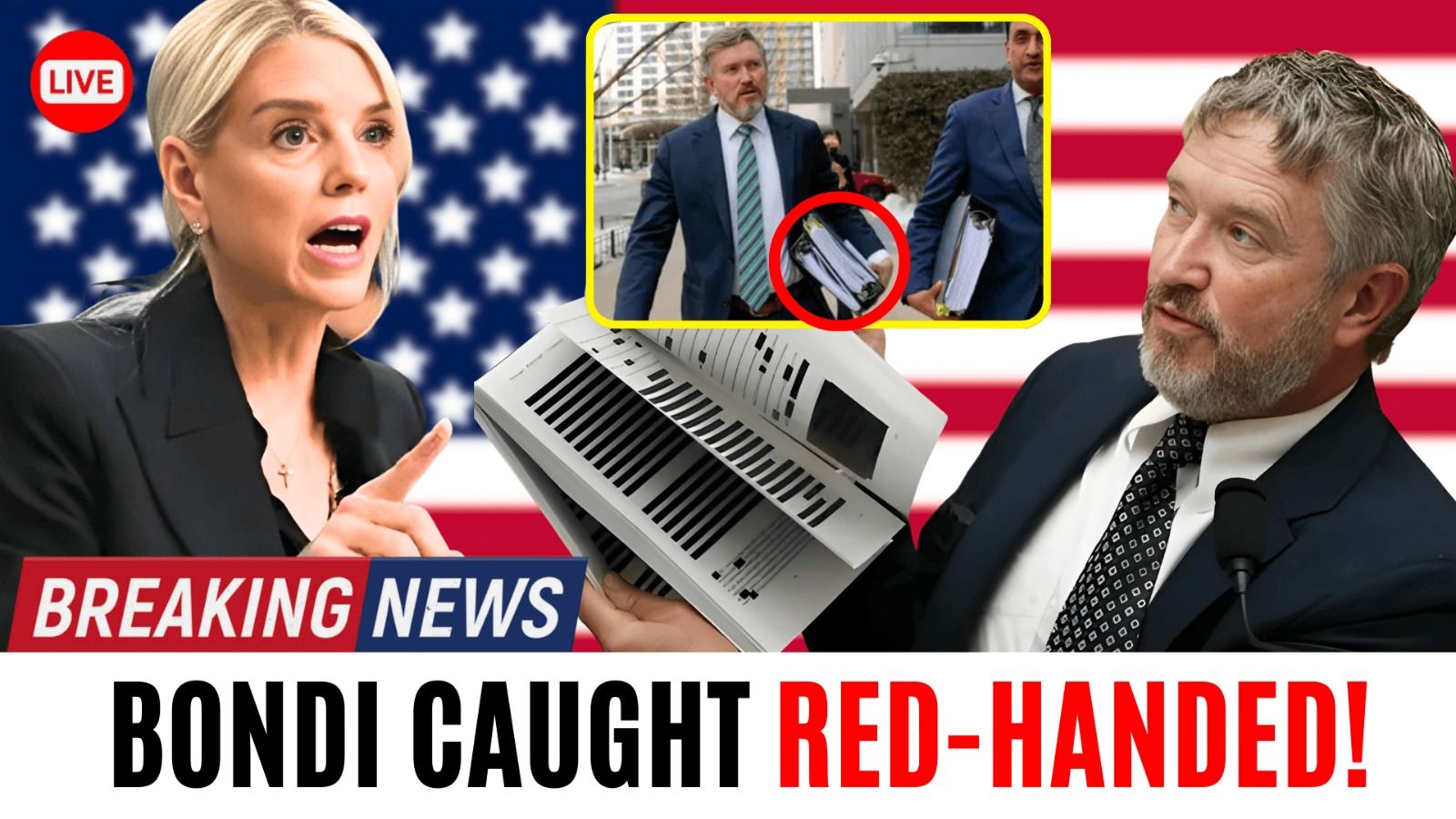
Twenty minutes ago, Republican Congressman Thomas Massie did something extraordinary during Attorney General Pam Bondi's testimony. He had a document in his hand. FBI letterhead. Lines highlighted with red marks. And holding this document directly to the camera, he said: "I caught you red-handed." The concealed name was not a victim. He was not a witness. He was a billionaire whom the FBI indicated might have been complicit in Jeffrey Epstein's crimes. And when Massie presented the evidence in front of all the cameras, Bondi didn't deny it. He attacked. He called him a "failed senator." She blamed it on the "Trump syndrome." If you think you know how this will end, you're wrong. What happens in the next 6 minutes will completely change your perspective on this investigation. I have been watching Congressional hearings for years. I have seen witnesses dodge questions. I've seen politicians protect their own party. But I have never seen a Republican congressman look at a Republican attorney general and say, "I caught you red-handed." And he meant it. This happened during the House Judiciary Committee oversight hearing on February 11, 2026. The room was packed. Survivors of Jeffrey Epstein's abuse sat in the gallery, dressed in white. Cameras were shooting from every angle. And Thomas Massie — a former engineer, libertarian-leaning congressman from Kentucky, and co-author of the Epstein Files Transparency Act — was waiting his turn to ask questions. Massie wasn't there to put on a show. He was there because he had spent the previous two days in a secure reading room at the Justice Department. He had been reviewing unredacted versions of the Epstein files. The files that Congress ordered to be released. The files published by Bondi's ministry with countless meaningless redactions. And Massie had found something. A single specific redaction. A name that should never be hidden. And he was about to explain this to Bondi in front of the whole country. Let me take you to November 2025. Thomas Massie and Democrat Ro Khanna jointly introduced the Epstein Files Transparency Act. Bipartisan. The law required the Justice Department to release all records related to Jeffrey Epstein without redaction. There are no exceptions for powerful people. It passed into law. The President signed it. And when the deadline came, the Ministry of Justice released the files with thousands of meaningless redactions. The strange part was that the victims' names were left exposed. The victims' information had been published. But the names of the strong men? It had been redacted. Massie and Khanna had threatened prosecution. They had accused the Ministry of covering up in public. And on February 11, 2026, Massie was sitting across from Bondi with evidence he couldn't explain. I bet you think you know how this will end. Most people assume: The Attorney General will brush it off, nothing will change. Standard Washington theater. Keep that estimate in mind. Because what Massie did and what Bondi confessed will prove you wrong. Those who know Massie know: When the man asks a pointed question, he already knows the answer. And he's ready to get you to confess. "Attorney General Bondi," Massie began. His voice was calm, almost conversational. The tone of a man who didn't need to raise his voice. Because the facts would do all the work. "I want to ask you about something I found while reviewing the unredacted Epstein files this week." He removed a document. Printed, highlighted. A stage prop that says this moment was planned. "This is an FBI document." It lists individuals connected to the Epstein investigation. And there is a name in this document. A name marked by the FBI as a potential accomplice. He stopped. Not for drama, but for clarity. To ensure that every word is recorded clearly. "But when your ministry shared this document with the public, that name was redacted." Can you explain why the name of a potential accomplice was concealed? "Can you explain why the name of a potential accomplice is being kept secret?" The hall fell silent. It wasn't the polite silence of people waiting for an answer. It was the tense silence of people who realized something was about to break. He shifted in his Bondi chair. You could see it. Micro movement. A glance at the staff. He knew what was coming. He just didn't know how bad it would be. Bondi tried the standard move. Guidance on the process. "Congressman, as I have stated repeatedly, the Department of Justice worked day and nite to publish these files within the deadline set by Congress." We made every effort to balance transparency with the protection of victims and the requirements of ongoing investigations. Massie did not accept. "This is not what I asked." I didn't ask about your process. I asked for a single specific name. Why was it edited? Bondi tried again. "There could be multiple reasons for the redaction of names in these documents." Privacy concerns, ongoing investigations, grand jury secrecy rules... "This name," Massie interrupted. Her voice was still calm, but now it was firmer. "Not a victim." Not a witness seeking anonymity. This is a name that the FBI has identified as his accomplice. So I ask again. Why was this specific name hidden from the American people? And then Massie said the name out loud. For the record. In front of all the cameras. "Les Wexner." "Les Wexner." If you've watched this far and are starting to understand what's going on, subscribe to the channel and like the video. Write in the comments what you think and let's continue. Because what happens next is the moment Bondi realizes he's been caught. Les Wexner. Billionaire. Former CEO of Victoria's Secret. Jeffrey Epstein's known associate. The man who gave Epstein power of attorney over his financial empire. The man whose connection to Epstein has been documented for years. And according to the FBI document in Massie's possession, a name that appears as a potential accomplice in the investigation materials. Bondi tried to recover. "I believe the congressman said Les Wexner's name appeared more than 4,000 times in the documents we released." Massie didn't let him finish. "I know it has been passed 4,000 times." I reviewed the files. But in this specific document, the one where the FBI identified him as a potential accomplice, his name is redacted. Why? Bondi looked at his staff again. Someone was typing frantically, searching for something, trying to find an answer to get them out of this situation. "Congressman, if there is an error in that editorial, we will review and correct it." "Member of Congress, if there is an error in that editorial, we will review and correct it." Massie leaned forward. And that was the moment. A moment that will be watched over and over for years. "Attorney General Bondi, I'm glad you said that. Because about 40 minutes ago, after bringing this issue to the public's attention, your department quietly removed the redaction of Wexner's name from that document. "Another paper was removed." "Then let me make it very clear what just happened." I caught you hiding the name of a potential accomplice. And 20 minutes after I caught you, you corrected it. "The hall came alive." Not with shouting. With the rustling of reporters' notes, the zooming of cameras, and the staff leaning forward. This was no longer partisan theater. This was proof of something real. Massie hadn't finished. "So my question is not whether you will correct it or not." After you caught you, you already corrected it. My question is: Who made the initial decision to redact Les Wexner's name as a co-conspirator? "And that's when Bondi made her biggest mistake." Instead of answering the question, providing an explanation, promising an investigation, or even just saying "I don't know, I'll find out," he attacked. "Congressman Massie, I find it interesting that you are asking these questions now while you sat quietly when Merrick Garland was the Attorney General." Where were your questions then? Massie's face didn't change. He was expecting this. "Now I am asking." Chief Prosecutor, you are the one sitting in that chair. You are the one who approves these redactions. So answer the question. Who made the decision to conceal Les Wexner's name? Bondi's voice rose. Not much. Just enough to hear the edge. "Congressman, you clearly stated that you are experiencing Trump syndrome." Despite being a Republican, you opposed this president at every opportunity. Massie's voice came thru sharp and clear. "I wrote the law you violated." I am not asking you about President Trump. I am asking you for the name of the billionaire that your department hid from the American people in a document about its accomplices. Answer the question. It seems your message is empty. Could you please provide the text you'd like me to translate? There are two types of moments in congressional hearings. Moments when a witness cannot answer. Because the information is confidential or privileged. And moments when a witness won't answer. Because the truth is worse than silence. Everyone watching understood what kind of moment this was. Bondi tried to brush it off once again. "Do you want to talk about cover-ups?" Why didn't you ask Merrick Garland about Epstein twice while sitting in that chair? Massie didn't buy the bait. "Today I ask you." Under oath. Did you personally approve the redaction of Les Wexner's name in that FBI document? Bondi's jaw dropped. "I will not take lessons from a failed politician who spends more time attacking their own party than fighting for my constituents." "Here, I will not listen to a failed politician who spends more time attacking his own party than fighting for my constituents." Failed politician. He said it on camera. To an incumbent congressman. In front of the victims. In front of the press. An attack showing that someone has run out of answers and is reaching for the only weapon left. Personal devastation. Massie smiled. Not a big smile, a small one. "Thank you for proving my point." "Attorney General, I'm not a failed politician. I am a sitting member of Congress who wrote the law requiring transparency about Epstein. And you just spent 6 minutes attacking me instead of explaining why a co-conspirator's name is being withheld. He paused. "I think the American people can draw their own conclusions about what this means." "I think the American people can draw their own conclusions about what this means." Subscribe to the channel for more of this content. I will follow this story with every development. Now let me tell you what will happen next. Because this story is not over. Massie and Khanna threatened Bondi with mandatory compliance proceedings, a rarely used authority by Congress. If he continues to refuse to comply with the Epstein Files Transparency Act, it could result in a fine or imprisonment. The Department of Justice has released only 3 million pages of the 6 million pages ordered by Congress. This means that half of the files are still missing. And if they're willing to hide Les Wexner's name as a co-conspirator, what else are they hiding in the other 3 million pages? The victims sitting in that courtroom want answers. Members of Parliament from both parties are demanding answers. And Bondi's response today — attacking the person asking the question instead of answering it — only made matters worse. Because you can't call a sitting congressman a "failed politician" for asking about a cover-up and expect the story to go away. If anything, it proves his point. 20 minutes. The time between Massie catching Bondi hiding a name and the Justice Department quietly lifting the redaction was that long. 20 minutes proved that redaction was never necessary. It was a choice. A decision made to protect a powerful person. And when that someone is a billionaire marked by the FBI as a potential accomplice in one of the most significant sex trafficking investigations in American history... "I caught you red-handed" is no exaggeration. Documentation. Thomas Massie entered that hearing with evidence. He asked narrow, specific, indisputable questions. And when Bondi couldn't answer them, he didn't accept being brushed off. He pressed. He repeated. He made her sit in silence until she had no other option left — until she had nothing else to do but resort to personal attacks. Because he had nothing else left. This is not partisan theater. This is accountability. And the fact that it comes with a Republican asking a Republican attorney general questions makes it impossible to ignore. The clip is still circulating. The victims are still watching. And somewhere in Washington, Pam Bondi is having a very hard conversation with her staff. While the congressman who wrote the law requiring its release watches their every move, how they will explain the 3 million missing pages. This is not the end. This is just the beginning of something much bigger. Subscribe, like, and watch the two videos you see on your screen now.
Suddenly, chaos erupted on Capitol Hill. Commerce Secretary Howard Lutnick came to the Senate as a witness... but as soon as he walked thru the door, journalists surrounded him and started asking questions. "What will you say about your interactions with Epstein?" "Did you have a financial relationship with Jeffrey Epstein?" "Why did you continue to communicate with him after he was convicted of sex crimes?" Lutnick did not answer these questions. He just said, "I can't wait to testify today," and kept walking. But a journalist shouted after him: "What do you say to those who want you to resign?" People of your level have resigned from the British government. Lutnick didn't hear. Or he didn't want to hear it. First, let's understand the background. Who is Howard Lutnick and why is he so important? Lutnick is the president's Secretary of Commerce. CEO of Cantor Fitzgerald. One of the most recognized names on Wall Street. And now, he is a name mentioned in the Epstein files. What had Lutnick said before? In an interview with the New York Post last year, he was very clear. He had said that he had only one interaction with Epstein in 2005. The story was as follows: Lutnick had bought a house in New York as Epstein's next-door neighbor. Epstein had invited him over for coffee. Lutnick and his wife had gone. During the house tour, when they opened the door to one room, they saw a massage table in the middle and candles around it. Lutnick asked Epstein, "A massage table in the middle of the house?" How often do you get massages? Epstein replied, "Every day." Then Epstein had approached strangely and said, "And the right kind of massage." According to Lutnick, they exchanged glances with his wife and immediately left. In the 7-8 steps it took to get home, they had made their decision: "I will never be in the same room with that disgusting man again." In an interview with the New York Post, Lutnick was very clear: "Socially, for work, even for charity events, if that man was there, I wasn't going." Because he's disgusting. "This story seemed consistent." Until the Epstein files were opened. What is in the Epstein files? After 2005, there are at least 8 significant interactions recorded between Lutnick and Epstein. After meeting him once and finding him "repulsive," he contacted him eight more times. Senator Merkley read this timeline in court: 2009: Lutnick asked for Epstein's phone number. 2011: A drinking date was set. 2012: Lutnick planned a trip to Epstein's private island with his family. And he went. 2013: They exchanged articles on intellectual property and gambling. They co-signed the same investment. Neighbors, the same investment, maybe they talked, maybe they didn't. 2017: John Paulson asked Epstein for a donation for an event and wrote, "You're a close friend of the Lutnicks, this event is honoring him." 8 interactions. For 14 years. With the man who said, "I will never see you again." Do you think this is "meeting once and then stopping"? Or is it an ongoing relationship? Senator Van Holland directly asked Lutnick: "Did you really visit Epstein's private island in December 2012?" You said you had no contact with him after your only interaction in 2005. Lutnick's response was: "I had lunch with him while we were on a boat during a family vacation." My wife was with me, along with our four children and the nannies. Another couple was there with their children. We had lunch on the island for an hour and then left. We were with all my children, nannies, and my spouse. We are on a family vacation. We weren't apart. "Wait a minute." The man who said, "I will never be in the same room with that disgusting man again," takes his children to that man's island 7 years later. To the island where child sex trafficking is carried out. To the island of a convicted sex offender. Van Holland continued: "You do realize this visit took place after you were convicted of inciting prostitution of a minor in 2008, don't you? You stressed that you felt like a bad person in 2005. But then you took this trip and had other interactions. Lutnick continued his defense: "As far as I can remember, I saw him two more times. I didn't see him at all for six years after the first meeting. Then, one and a half years later, once more. And never again. "But the documents say otherwise." There are 8 interactions in the records. And then the nanny issue came up. Van Holland asked: "There is a reference in the Epstein files about a nanny exchange involving you. Was the nanny who was with you on that trip the same person as the nanny Jeffrey Epstein expressed a desire to meet? Lutnick's answer: "No. I have no idea about that. I mean, I don't remember it having anything to do with me. I don't know. Van Holland added: "You know, this guy was a convicted sex offender and frankly, it wasn't a very suitable place for children and nannies." Was Ghislaine Maxwell on the island at the time? "No." Nanny change. It's in the Epstein files. Lutnick says, "I don't know." But there is a document. If you want to keep up with such developments, don't forget to subscribe to the channel. Van Holland changed the subject. 2011 dinner. "Did you have dinner at Epstein's New York home in 2011?" Lutnick: "No." "So there is information about Woody Allen and his wife having dinner at Epstein's house." Isn't there something wrong with that? Lutnick: "Actually, I don't know what you mean." I looked at millions of documents, searched for my name like everyone else. What I found was, I think in May, a one-hour meeting at 5 o'clock. "It wasn't dinner, it was a one-hour meeting at 5 o'clock." The Woody Allen issue went unanswered. Lutnick said, "I don't know." But there are things in the Epstein files. Senator Merkley summarized Lutnick's contradictions: "The reason people are disturbed is that you said you cut off all contact last year, but there are 8 examples of interactions in the records after 2005." "In 2009, you wanted to talk to Epstein." You asked for his phone number. "There was a drink date in 2011." "In 2012, you were planning a trip to a private island with your family." It looks like you know someone well enough to call them and say, 'Let's bring our families together, let's visit each other.' "In 2013, exchanging articles on intellectual property and gambling." "You signed the same investment." You were neighbors. You made the same investment. "In 2017, John Paulson wrote to Epstein: 'You are a close friend of the Lutnicks.'" "Collectively, when you said you cut off all contact in 2005, it was probably not complete and thorough." 8 interactions. "Close friend" definition. The same investments. Family trips. And Lutnick still says, "I've seen him three times in 14 years." Do you think these statements are consistent? Or is something missing? Another senator addressed Lutnick: "May I make one final closing comment, Mr. Secretary?" Senator Van Holland asked about your interactions with your former neighbor, Mr. Epstein. It was encouraging to see you state that you decided in 2005 he was a disgusting man and that you should have no contact with him. I wish many people who knew him had come to this conclusion as well. "But taking your family to lunch on his island and having appointments with him bothers me." Please explain everything. End this because this is a serious concern for my constituents. "The President was elected on the promise to release the Epstein files." You casually said, 'I searched for my name, like everyone else.' No, not everyone is worried about their name being in the Epstein files. "I know he is your neighbor." This was a coincidence. But please explain everything related so that we have a chance to work together and make progress. Lutnick's response: "To the best of my recollection, I met him when he moved in next to me, and I saw him two more times in 14 years." I didn't see him at all for six years after the first meeting, then a year and a half later, and then never again. And with my wife. "As Senator Van Holland said, there is not a single word that I did anything wrong, even from a distance." "I didn't have anything you could call a relationship, or a familiarity." I literally saw him three times in 14 years, with long gaps in between. The only thing I can remember is this. The only thing in the documents is this. "I looked at the documents without any fear because I know, and my spouse knows, that I absolutely did nothing wrong in any way." "I looked at the documents without any fear because I know, and my spouse knows, that I definitely did nothing wrong in any way." But the documents say otherwise. In a New York Post interview, Lutnick said, "Socially, for work, even for charity, if that guy was there, I wasn't going." In the Senate, Lutnick said: "I saw him three times in 14 years." The Epstein files say: 8 interactions. Asking for a phone number. Drink date. Island trip. Article exchange. Joint investment. Definition of "close friend." Three different versions. Which one is correct? The man who said, "I will never see him again," is taking his children to the island 7 years later. To the island of a convicted sex offender. To the place where child sex trafficking occurs. And he is partnering with the man he finds "disgusting." Lutnick had said other things about Epstein in a New York Post interview. Miranda Divine had asked: "Why did Bill Gates and other people want to be around him? You didn't see what they saw? Lutnick's answer: "No, they participated. His method was, you know, get a massage, get a massage. And I assume that what happened in that massage room was filmed. This man was the greatest blackmailer in history. He was blackmailing people. That's how he ended up with money. Divine asked: "So what happened to those videos?" Lutnick: "I assume that a long time ago, they traded those videos for an 18-month sentence." This sentence allowed him to receive visitors and leave prison during the day. How does a serial sex offender get 18 months and get to go to his office and accept visitors during the day? There must have been a deal. "I don't know, but I assume there was a trade for the videos because there were people in those videos." Lutnick says Epstein was blackmailing. He says the videos were exchanged. But the same guy took his kids to this guy's island. Does this make sense to you? Other topics were discussed during the hearing. Republican Louisiana Senator Kennedy asked Lutnick questions about the Census Bureau. "The Census Bureau is under your jurisdiction, isn't it?" "Yes." "And the Census Bureau is tasked with defining what it means to be poor or living in poverty in America." Is that correct? "I think you're doing an economic analysis for America, but it also defines the poverty level, right?" "I don't know." "You need to look at it because it defines." "Okay." "If you know, this is not a test." What percentage of Americans live at or below the poverty level? "I don't know the percentage." "Okay, about 11 percent." It has remained constant. The Minister of Trade does not know the basic data of his own ministry. So, what will happen now? Lutnick's statements are inconsistent. The documents say otherwise. Senators keep asking questions. "I'll never see him again," he said, interacting with him 8 more times. He said, "Disgusting," and took his children to his island. He said, "I had no relationship," and made a business partnership. Democrats want him to resign. Some Republicans appear uneasy. And the Epstein files may contain more information. Lutnick testified. The documents are out in the open. And the questions are waiting to be answered. There are 8 interactions in the records. Lutnick says, "I saw it three times." One is telling the truth, one is lying. Documents don't lie. This incident is not over. More documents may emerge. More questions could be asked. And Lutnick's answers could be subjected to further scrutiny. Subscribe to the channel so you don't miss any updates.
Thomas Massie took the podium with four documents in hand. A Republican from Kentucky. A politician with an engineering background, obsessed with details. And today, he had very specific questions he wanted to ask FBI Director Kash Patel. "There are four documents I want to put on the record." Massie listed the documents one by one. The first: An article explaining how Jeffrey Epstein operated in plain sight for 6 years. It contains a quote from Acosta. Alexander Acosta, the Secretary of Labor during the Trump administration and the prosecutor in the Epstein case. What did Acosta say? "I was told Epstein belonged to intelligence and to leave him alone." Second document: Warnings about Epstein's protector's CIA connections. Third document: From Fox Digital. The headline is: "Epstein's Private Calendar Reveals Meetings with Obama Administration Official and CIA Chief." Fourth document: Wall Street Journal article. It highlights Ehud Barak's 36 meetings with Jeffrey Epstein. Ehud Barak. Former Prime Minister of Israel. And the former head of Israeli military intelligence. He may still hold this position during the period he met with Epstein. Four documents. All four point to intelligence connections. Acosta's "intelligence-related" statement. Meetings with the CIA chief. 36 meetings with the head of Israeli military intelligence. The CIA warnings of the guard. Do you think this is a coincidence? Or is there a pattern here? If you want to support, liking and subscribing would be very helpful. Before Massie could finish presenting the documents, the Maryland representative interrupted. He had a document to submit, too. Judge Engelmayer's decision in August. "The government's 100,000-page Epstein files overshadow the 70-plus pages of Epstein grand jury materials." 100,000 pages. The FBI has a 100,000-page Epstein file. And only a small portion of it has been shared with the public. Massie took the floor and turned to Patel. "Director Patel, I watched part of your Senate hearing yesterday. When Senator Kennedy asked you, you said you had seen most of the files, who Epstein sold these women to other than himself, you answered according to the transcripts: There is no credible information that he sold them to anyone else. Patel nodded. "You also said in the hearing and here today that the issue is that the case files were restricted by limited search warrants from 2006-2007." And that the non-prosecution agreement would preclude future investigations. Massie paused here. Because he was about to make an important point. "These restrictions are only applicable to the Southern Florida District." They do not apply to the Southern District of New York. New York Southern District. The place where the 2019 sex trafficking indictment was filed. And this indictment revealed many things. Including FD 302 documents. What is an FD 302? FBI interview documents. When agents interview someone, the official documents that record that interview. And these documents are in the hands of the FBI. Massie has now reached a critical point. "According to victims who cooperated with the FBI in this investigation, the documents in the FBI's possession, the documents in your possession, detail at least 20 men." Jeffrey Epstein's victims, 20 men he sold to these people. 20 names. The victims have given 20 names to the FBI. And these names are in the hands of the FBI. "Among these victims are minors like Virginia Roberts Giuffre." Rest in peace. Massie continued reading the list. "That list has at least 19 other individuals on it." A Hollywood producer, worth several hundred million dollars. A royal prince. Someone high-profile from the music industry. A prominent banker. A high-profile government official. A high-profile former politician. Owner of a car company in Italy. A rock star. A magician. And at least six billionaires. Including a billionaire from Canada. Massie also gave a name: Jeff Staley. The CEO of Barclays Bank. "We know that these people are in the FBI files." In the files you control. I don't know exactly who they are. But the FBI knows. He looked at Massie Patel. "Have you initiated an investigation into any of these individuals?" And have you seen these 302 documents? This question was important. There are 20 names. The victims have provided these names. The FBI has documents in hand. What did Patel do? Patel's response was as follows: "I asked my FBI agents to review all Epstein files and bring forward any credible information." And we are working with Congress, not just to disclose and present this information to you, but also to bring forth any investigations arising from any credible inquiries. Then he added: "I have not been presented with any new material that would initiate a new indictment." Wait a minute. The victims have provided 20 names. They have FD 302 documents. And Patel says "no new material has been brought in." Aren't these documents new material? Massie thot the same thing. "Is the gap here, or is your claim that these victims are not credible?" Didn't the 302 documents produce reliable statements that could possibly constitute probable cause? Patel replied: "This is not my claim, sir." This is the claim of two different United States attorney's offices from three separate administrations who have reviewed the same materials over the course of a lifetime. Three administrations. Obama, Trump, Biden. All three looked into these cases. None of the three opened a new indictment. But the question is: Is looking the same as taking action? It is easy to examine the files and say "not credible." But the victims are naming names. There are documents. Why isn't action being taken? Do you think these files are really "not reliable"? Or is there another reason? Massie continued. "Are the 302 documents in the hands of the FBI?" "Yes, sir, they reviewed all of them." "Well, did you personally review these 302 documents?" Documents in which the victims named the people who victimized them? Patel's response was noteworthy: "Personally... no, but the FBI investigated." FBI Director. Files of one of the biggest sex trafficking scandals in history. 20 people named by the victims. And the director hasn't personally investigated. Massie caught this point. "Then how can you sit here and say there is no name in front of the Senate?" Patel replied: "I provided a name today." As the Department of Justice and the FBI, we are not in the practice of disclosing victim names. This is not something we do. We also do not have a habit of disclosing unreliable information. "But multiple authorities looked at the entirety of what we have." Multiple authorities looked into it. Okay. But the victims are speaking. They are naming names. And the FBI says "not credible." Why is the word of the victims not trustworthy? Massie changed the subject. The Attorney General's White House event. "Did you attend the event at the White House where the Attorney General explained the folders to social media influencers?" "Yes, I was there." "So, if you are willing to meet with social media influencers who will take advantage of these victims' sad stories, will you also meet with the victims?" "The FBI will speak with anyone who has new information." "Will you personally meet with them?" "The FBI and the professionals handling the cases will meet with them." Be careful. Massie asked, "You personally?" Patel said, "The FBI will talk to you." He did not say he would meet in person. Meetings were held with social media influencers. An event was held at the White House. But there are no personal meetings with the victims. Does this make sense to you? Influencers are given time, but not the victims? Massie touched on another topic. "Was there an order to disclose the documents to the Audit Committee?" The day I submitted my discharge request to disclose these files? "I don't know what day it was." "No?" "Well, they were announced that day." And because they rushed, there were unredacted victim names. The victims are not happy about this. Victim names. Names that should remain confidential. It was published without being edited due to haste. And the victims are not happy about it. Why was there such haste? Is it a coincidence that it was published on the same day Massie filed his petition? Massie moved on to his final questions. And these questions were perhaps the most disturbing ones. "Did you investigate the CIA connections? Have you seen the CIA file on Jeffrey Epstein? And if you wanted to see it, would they show it to you?" CIA file. Claims about Epstein's connections to the CIA have been circulating for years. Acosta had said it was "intelligence." His bodyguard had warned him about CIA connections. He had a meeting scheduled with the CIA chief. Patel's response was: "I can speak for the FBI." And that assumes it's a CIA file. I reviewed everything provided to us inter-agency. Not me, the FBI. "Would you be willing to look at the CIA file?" If such a file exists and has not yet been submitted to the FBI? "The FBI will look into any new investigation leads." "Be careful." Massie asked, "Will you look at the CIA file?" Patel said, "The FBI will look at new leads." He did not answer directly. He didn't say whether he wanted the CIA file or not. Why? If there is a CIA file, why wasn't it requested? Why wasn't this file requested when the intelligence connection allegations are so strong? Massie asked his last two questions. It had nothing to do with Epstein, but they were important questions. "Have you made any progress in the January 6 pipe bomb investigation?" "It's an ongoing investigation, we have made progress." "Have you made any progress on the motive of the Las Vegas shooter?" "Sir, I will have to get back to you on that." Las Vegas attack. 2017. 60 people died. Hundreds injured. The bloodiest armed attack in American history. And the FBI still doesn't know the motive. Or maybe they aren't saying. What did we learn from this inquiry? First: The FBI has 100,000 pages of Epstein files. Only a small part of it has been shared with the public. Secondly: The victims have given at least 20 names to the FBI. Hollywood producer, royal prince, billionaires, politicians, government officials. These names are recorded in the FD 302 documents. Third: Patel has not personally reviewed these documents. The FBI director has not personally read the documents of the biggest sex trafficking scandal in history. Fourth: Three administrations looked at these files and none of them brought charges. Why? Fifth: Social media influencers were interviewed, but the victims were not interviewed in person. Sixth: Due to haste, the victims' names were published without redaction. The victims are not pleased with this. Seventh: The CIA connection allegations are strong, but the CIA file was not requested. Or at least Patel did not confirm that. Let's go back to the four documents presented by Massie. Acosta: "I was told Epstein belonged to intelligence." Epstein's protection: Warning about CIA connections. Epstein's calendar: Meetings with an Obama administration official and the CIA chief. Wall Street Journal: 36 meetings with Israeli military intelligence chief Ehud Barak. These four documents paint a picture. Epstein was not an ordinary criminal. He had connections to the intelligence world. And these connections have not been fully investigated yet. Do you think these intelligence connections should be investigated? Or should some things remain secret? 20 names. The victims provided these names. The FBI has documents in its possession. And none of these names have been shared with the public. A Hollywood producer, worth several hundred million dollars. Who? A royal prince. Who? Someone high-profile from the music industry. Who? A very prominent banker. Who? A high-profile government official. Who? A high-profile former politician. Who? At least six billionaires. Who? The answers to these questions are in the hands of the FBI. But they are not shared with the public. It is said that "it is not reliable". Aren't the victims' words reliable? Is Virginia Giuffre's word not trustworthy? Patel had said "no name" in the Senate. Today, he said "I gave a name today" to Massie. So, there is a name. But it is not explained. Why? Three administrations looked into it. Obama, Trump, Biden. None of them filed an indictment. Why? CIA connections are being alleged. The CIA file was not requested. Why? Social media influencers were consulted. The victims were not met in person. Why? These cases cannot be considered closed until these questions are answered. There are 100,000 pages. There are 20 names. And the victims are still waiting for justice.
Attorney General Pam Bondi appeared before the Senate Judiciary Committee. This was not a routine oversight hearing. It was the annual Justice Oversight Committee meeting, but the timing changed everything. And what Bondi said there would cause much more trouble than what he didn't say. Bondi started the hearing with these words: "The two-tiered justice system is over." "But the documents that emerged today show the exact opposite." The two-tiered justice system has not ended. It has taken on a new form. And Bondi himself stands at the center of this new system. The irony is that the person who said, "the two-tier justice system is over," has now become the biggest symbol of that system. Bondi's statements today caused a seismic impact in the legal community. Because Bondi admitted something. Not just controversial, but illegal. And this confession could end his career. Perhaps the end of his freedom. First, let's understand the background. Why is this hearing so critical? The trial took place just a few days after former FBI Director James Comey was indicted by a federal grand jury. This timing is not a coincidence. Democratic senators claim that the Justice Department was weaponized to target the president's political enemies. The Comey indictment bolstered those claims. Because Comey was one of the president's most well-known critics. CBS News correspondent Chanel Call followed the hearing and summarized the situation as follows: "Some Democratic lawmakers are now accusing the Justice Department of pursuing people perceived as enemies of President Donald Trump." Senators grilled Bondi on a number of issues. How the Epstein files were handled. The existence of that infamous client list. Hiring of January 6 defendants by the Department of Justice. Deployment of National Guard units to American cities. Each topic is serious. Each topic is a separate debate. A heated exchange occurred between Illinois Democratic Sen. Dick Durbin and Bondi over the deployment of the National Guard. Durbin claimed that the deployments were pushing constitutional limits. But none were as damning as Bondi's original confession. According to court documents dated November 10, 2025, and reported in detail by Law and Crime, Bondi authorized a prosecutor to handle politically sensitive cases. These cases targeted the president's political opponents. The issue is this: This prosecutor was not properly appointed under the United States Constitution. The appointment clause is clear and unambiguous. Certain federal officials should be appointed thru specific processes involving presidential nomination and Senate confirmation. Or, clearly defined alternatives should be used for lower-level officials. These requirements are not optional. It exists precisely to prevent the kind of unchecked power that Bondi's actions represent. The Founding Fathers did not include this provision for nothing. This rule has been in effect for over 200 years. What happened when this flaw emerged? The indictments faced the risk of collapsing in court. All the cases could have been invalidated. Months of work could have gone to waste. And what did Bondi do? Instead of acknowledging the constitutional violation and correcting it thru legal means, he tried to retroactively resolve the issue. He signed the documents later. And he backdated the documents to create the impression that the prosecutor had been properly appointed from the very beginning. In other words, he manipulated the documents. This is not a technical error. Not a clerical error. This is an attempt to rewrite history to cover up a constitutional violation. Do you think this can be dismissed as an "administrative error"? Or is it a deliberate cover-up? Share your thoughts in the comments. Here is the point that makes the situation even worse. And this point is very critical. The Department of Justice itself acknowledged the issue. In court filings opposing Bondi's position, DOJ attorneys explicitly stated: The attempt to retroactively validate the appointment was unauthorized. "Unauthorized." "This word is very important." You need to understand the legal weight of this word. The lawyers of her own department describe her own attorney general's actions as "unauthorized." This shows that the government acknowledges the constitutional flaw and that Bondi acted anyway. This acknowledgment transforms the situation from negligence to intent. Intent. This is the difference between an administrative error and criminal liability. And this difference could determine whether Bondi will spend the rest of his life behind bars. Bondi is no novice. Lawyer. Former Florida state attorney general. Someone who has been a prosecutor for years. He understands constitutional law. He understands the appointment clause. Despite this information, the decision to proceed exposes him to the most serious federal charges that could be considered. Legal experts describe this situation as "unique." Because normally such violations are committed by lower-level bureaucrats and go unnoticed. But here, the country's highest legal authority appears to have knowingly and willingly violated the constitution. So, what charges could come up? Legal experts are considering several possibilities. First: Obstruction of justice. Backdating documents to conceal constitutional defects during active legal proceedings fully fits the definition of corruptly obstructing the administration of justice. The law does not require dramatic gestures or open threats. Document manipulation designed to conceal illegal behavior is more than sufficient. Obstruction of justice alone can carry up to 20 years in prison per count. And there can be multiple counts. Each manipulated document could be counted separately. Secondly: Abuse of office. Using the power of the attorney general's office to conduct politically motivated prosecutions while knowingly violating constitutional protections constitutes official oppression. Federal courts take this charge very seriously. They take it even more seriously, especially when it comes to high-ranking officials. Third: Conspiracy to deprive constitutional rights under color of law. Federal law defines it as a crime for government officials to knowingly violate constitutional protections while acting in their official capacity. If Bondi coordinated with others to advance these prosecutions despite knowing they were unconstitutional, this law comes directly into play. Each of these charges carries a serious prison sentence. When multiple numbers are added consecutively, the math becomes inevitable. The number of five justice blockages, when combined with multiple civil rights violations, easily pushes the total penalty exposure into the life imprisonment range. Do you know what one of the most significant aggravating factors recognized under federal guidelines is? Abuse of a position of trust. As Attorney General, Bondi was the highest law enforcement officer in the country. Head of the justice system. The person responsible for upholding the Constitution. This does not protect him. On the contrary, it makes his behavior more blameworthy. Judges definitely take this factor into account when imposing a sentence. And this factor can significantly increase the sentence. There is also the issue of exposure at the state level. Some alleged behaviors, including the falsification of official documents, may violate state laws. And state charges cannot be wiped away by a presidential pardon. This is a very critical point. Even if there is a federal pardon, state charges continue. Even if federal charges are somehow politically neutralized, state prosecutors remain free to pursue their own cases. That's why legal analysts describe Bondi's position as "uniquely perilous." The escape route is very limited. It is important for these developments to reach a wider audience. If you also think these topics should be followed, subscribe to the channel and like the video. Politically, Bondi has been a controversial figure from the very beginning. Democratic lawmakers have long accused him of bending the Justice Department to serve the president's interests, selectively targeting critics while protecting allies. Until now, these accusations mostly lived in the realm of politics. Difficult-to-prove allegations. It was just words. Democrats would make a claim, Republicans would deny it. What changed everything? The emergence of documented constitutional violations supported by his own confessions. There are now documents. There are dates. There are signatures. And most importantly, there is the statement of DOJ's own lawyers saying "unauthorized." This shift explains the growing bipartisan outrage. Even conservative constitutional experts, who generally support broad executive power, have publicly stated that Bondi has crossed a line. This is an important signal. Normally, those who defend the executive power are now distancing themselves. When the advocates of the executive power refuse to defend the executive, the seriousness of the situation is evident. Court records do not care about party loyalty. It preserves the truth permanently. Bondi's confessions now exist as part of the official record. The prosecutors don't need to speculate. They can only point to their own words and actions. There are several paths before the prosecutors. Each has its own unique risks and consequences. They might avoid making accusations by citing political sensitivities as an excuse. But given the strength of the evidence, this is becoming increasingly difficult. Public pressure is increasing. They might bring charges and offer a plea deal in exchange for cooperation. This could be the most likely scenario. Or they could ask for a full indictment and leave the decision to the jury. This is the riskiest scenario. If a plea deal is offered, it will likely require Bondi to testify against others. The pressure to cooperate will be immense. Life imprisonment is a strong source of motivation. Cooperation can mean the difference between decades behind bars and a reduced sentence. If he chooses to fight, the risks multiply. Juries tend to respond harshly to government officials who abuse their power. Judges are inclined to impose harsher sentences post-trial than they were after negotiated plea deals. The stakes are high. Do you think Bondi will fight or seek a deal? Share your predictions in the comments. There are broader implications from a legal rule perspective as well. This case will affect not only Bondi but the entire system. Prosecuting a former or current attorney general for constitutional violations sends a clear message that no office grants immunity. It reinforces the idea that the Constitution is not optional, even for those tasked with enforcing it. This principle is one of the cornerstones of democracy. At the same time, political repercussions become explosive. Supporters frame the prosecution as persecution. Critics frame the inaction as complicity. This tension guaranties that it will reshape public trust in the justice system, regardless of what happens next. One thing is already clear. Pam Bondi put herself in this position with her own actions. No one forced her. It was his own decision. The attempt to retroactively legitimize unconstitutional prosecutions turned political debate into criminal exposure. There are documents. Confessions are on record. The results are no longer hypothetical. Court records are public. DOJ's own lawyers said "unauthorized." And up to 20 years in prison is on the table. This number can be multiplied with more than one figure. The possibility of life imprisonment is real. This story is still developing. Prosecutors are examining the evidence. Legal teams are weighing the risks. The decisions made in the coming months will determine whether this will end with a cautionary tale or a historic prosecution.
Three minutes ago, Deborah Ross took the podium. She had a file in her hand. He was sitting across from FBI Director Kash Patel and didn't know what Ross would ask. "Director Patel, I'm pleased to change the order a bit." Because I will be following up on some of the things you discussed with Mr. Fry. Ross opened the file. It contained Patel's own words. Quotes from the confirmation hearing in January. The sentences he said under oath. "And I want to remind you of your confirmation hearing." Patel looked relaxed. He didn't yet know what was coming. He was unaware of the contents of the file in Ross's hand. "During your confirmation hearing, you swore under oath that, and I quote, there will be no politicization at the FBI." No retaliatory action will be taken by the FBI, if I am confirmed. Ross turned a page. He took out a second document from his file. Written responses to the Senate questionnaire. "And in your written response to the Senate questionnaire, you said, and I quote: Personnel decisions will be based on performance and adherence to the law." Every FBI employe will absolutely be held to the same standard. And no one will be fired because of duty assignments. "These were Patel's own words." It had been recorded in the congressional records. It had been submitted in writing. And now Ross would put these words to the test. Ross asked his first question. It seemed like a simple question, but there was a strategy behind it. "Now I want to go thru a few scenarios with you." To understand whether these are politicization of the FBI or decisions based on performance and adherence to the law. "The first question: Would hiring FBI agents, analysts, and supervisors only from one political party constitute the politicization of the FBI? Or would it be personnel decisions based on performance and adherence to the law?" Patel replied: "We don't ask FBI applicants about their political parties." "Mr. Patel, do you ask FBI applicants who they voted for?" "FBI doesn't ask." Ross stopped here. Because he had information. And this information contradicted what Patel had just said. "In the lawsuit Mr. Driscoll filed against you and the FBI, are you aware that after this lawsuit was filed, he was asked whom he voted for?" Patel's response was: "This case has been illegal since it was filed." I cannot comment. "But this also means that what you just said is not the case for him." Let's continue. Patel didn't say anything. Ross moved on to the next question. But an important point was on the record: Patel said "the FBI doesn't ask," but it is alleged that it was asked in the Driscoll case. Ross asked his second question. And this question would change everything. "Let me ask you an even easier question." "Would firing agents for working on cases assigned to them that the president doesn't like be politicizing the FBI? Or would it be personnel decisions based on performance and adherence to the law?" Patel's answer sounded familiar: "The FBI does not fire anyone solely because of their assignments." Just. Again that word. Schiff had also caught this word in previous interrogations. Ross caught it too. This word is important because it leaves a door open. "Not just" for assignments, but could it be "partially" for assignments? "Has the FBI ever been sued by someone who thot they were fired because of their assignments?" In the entire history of the FBI? "I'm sure it has been done." "During your term?" "I'm sure there are ongoing cases." "Yes, actually there are ongoing cases." And actually, people are being asked who they voted for. And actually, you are running the FBI for the President of the United States instead of the people of the United States. Ross did not hesitate. He continued. His voice didn't rise, but his sentences were sharply cut off. "Because my questions were not hypothetical." These are things you did while you were in office. Do you think an FBI director saying "we're not firing you just for your assignments" is a sufficient explanation? What does this statement tell you? Ross has now moved on to concrete names. And these names were not ordinary people. They were professionals who had served the FBI for years and had won awards. "Last week, you fired former deputy director Brian Driscoll, according to a lawsuit filed by longtime FBI agents." Brian Driscoll. Remember this name. Because this name will be talked about a lot in the coming months. "He had served in the bureau for nearly 20 years." He had won the Medal of Valor for his bravery during a dangerous ISIS raid. He had extensive crisis intervention experience. And he was leading the FBI's Critical Incident Response Group. Ross paused for a moment. He waited for the room to digest this information. "When the administration interviewed Mr. Driscoll for this position, they asked him about his political leanings and who he voted for in the last five elections." The last five elections. So, 2008, 2012, 2016, 2020, and 2024. Asking an FBI agent "who did you vote for." To an agent who has served for 20 years and received the Medal of Valor. "Mr. Driscoll refused to answer these questions." Because such questions politicize the FBI in an unacceptable way. Driscoll did not answer. He exercised his constitutional right. He maintained the confidentiality of the vote. And then what happened? He was fired. 20 years of service. Medal of Courage. Heroism in the ISIS raid. Leadership of the Critical Incident Response Team. All of this ended suddenly. Because he didn't say who he voted for. Do you think this is fair? Should an agent's disclosure of their political preferences be a condition for job security? Ross moved on to the second name. Steve Jensen. "You fired Steve Jensen too." He had served in the FBI for nearly twenty years. He had conducted critical counter-terrorism, counterintelligence, and organized crime operations. Ross looked at a document. And he read Patel's own words. Words from Patel's own mouth. "You had described it as embodying what the American people once expected from the FBI." Patel's own words. "It embodies what the American people expect from the FBI." He had said this about Jensen. This statement is in the public records. "But he was fired." Because he participated in the investigation of the crimes committed on January 6. Ross continued: "And the president's MAGA base criticized you on social media for keeping him at the FBI." Now he's not at the FBI anymore. "Think for a second." Steve Jensen. 20 years of experience. Counter-terrorism expert. Counterintelligence. Organized crime. Patel had described him as "embodying the expectations of the American people." He praised this man. And he was fired when criticism came on social media. MAGA accounts on Twitter asked, "Is this guy still at the FBI?" A few weeks later, Jensen was out of a job. Is this a performance-based decision? A compliance-based one? Or is it due to social media pressure? Ross moved on to the third name. Walter Jardia. "You also fired an honorable combat veteran." Special Agent Walter Jardia, with decades of experience in the office. Walter Jardia. War veteran. Someone who fought for this country. Then he joined the FBI and served for decades. "Because he worked on the Russia interference investigation into the 2016 presidential election." And helped investigate Peter Navarro, a close ally of the president. 2016 Russia investigation. Peter Navarro investigation. These are the cases assigned to Jardia. Tasks assigned by his superiors, not ones he chose himself. That's how things work at the FBI. A case is assigned to you, and you investigate that case. You have no choice. And he lost his job because of these duties. War veteran. Decades of experience. And he was fired because of a job assignment. What did Patel say at the confirmation hearing? "No one will be fired because of job assignments." "This statement is on the record." It has been submitted to the Senate in writing. Now there are three names. Driscoll, Jensen, Jardia. What do the three of them have in common? Having worked on investigations related to the president. All three have served for many years. All three had successful careers. All three were fired. Ross moved on to the conclusion section. And his words were harsh. He didn't use diplomatic language. "Director Patel, it is very clear that you failed your own test." "Failed in his own test." What does this mean? It means that Patel has not kept the rules he set himself, the promises he made himself. Patel had made four promises at the confirmation hearing. All four are on the record: There will be no politicization in the FBI. There will be no retaliatory actions. Decisions will be based on performance and compliance with the law. No one will be dismissed for job assignments. What happened now? Brian Driscoll was asked who he voted for, and he was fired when he refused to answer. Steve Jensen was fired for working on the January 6 investigation. After social media pressure. Walter Jardia was fired because he was working on the Russia investigation. Were these four promises kept? According to Ross, no. "You prioritized saving your job over doing what was right for the FBI and the American people." "This sentence was very important." Ross was clearly stating what Patel's priority was. Not protecting the FBI. Not serving the American people. Protecting your own seat. "Actually, I believe you were honest about this during your confirmation hearings." This was an ironic sentence. Patel was honest, yes. But what was he honest about? He was honest when he wanted to protect his job. And while doing this, he didn't keep his promises. "This is not compliance with the laws." Ross finished his words: "Thank you, and I am returning the remainder of my time." Ross finished his words: "Thank you, and I am returning the remainder of my time." Now let's take a step back. What did we learn from this inquiry? First: FBI agents are asked who they voted for. "The FBI doesn't ask," Patel said. But he is alleged to have been asked in the Driscoll case. He was asked who he voted for in the last five elections. Secondly, the phrase "We don't just fire for appointments" is repeated. The word "only" in that sentence leaves a door open. Not completely, but can they be fired for assignments? Third: There are three concrete names. Driscoll, Jensen, Jardia. The common point of all three: having worked on investigations related to the president. All three were fired. Fourth: Patel's own words contradicted him. Jensen, whom he said "embodies the expectations of the American people," was fired. He said, "No one will be fired for appointments," but three people who were fired for appointments are still at the table. What does this picture tell you? Has the FBI become politicized? Or is Ross wrong? Patel did not make a defense in this interrogation. Did he not do it, or did he not want to do it, it is unknown. "I cannot comment on the ongoing case," he said. He said, "The FBI does not fire anyone just for assignments." But he did not respond to specific names or specific incidents. Brian Driscoll. He is a recipient of the Medal of Valor. Hero in the ISIS raid. Leader of the Critical Incident Response Team. 20 years of service. He was fired for not saying who he voted for. Steve Jensen. Counter-terrorism expert. Counterintelligence. Organized crime operations. 20 years of service. The man Patel praised. He was fired due to pressure from social media. Walter Jardia. War veteran. He fought on the front lines for this country. Decades of FBI experience. He was fired for working on the Russia investigation. Three names. Three careers. Three families. And the common point: having worked on cases related to the president. Patel had said there would be "no retaliation" at her confirmation hearing. So, are these three people victims of retaliation? Or were they really fired for not "meeting standards"? The Driscoll case is ongoing. The court will decide. But the questions are already on the table. Ross's interrogation was brief. But it was effective. Because he didn't ask hypothetical questions. He didn't create imaginary scenarios. He gave concrete names. He narrated concrete events. And he used Patel's own words against him. "No one is going to be fired for assignments," Patel said. Ross named three people. All three had been fired over their handling of the assignments. "There will be no politicization at the FBI," Patel had said. Ross asked a question: Are agents being asked who they voted for? It is alleged that it was asked in the Driscoll case. "There will be no retaliation," Patel had said. Ross has three careers. All three ended after working on investigations related to the president. What should the American people think after this inquiry? Is the FBI independent? Or has it become a political tool? Which one do you think? Ross responded, "You put saving your job ahead of doing the right thing for the FBI and the American people." Patel did not respond. The time is up. But the questions remained unanswered. The Driscoll case is ongoing. The stories of Jensen and Jardia were also not forgotten. These names have been recorded. It was recorded in the congressional minutes. And one day these questions will have to be answered. If the court finds Driscoll to be right, what does that mean? It would prove that the FBI director made illegal firings. And Patel's words during the confirmation hearing would have been false. The continuation of this content depends on your support. Follow the channel, like the videos. I will continue to share updates here.
Adam Schiff took the floor. Facing him was FBI Director Kash Patel. Schiff had come to this point by spending years as a prosecutor and on the intelligence committee. He knew what to ask and how to corner him. The person who conducted the impeachment inquiry during Trump's first term. And today he had a list in his hand. A list of the commitments Patel made during his confirmation hearing. "Mr. Patel, you made several important commitments during your confirmation hearing." For example, you told Senator Coons: There will be no politicization at the FBI. If I am confirmed as FBI director, there will be no retaliatory action. He looked at the Schiff file. "Now I will ask you a very specific question." "Have you fired or disciplined any FBI agents or employes, in whole or in part, because they were part of the Donald Trump investigation or January 6th?" Patel's answer was brief: "No." But Schiff didn't stop there. Because he had other information. "You also assured Senator Blumenthal," Schiff said. "You said all FBI employes would be protected from political retaliation." "So today, are you testifying that you had no role whatsoever in the firing of a single FBI agent for political retaliation?" "None for political retaliation." "And if any FBI agent says otherwise, they would be lying." Is this your statement? Patel's response was interesting: "I'm only talking about my own actions." Everyone can make their claims. "Schiff paused here." "No, these are allegations against you. If senior FBI agents or employes say you fired them for political retribution, for the cases they were assigned, are they lying? "Everyone who was removed from the FBI was removed because they did not meet the standards, could not fulfilll their constitutional oath, and could not perform their duties." "When you say meeting the standards, are you referring to the standards of protecting the president under all circumstances?" "No." "No." Schiff got stuck on one word. And that word would change everything. "You also assured Senator Blumenthal that every FBI employe will be held to the same standard. No one will be fired because of their assignment. "Are you testifying today that no one at the FBI has been fired in whole or in part because of a prior assignment?" Patel's response was notable: "No one at the FBI was fired solely for their assignments." Just. Schiff caught that word. "Mr. Patel, I'm asking you. Have you fired anyone, in whole or in part, because they worked on the Trump investigation or worked on January 6? "No one at the FBI has ever been fired solely for their job assignments." "You're just saying." Does this mean they were fired in part because they were assigned to the January 6 case or the Mar-a-Lago case? "You're being very careful here, Mr. Patel." You just say. Does that mean they were fired in part because they were assigned these cases? Is this your statement? "Absolutely not." "Okay, then let's just take the word out," Schiff said. "Have you ever fired or disciplined any FBI employe, in whole or in part, because of their work on the Donald Trump investigation or January 6? Yes or no?" "All firings at the FBI, by employees... no." "I'm asking you a very specific question." "And I will answer the question." But you don't like the answer because this is the truth. Do you think this dialog is normal? Why is an FBI director giving such an indirect answer to a yes or no question? Let us know in the comments. Schiff continued with his questions. "Did you tell anyone at the FBI that all FBI employes identified as having worked on cases involving the president would be removed from their jobs?" "People are not being assigned to tasks..." "Just answer my question." Did you tell someone this? "People are not taken for cases, no." "You are not answering my question, Mr. Patel." "I would never tell anyone at the FBI that they were hired primarily for assignments." "So, someone who says that would be a liar." Is this your statement? "Everyone can say what they want." "No, I know." But you say they will be liars. "I'm telling you what I told you." Schiff made an important point: "Because there is Mr. Patel in the case filed against you. So, are you saying that Mr. Driscoll and the others are lying? "I will not address the complaint in the ongoing case." Driscoll case. Brian Driscoll, who worked at the FBI, had filed a lawsuit against Patel. And there were serious allegations in this case. Schiff went even further. "Did you tell anyone at the FBI: the FBI director tried to put him in jail and didn't forget it?" And my job was tied to getting agents who worked on cases against the president removed. "No." "Didn't you tell anyone?" "No." "Well, did you tell anyone that you knew these mass firings were probably illegal, that you would sue, and then testify?" "None of the firings or demotions at the FBI were done for anything other than just cause." "Did you tell anyone this?" "No." During my tenure, no decision at the FBI was made for anything other than failure. "Mr. Patel, you seem like you don't want to answer the question." If these allegations are true, it means the FBI director fired people knowing it was illegal. Do you think this is an allegation that should be taken seriously? Now take 10 seconds to subscribe so that the videos appear easily for you, you won't regret it. And then Schiff moved on to the Epstein files. That's where the real issue began. "You said you are the most transparent FBI director in history." Now I'm going to test you. "In 2024, Glenn Beck asked you about Epstein's Black Book." And you said the Black Book is with the FBI. And he asked, well, under whose control. You also said it was under the direct control of the FBI director. "Did you say this, Mr. Patel? Did you represent this to Mr. Beck and the president's supporters? Or did you lie?" "No." "Was it true that the Black Book was in the hands of the FBI director?" "The Black Book was in the hands of the FBI." "Okay, now that you are the FBI director, the Black Book is in your hands, right?" "That index was published." "So you published what is known as Jeffrey Epstein's Black Book?" "Yes, we published it." "Yes, we published it." Schiff returned to Senator Kennedy's question. And here was the critical point. "Senator Kennedy asked you, and I will be very careful here." You have seen most of the files. Who did Epstein sell these young women to beside himself? "And you said: Himself." There is no reliable information that he sold to other individuals. Never. If there were, I would have filed the lawsuit yesterday. "And Kennedy asked: So the answer is nobody?" And you said: For the information we have. "Your statement today is that in all the Epstein cases, Jeffrey Epstein did not engage in human trafficking with anyone other than himself?" Is this your statement? Patel objected: "I never said Jeffrey Epstein didn't traffic others." "Well, did he sell young women to anyone other than himself?" That was Mr. Kennedy's question. "Senator, I said that the information obtained by three administrations led to decisions that there were no credible investigative leads to prosecute and investigate others." "Today I am stating what your statement is." You just read it and I said it 10 minutes ago. Let the records reflect my statement. Schiff insisted: "I want to make sure there is no misunderstanding. Because victims like Virginia Giuffre have given statements to the contrary. And you are telling the American people today that there is only one name on the Epstein list, Jeffrey Epstein. Should we believe this? "This is not what I said." "This is what you said." And you can say what you want. Do you think this discrepancy between the victims' statements and the FBI's explanations is normal? Is one side lying? And then Schiff brought up the Maxwell interview. "Todd Blanche, Ghislaine Maxwell ile görüşmeye gittiğinde, Maxwell şunu söyledi: Bu karakterler grubunun, ki olağanüstü bir grup, ve bazıları sizin kabinenizde, sadece cinsel iyilik istedikleri için yanında olacağını mı düşündüm?" I really don't know. "And the next question, Todd Blanche's question, the president's former criminal attorney's question, who is not in the cabinet." His question is: When do you think was the last time you were with Mr. Epstein, when he was getting a massage? Schiff turned to Patel: "Who are the cabinet members that Ghislaine Maxwell referred to, who are part of this group of characters connected to Mr. Epstein?" "The Deputy Attorney General took the aggressive step that no one else did and interviewed Ms. Maxwell for two days." And we aired the entire interview. "The members of the cabinet..." "I'm not holding that meeting in front of me." You are selecting it piece by piece. The American people can read the whole thing. Patel did not mention the names of the cabinet members. Maxwell had said, "some are in your cabinet." But the names were not disclosed. Schiff asked his final question. And this question was perhaps the most disturbing. "Since you won't explicitly name the cabinet members connected to Epstein, let me ask you one last question." "Immediately after giving this statement, in the presence of an FBI agent, Maxwell is transferred to a minimum-security prison." A prison that is not suitable for a sexual offender like her. "Who made this decision and why?" "The Bureau of Prisons." "The Bureau of Prisons, on its own, without consulting Blanche or anyone else, immediately after this meeting, completely unrelated to this meeting, completely unrelated to what they said, decided to transfer him to a prison unsuitable for a sex offender?" "Do you want the American people to believe this? Do you think they are stupid?" "No, I think the American people believe in the truth." I'm not in the details of the daily movements of the prisoners. What I do is protect this country, provide historical reform, and fight against people like you using intelligence as a weapon. What I am doing is protecting this country, achieving historical reform, and fighting against people like you using intelligence as a weapon." And here Patel lost control. "And we proved over and over again that you were a liar at your Russia gate, on January 6." You are the biggest fraud sitting in the United States Senate. "You are the disgrace of this institution and a complete coward." I wasn't surprised. "I wasn't surprised that you continue to lie and put on a show from your podium." So you can go and raise money for your clownery. "At best, you're a political clown." Schiff remained calm. Patel continued: "The FBI is protecting this country." We are bringing historic reform. But all you care about is a child sex predator prosecuted by a previous administration. "Obama Justice Department and Biden Justice Department did nothing." And what did President Trump do? He boldly made new accusations. "And what did we do?" You said I was the most transparent FBI director in history. We provided you with 33,000 pages of information. I challenge you to say something reliable about the truth. "Now go run to the cameras, wherever you want to go." The president intervened: "Both of you be quiet." The president intervened: "Both of you be quiet." What did this 15-minute interrogation show? First: Patel did not answer yes or no questions directly. "No one was fired for just assignments," he said. The word "only" is critical. Does this mean they were partially fired? Second: There's the Driscoll case. FBI employes have filed a lawsuit against Patel. The allegations are serious. Patel declined to comment, citing an "ongoing lawsuit." Third: The Epstein files say there is "no credible information." But the victims say otherwise. Names like Virginia Giuffre have testified. Fourth: Maxwell said "some of them are in your cabinet." Patel did not name names. And Maxwell was transferred to a minimum-security prison immediately after the meeting. Fifth: Patel lost control. He used terms like "the greatest fraudster," "a disgrace," "a total coward," "a political hack." Is this the kind of language expected from an FBI director? Do you think an FBI director should speak like this in the Senate? Is this attitude professional? The main question Schiff asked remained unanswered. Did President tell Patel to hide the Epstein files? Patel did not answer directly. He blamed past administrations. Attacked Schiff. He said they made reforms. He said they had published 33,000 pages. But the question was: Who are the cabinet members? Why was Maxwell transferred to a minimum-security prison? Why do FBI employes claim they were fired for political reasons? None of these questions have been answered clearly. A family from Vermont is still waiting for insurance premiums. Maxwell is in a minimum-security jail. The Driscoll case is ongoing. And 80% of the Epstein files are still sealed. Questions continue to be asked. If you want this kind of content to continue, what you need to do is simple. Subscribe and like.
3 minutes ago, Peter Welch stood up in the Senate. He was sitting across from Attorney General Pam Bondi. And before Welch began to speak, he made an interesting statement. I've noticed that when your colleagues corner you, you bring up something from their past. I'm waiting for my turn too. But you don't need to do that now. The salon laughed. Welch didn't laugh. Vermont senator, former prosecutor. This man knows how to ask questions well. He worked in the courts for years. He recognizes people's evasive answers. And he wasn't quite used to Bondi's condescending attitude. Welch's opening sentence was not random. He had watched what Bondi did in previous interrogations. When a senator asked a difficult question, Bondi would dig into that senator's past. Distraction tactic. And Welch ruled that out from the very beginning. What happened in the next 10 minutes? The issue of health insurance was put on the table. Voting rights were questioned. The "derdest dava" excuse has been tested. And a $50,000 scandal came to light. Welch opened his first question with health insurance. Federal employes are not getting paid due to the government shutdown. I agree with this. But that's not the whole story. There's an issue here that will affect Americans. Both those who voted for the President and those who voted for Vise President Harris will be affected. He took a letter out of his pocket. A family from Vermont wrote. A five-person nuclear family. The parents are 54 and 55 years old. There are three children. One of the children has acute myeloid leukemia. "November 1st is a critical date," Welch said. Everyone will receive premium increase notices on that date. If we don't solve this problem, this family's insurance premiums will triple. They will reach a figure they cannot afford. He returned to Bondi. The same threat applies to families in Florida as well. For families in Vermont as well. I hope you share this concern and that we can solve it together. Bondi's response was: "I would be happy to speak with that family. Because there are many non-profit organizations that help children with terminal illnesses. I'm working with some people in Florida. Wait a second. Welch is talking about a systemic health crisis. An insurance issue affecting millions of Americans. Everyone receiving assistance under the Affordable Care Act is at risk. What does the Attorney General say? They should apply to charities. Do you think this is an answer? The child has leukemia. They are unable to pay the family premium. And the country's Attorney General says, "There are aid organizations." It proposes charity instead of government policy. But Bondi's next sentence was even more interesting. When it comes to healthcare, the government has shut down. As I understand it, perhaps you are not one of them, but many Democrats want health insurance for illegal immigrants. This is what shut down the government. " Now let's think for a second. What did Welch ask? He talked about the insurance premiums of the family of a child with leukemia. He gave the date as November 1st. He told a concrete family story. What did Bondi answer? Democrats want insurance for immigrants. Can you see a connection between these two sentences? I can't see. Bondi sidestepped the question and turned it into a political accusation. A child with leukemia was mentioned, and the response was about immigrants. Welch maintained his composure. He cut Bondi off. "Let me clarify this," he said. If this health support is lost, families in red and blue states will suffer. There are also people in Vermont who vote for the president. Their health is also at risk. The November 1st deadline is approaching. It's not just that Democrats don't want to negotiate. We want to negotiate. We expect the President to encourage our Republican colleagues to sit down and talk. Working together, we can find a solution that benefits the people in Florida who you care about and who voted for the president. In Vermont, I care about people, some of whom voted for Vise President Harris and some for the president. Bondi couldn't say anything. He told a child with leukemia to "go to a charity." What could he say now? Do you think this is an acceptable approach? Is this how an Attorney General should answer a question about a health crisis? I'm curious about your thoughts in the comments. You can subscribe for more videos like this. Your support is very important to us. Let's continue. Welch moved on to the second topic. The issue of voting rights. Regarding respect for voting rights, we received the letter your boss sent us in Vermont. A letter requesting all information in the Oy file. And in the announcement of this letter, your supervisor expressed a concern. He spoke of the 'left' side of the voting process being taken over. He fixed his eyes on Bondi. Now I'm asking. Do you have any information about Vermont, specifically regarding the claim that the voting process has been taken over by the 'left' side? Bondi's answer was to escape. I didn't quite understand what you said. We are currently involved in voter registration cases in six states. Is this what you're talking about? No. I'm talking about the letter requesting all the voting file information. Including personal information. And when this letter was sent, your boss made a claim. He said the voting process was hijacked from the left side. These letters also came to Vermont. My question is: what do you mean by 'left'? And do you have any evidence that the system has been taken over by the 'left'? We must hold fair and free elections. I know this. But I'm asking a specific basic question. We will hold fair and free elections in this country. Welch asked three times. Bondi repeated the same general sentence three times. Fair and free elections. Concrete evidence? No. A specific foundation? No. Just general talk. Welch touched on a critical point here. Regarding the limits of prosecutorial authority. You are the prosecutor. You have the authority to initiate an investigation. You have the power to decide whether to sue a state or an individual. This is an incredible authority. And I know you took this responsibility seriously when you were a prosecutor in Florida. As County Prosecutor and as Florida Attorney General. You took seriously the fact that you needed to have a factual basis before proceeding. Isn't it? Bondi shook his head. I take this role very seriously. I take my oath very seriously. Okay. I also take fair and free elections very seriously. We all get it. And our office is entitled to that information. Then I'm asking. What is the factual basis that justifies your request for all this confidential voter information from Vermont? Bondi's answer was interesting. The information will remain confidential in our office. And you just said you have a Republican governor. So, what you're saying doesn't make sense. We wanted this from every state. "What evidence do you have?" he asked. Bondi said, "You have a Republican governor." What kind of answer is this? I know you wanted it from every state. I'm asking for the factual basis regarding Vermont. No answer. There's no foundation. Bondi's chief of voting rights claims a "left" takeover. But Vermont has a Republican governor. The former Republican governor was the treasury secretary for years. He had also served as state secretary along with his election responsibilities. Where is "Sol" then? Where's the evidence? Are Vermont's Republican leaders "left-wing"? Do you think an Attorney General can send such requests to states without evidence? What should be the limit of this authority? Welch asked the right question, but didn't get an answer. But Welch's real trap hadn't been set yet. The issue of "derdest dava." You stated that you cannot discuss the case at hand. And the committee generally accepted this answer. But I noticed that you talked about the ongoing case for a long time. Especially regarding the questions from Senator Cruz. When asked by Kavanaugh about the sentencing of the defendant. He is a punishment. He received an 8-year sentence. I understand. But you're going to appeal, aren't you? We will appeal, yes. So, isn't this a pending case? This was the important moment. Bond was caught by his own rules. He had given Cruz a detailed answer to his question. He had recounted all the horrific details of the threats made against Kavanaugh and the other justices. He said what they were threatened with. But what about the questions from the other senators? The case is ongoing, I cannot comment. Is this the same standard? Special treatment for Cruz, closed doors for everyone else. Bondi went on the defensive. No. I didn't answer Cruz's question. Wait. I haven't answered any questions about the ongoing case you mentioned. These were the facts that emerged during the sentencing hearing. You can see the disciplinary records. With all its terrible details. What they threatened to do to Judge Kavanaugh and the other justices. I condemn what that person did. But this was a punishment. The thing is, this case is ongoing. You said you would appeal. This is your right. And you used the pending case as a reason to reject the other questions. Welch had caught Bondi on his own terms. Either all cases are pending, or none are. You can't choose both. You can't give a detailed answer to one senator and brush off the others. Do you think this double standard is acceptable? Can an Attorney General provide detailed answers to some senators while dismissing others with "pending case"? Is this justice? And then Welch came to the final topic. The $50,000 issue. He wanted to go back to Homan. I want to return to the Homan issue. You know there's a recording. It's about Bay Homan. So, first of all, is there an audio and video recording of the $50,000 transfer? Bondi escaped. You need to speak to Director Patel about this. No, I'm asking you. Don't you know the answer yet? I don't know the answer. You know the answer. Don't call me a liar. Bondi's tone changed. I didn't call you a liar. You said you knew the answer. I said I don't know. So, what you're saying is that I need to talk to Director Patel. What I'm saying is that the investigation was resolved before I took office as Attorney General. Welch continued. If you don't know, why don't you know? Is there a record? Senator, I believe this was resolved before I took office. So I don't know. It wasn't solved. Isn't it in the public interest for the people to know what happened to the $50,000? The $50,000 the FBI handed over to Homan? Did you hear what I just said? It was resolved before I started my job. It wasn't solved. There are 50,000 dollars. At Homan's or someone else's. Wouldn't you like to know where it is? Bondi's answer was unexpected. You're not going to sit here and trash Tom Homan. The FBI and Vise President Blanche said there were no problems. I'm not disparaging Tom Homan. He got $50,000. Homan is doing a great job with border security. How do you know he took it? Tom Homan is doing a great job keeping our borders safe. You are a border province. Pay attention to what happened. Welch asked for $50,000. Bondi said, "Homan is doing a great job." He didn't answer the question about where the money is. He didn't answer the question of who took it. He didn't answer the question about whether there was a record. He only praised Homan and closed the topic. He avoided the $50,000 question by skipping border security. 50,000 dollars is not a small amount of money. A sum transferred by the FBI. And the Attorney General says, "I don't know." Or he doesn't want to know. Which do you think is more concerning? What did we learn from this 10-minute inquiry? Bondi's stance on the health issue became clear. The family of the child with leukemia is unable to pay the premium. November 1st is approaching. The Attorney General's recommendation: go to a charity. An individual philanthropic solution to a systemic problem affecting millions of Americans. There's a fundamental lack of voting rights. There are claims that he was captured on his left side, but there is no evidence. Vermont has a Republican governor. There are former Republican officials. What is the claim based on? Bondi couldn't answer. The standard for the pending case is inconsistent. A detailed response to Cruz, and to the others, "I can't answer. He told Cruz everything about a case that was being appealed. But he said "pending" to the other questions. $50,000 is missing. Or at least he doesn't know where Bondi is. Or he's not saying. It says "solved," but there's no answer to the question of where the money is. Remember what Welch said at the beginning of his speech? When my colleagues corner you, you bring up something from their past. This sentence actually summarized what Bondi was wearing. When a difficult question comes up, counterattack. Distract. Change the subject. I got a health question. "Democrats want insurance for immigrants," he said. It jumped from the child with leukemia to the immigrants. The question of voting rights came up. "We will hold fair and free elections," he said. General slogans instead of concrete evidence. The $50,000 question came up. "Don't criticize Homan, he's doing a great job," he said. He jumped from money to border security. Three different questions. Three different escape methods. There's no concrete answer in any of them. Meanwhile, a family from Vermont is still waiting. November 1st is approaching. Premiums will triple. Their children have leukemia. Treatment is expensive. Insurance is critical. And what did the United States Attorney General say? Go to a charity. " Do you think it's important for this kind of questioning to continue? Should senators be asking these questions? Or is it a waste of time? Did Bondi's answers to Welch's questions satisfy you? Share your thoughts in the comments.
3 minutes ago, a man named Ted Lieu took the podium and asked Kash Patel such things that I had to pause and rewind several times while watching. I'm serious. Adam is asking questions, Patel is answering, and his answers are so ridiculous that you can't help but think. Is this really the FBI director? Let me explain what I'm talking about. Ted Lieu is a representative from California. Adam started his speech from a very clear place. He reminded them that the FBI searched Jeffrey Epstein's Manhattan home in 2019. Patel confirmed this. Then Lieu asked. A safe was found in that house, wasn't it? Patel's answer was interesting. He said he didn't have the catalog of evidence in front of him. Lieu insisted. And inappropriate photos of young girls were found in the cash register. Is that right? Patel said the same thing again. He said, "I accept what you're saying." Now listen carefully. Adam is the FBI director. The person at the head of the largest human trafficking case in American history. And a congressman asks him about the evidence found by his institution. What's the answer? It's not in front of me. I accept. This was talked about everyplace back then. The New York Times ran it on the front page. Jeffrey Epstein was arrested on sexual assault charges. Nude photos of girls were found in the safe at his home in Manhattan. July 2019. Everyone knows this. But the FBI director doesn't know. Or he's pretending not to know. Which do you think is worse? Is he really unaware, or is he pretending not to know? Think about this and write it in the comments. Lieu didn't stop there. He went much further. There's a writer named Michael Wolf. He conducted approximately one hundred hours of interviews with Adam Jeffrey Epstein. One hundred hours. This is a very serious number. Ve Lieu wanted to play a video of this author's interview there. Do you know what Wolf said? Let me explain. "We were sitting with Epstein," Wolf says. At one point, Epstein said, "Wait a minute, let me show you something." He went to the cash register. He took out photos from inside. Polaroid photos. And he showed them by spreading them out like playing cards. According to Wolf, the President was in these photos. About a dozen photos. In the photos, the President was seen with girls of uncertain age. It was taken at Epstein's home in Palm Beach. Wolf said he clearly remembered three of them. In both cases, topless girls were sitting on the President's lap. In the third one, the President had a stain on the front of his pants, and the girls were pointing at it and laughing. Now wait a second. This is a very serious claim. A writer clearly states this. In front of the cameras. And this is a man who conducted a hundred hours of interviews with Epstein. After showing the video, Lieu turned to Patel. As you know, the President and Jeffrey Epstein were friends. They have photos together. Is that right? Patel replied. I don't have all the photos, but I know they have photos together in public places. Lieu dropped the real question. Are there photos showing the president with girls of uncertain age? Patel's answer was short and clear. No. Lieu asked. How do you know this? And Patel said this. If such information existed, it would have been brought to light by multiple administrations and FBI inspectors over the past twenty years. Lieu did not accept this answer. And he was right. Because there was a very simple truth at stake. No one knew about the president's strange birthday message to Epstein. Until the Wall Street Journal revealed it. Then suddenly, Epstein's estate management gave this to Congress. So, the argument that Yani Patel would have already released the information if he had it doesn't hold up. Because new things are constantly coming out. Things that have been hidden for years are coming out one by one. The event continued. You weren't there for that call. You don't know what Epstein did with those photos. Maybe someone picked up before the call was made. Maybe in property management. Maybe with someone else. Patel did something interesting here. "You're right, that's a very good point," he said. "You're right," he said. The FBI director told a member of Congress, "You're right." This is significant because Patel indirectly admitted he couldn't definitively say the photos didn't exist. Lieu didn't miss the opportunity. He asked if you had spoken with Michael Wolf. Patel's answer was again very strange. He said he didn't meet with him personally. He said the FBI might have spoken to him, but he didn't know. I don't know. The FBI director doesn't know. The event continued. Michael Wolf has a hundred hours of interview recordings with Epstein. Did the FBI seize these records? Patel gave the same answer again. I don't know. Lieu asked. Could you learn and give us information? Patel said, "Of course." Now let's think for a minute. A writer comes out and says that Epstein showed me photos of the President from his safe. With girls of uncertain age. And the FBI director doesn't know if this man was spoken to. He doesn't know if the 100 hours of recordings he has were seized. Is this normal in your opinion? This is the FBI's largest human trafficking case. And the director is unaware of the most basic information. Lieu moved on to another topic. Have you looked at all the photos in the Epstein files? Patel replied. "I looked at the information provided by the researchers," he said. This is a very important distinction. Patel says he didn't look at all the files. He says he looked at the part that the researchers presented to him. So, did he only see as much as the researchers showed him? Who filtered the rest? Who decided what to show and what not to show? After a while, he asked about the birthday message. Were there any strange birthday messages from the President to Epstein in the Epstein files? Patel said no, there wasn't. And he added. That's exactly what I'm trying to say. Epstein's estate management has a vast amount of information. And they had never published this information before. Lieu immediately jumped. Great, then can't the FBI subpoena this information from Epstein's estate management? And Patel said something very controversial here. He said that even with a subpoena, the property management is not required to provide this information. Lieu reacted very strongly to this. He said this is completely wrong. You are the FBI. You can issue a summons. And you need to take it out. That's how the law works. Patel objected. He said that's not exactly how the law works. But Lieu was right. The FBI has the authority to issue federal subpoenas. Property management cannot deny this. Patel either doesn't know the law or he knows it but is saying it wrong. They are both very serious. The difference between these two is very important. The FBI director either doesn't know their powers or is deliberately not using them. Which one do you think? Think about this and share your ideas in the comments. Lieu changed the subject. He was added to Epstein's client list. He asked if there was such a list. Attorney General Pam Bondi confirmed the existence of such a list earlier this year, Lieu said. Then he asked a simple question. Is Prince Andrew on this client list? Patel replied. Information about Prince Andrew was shared with the public, he said. Lieu asked again. Is Prince Andrew on the customer list? This kind of question was quite challenging for Patel. If you don't want to miss these difficult situations, you can subscribe. We're really putting in the effort to prepare these news and developments, friends. Anyway, let's continue. Patel said the same thing again. He said you can look at the published name directory. He didn't answer, so. He didn't say yes or no. He said to look at the published list. Then Lieu asked the main question. Is the president on this customer list? Patel's answer was this. The index has been published. The index will speak for itself. The index will speak for itself. What does this mean? You're asking the FBI director if the President is on this list. Adam isn't saying yes or no. The index speaks, it says. Lieu then turned to the camera and said the following. America, be careful. This is a huge red flag. The FBI director was unable to answer the question of whether the President was on Epstein's client list. And time's up. Now let's put all this conversation together. Because when you look at the pieces one by one, they might not seem that big. But when you put them together, the resulting picture is terrifying. First piece. In 2019, the FBI found a safe at Epstein's home. It contains photos of girls. The FBI director seems unaware of this. Second part. One writer says Epstein showed him photos of the President from that safe. Has the FBI spoken to this writer? The director doesn't know. Have the hundred hours of recordings been seized? The director doesn't know. Third piece. Epstein's estate management has a vast amount of information. Has the FBI issued a subpoena? No. Patel says a summons cannot be issued. This is legally wrong. Fourth piece. There's a customer list. The Attorney General confirmed this. Ama Patel doesn't say whether the President is on this list. The index speaks, it says. Fifth piece. The president's strange birthday message to Epstein isn't even in the FBI files. He came from property management. So, the FBI has information they don't have. And the FBI isn't taking steps to get them. Put all these pieces together. What do you see? Let me tell you what I see. The FBI director either really knows nothing or knows very well but isn't saying. He hasn't read all the files. He doesn't remember the photos that came out of the cash register. Unaware of the fate of the hundred hours of interview recordings. He's not issuing a summons to get information from property management. And he's not talking about the names on the customer list. This is a very serious situation. We're talking about human trafficking. We're talking about child abuse. And the FBI director isn't even answering the most basic questions. Ted Lieu did something very important today. It showed what Patel's "I don't know" answers actually meant. Saying "I don't know" sometimes really means not knowing. But I don't know so much that when it all comes at once, it takes on a different meaning. Or maybe you don't want to know. Or maybe you know, but you don't want to say. And Ted Lieu said exactly that. The FBI director was unable to answer this question. This is a huge red flag. Adam said this. Live on air. In front of millions. Now the real question is this. Where are these photos? Who currently has the photos that came out of Epstein's safe? Where did the Polaroids Michael Wolf talked about go? Why didn't the FBI speak with this author? Why didn't he seize the hundred hours of recordings? And most importantly. What else does Epstein's estate management have in its possession? Even the birthday message was given to Congress by property management without the FBI's knowledge. What else is there? These questions remain unanswered. And no one answers. I think Patel's performance today speaks volumes. Adam kept saying he didn't know. He said he would look into it. He said he didn't have any in front of him. These answers are not befitting an FBI director. But perhaps the most striking moment was this. When Lieu Epstein said to issue a subpoena to get information from Patel's property management, Patel said that's not how the law works. Ve Lieu said, "You are the FBI." He said you can issue a summons. This moment is very important. Because either Patel doesn't know his powers, which is terrifying. Or maybe he knows but doesn't want to use it, which is even more terrifying. Why wouldn't they want to use it? Because perhaps the information from that property management will be very disturbing. Perhaps it will burn very powerful names. Perhaps it will put the people Patel is trying to protect in a difficult situation. There will be much more content on this topic. Stay tuned and subscribe because this won't be the end of it. Today's events clearly showed something. The Epstein files are not limited to just the published portion. There is information the FBI has but hasn't looked at. The property management has information the FBI didn't get. And in the hands of a writer, there are a hundred hours of recordings that the FBI isn't interested in. The published files are not even the tip of the iceberg. The real information is still hidden. And the FBI isn't even lifting a finger to get them. Ted Lieu said this in front of everyone. He recorded it. And Patel's every "I don't know" answer was actually a confession. What confession? This is a confession. They're really not interested in these files. Or they don't want to be interested. Because if they get involved, the consequences will be enormous. And that customer list issue. The Attorney General confirmed the existence of the list. They asked Patel if the President was on this list. Adam couldn't answer. He said the index speaks for itself. This sentence will go down in history. The FBI director couldn't answer the simplest question. Or he didn't want to give it. No matter which one it is, the result is the same. There's something stored in these files. And the people who are hiding are in very powerful positions. Lieu showed this today. With a single query. With a single session. And with answers that flowed from Patel's own mouth. Sometimes the strongest evidence isn't what someone says, but what they can't say. And Patel couldn't say much today. This event doesn't end here. Stay tuned. Subscribe to the channel and also check out the videos on the screen. Much more is on the way.
3 minutes ago in the Senate, something unexpected happened. John Kennedy. Louisiana Senator. One of the most senior figures in the Republican Party. And he is a name known for his support of Patel. But today Kennedy was different. Kennedy was uncomfortable today. Today Kennedy asked the questions directly. He didn't accept the excuse. And the last question — the last question changed the atmosphere of the hall. Did Jeffrey Epstein hang himself, or was he murdered? And immediately after: "When will you release all the information? Before I die? The salon froze. The Republican senator was asking this question to the FBI director appointed by his own party. And Patel's answer — his answer was far from satisfactory. Kennedy appeared to support Patel at the opening. "Don't worry, Director, we'll make sure your agency receives sufficient funding," he said. A relaxing introduction. A friendly attitude. Then he asked about the judge's arrest in Wisconsin. A judge who violated federal law and assisted illegal immigrants was arrested. Kennedy agreed with Patel on this matter. This judge was violating federal law, wasn't he? Patel: "Yes, that's why we arrested him. As Americans, can we choose which laws to obey? No. Can a state court judge decide not to follow federal law? No. If you violate federal law, you'll be arrested, won't you? Yes, sir. This is called equal treatment before the law, isn't it? Yes, sir. Kennedy and Patel were in harmony. The question-and-answer flow was smooth. But this — this was just a warm-up lap. The real questions hadn't come yet. Kennedy then brought up the matter of Lisa Page and Peter Strzok. And here, interesting details emerged. You remember Lisa Page and Peter Strzok, don't you? Yes, Senator. Strzok worked for the FBI. Page is at the Ministry of Justice. And the Inspector General's investigation revealed how much they disliked their president. They determined that they wanted Secretary Clinton to win. Is that right? That's right, sir. Kennedy continued, "And this same Ms. Page sent an email to Mr. Strzok, with whom she was having a relationship. "Trump will never be president, right?" he wrote. And what did Strzok — the FBI's top official Strzok — reply? No, it won't happen. We will prevent it. Did I read that right?" "You read it right." The salon roared. We will prevent it. A high-ranking FBI official is planning to interfere in the election. And then? Page resigned before he was fired. Strzok was fired. And then — as you might expect — they sued. Because in Washington, divorcing your spouse is easier than firing a federal employe. Kennedy got to the real question: "Why did the FBI pay Strzok .2 million and Page $800,000?" Patel: "Senator, that agreement was made under the previous administration. I don't know. Who made the decision? Former Ministry of Justice. Who is at the Ministry of Justice? This kind of agreement can only come from the Attorney General. So, Attorney General Merrick Garland. Kennedy's reaction was harsh: "So the Attorney General decided to pay a total of million to two people who were fired after actively interfering in the 2016 election. " If you don't want to miss this kind of content, all you have to do is subscribe and like the video. Serious — it's that simple and that effective. Kennedy moved on to the Hunter Biden laptop issue. And here the role of the FBI was questioned. In October 2020 — shortly before the election — the New York Post published a story based on Hunter Biden's laptop. A news report exposing a scheme of influence peddling. Do you remember? Yes, Senator. A few weeks later, Anthony Blinken, who would soon become Secretary of State, organized a group of 51 so-called intelligence experts. There were real rock stars on the list – Jim Clapper, John Brennan, Michael Hayden, Leon Panetta. And what did they say to you? The New York Post's report is not true. It relies on Russian disinformation. He turned to Kennedy Patel: "The FBI has had the laptop for 10 months, haven't they? Yes, Senator. So the FBI knew – right before the election – that this wasn't Russian disinformation. And this was confirmed by the Inspector General's report. Yes. Kennedy hardened: "Who in the FBI — who — prevented the FBI from telling the truth to the American people? Patel: "That name is not in front of me at the moment, sir. Would you like to investigate? I'll look into it, sir. I want a name. Not an episode. The name of a person with a brain and a beating heart. Yes, sir. " Pay attention to what happened here. The FBI had obtained the laptop 10 months before the election. He knew the content. He knew it wasn't Russian disinformation. But when 51 intelligence experts said "Russian disinformation" — the FBI remained silent. He didn't fix it. He didn't intervene. He didn't tell the American people the truth. And Kennedy asks – who blocked it? Who decided to keep silent? There's a name within the FBI — who is that name? Patel didn't know. Or he didn't want to say it. "I'll look into it," he said. This question is important because it shows something: decisions are being made within the FBI. It is chosen whose information will be published, for whom and against whom. And the people who made these decisions — their names are unknown. The laptop issue might be a thing of the past. But could the same structure – the same "information storage" mechanism – be at work in the Epstein files today? Kennedy wanted to make exactly this connection. And then — the atmosphere in the hall completely changed. Kennedy went to Epstein. And this transition — it was sudden and harsh. Did Jeffrey Epstein hang himself, or was he murdered? The salon fell silent. This question was being asked by a Republican senator. To the FBI director of his own party. Patel replied: "Senator, I believe he hanged himself in his cell at the Metropolitan Detention Center. "I believe," he said. He didn't say, "I know." He didn't say, "The evidence shows." "I believe," he said. Kennedy continued, "Will you release all the information about this? Patel: "Senator, we are currently working on this issue with the Department of Justice. When do you think you'll finish? Patel paused: "In the near future, sir. And then Kennedy — Kennedy asked that question. The question that froze the atmosphere in the room. Before I die? " "Before I die?" This sentence wasn't just an ordinary joke. This sentence was an expression of years of impatience, frustration, and insecurity. And it came from a Republican senator. Patel's response: "Senator, we are working on it. And we do this in a way that protects victims while also not publishing irrelevant information for public consumption. In a way that protects the victims. We hear this sentence every time. Every FBI official says this. This phrase is in every Ministry of Justice statement. But the question is – are only the victims being protected? Or are other names being protected under the guise of the victims? Kennedy's question, "before I die?" perfectly reflected this doubt. We've been waiting for years. They keep saying "soon." They keep saying "we're working." But the files — the files just won't open completely. These questions need to keep being asked. If you found this video valuable, please subscribe and hit the like button — this channel will continue to ask questions like these. Now let's look at the big picture. Kennedy's questioning revealed several critical things. First — the FBI has a history of "information hoarding." The Lisa Page and Peter Strzok affair showed this. High-ranking FBI officials reflected their political preferences in their work. They said, "We will prevent it." And then — they were fired, but they received million in compensation. No one is asking for an account. Secondly — the FBI is making decisions not to "tell the truth." Hunter Biden's laptop has been in the FBI's possession for 10 months. They knew it wasn't Russian disinformation. But when 51 intelligence experts lied — the FBI remained silent. Who stopped him? Patel doesn't know. He says, "I'll look into it." Thirdly, it is said that the Epstein files will be opened "in the near future." But when? Kennedy's question was very clear: "Before I die? This question shows how empty the "soon" promises we've been hearing for years are. And fourthly — perhaps most importantly — these questions are being asked not by a member of the opposition, but by a senator from the ruling party itself. John Kennedy is a Republican. He supported Patel. He said it would ensure the FBI received adequate funding. And yet — and yet he asks these questions. What does this mean? This means: The Epstein files are not a partisan issue. This isn't a right-left issue. This is everyone's concern. And everyone – from both sides – wants an answer. A 3.5 million-page file has been released. But only 20% of it opened. Even at 20%, the world is shaking. Bill Gates - blackmail email drafts. STD claims. The allegation of secretly giving Melinda medication. Elon Musk — there are emails about his visit. What day is the craziest party on the island? question. For years he said "I refused" — the files show something different. Howard Lutnick — Secretary of Commerce. He said, "I haven't spoken since 2005" — emails from 2012 came out. A message listing the children's ages. And in his own words, he said, "He was the greatest blackmailer in history, and the others joined in." What Maxwell said in her FBI interview: "Some of them are in your cabinet. And the official statement from the FBI: "There is no evidence of blackmail. There is no customer list. 80% is still hidden. What's in that 80%? Kennedy's questioning revealed something else. Patel's defense mechanism. On easy questions – fluent and confident. Wisconsin judge? Yes, we arrested him. Lisa Page? Previous management. These are easy questions. The answers are ready. But when it comes to Epstein — everything changes. "I believe," he says. "We're working," he says. "In the near future," he says. "In a way that protects the victims," it says. Vague expressions. Evasive answers. There is no net date. There's no internet plan. There's no clear information. The same man — he speaks very clearly about the Lisa Page and Strzok matter. The previous Attorney General decided. Merrick Garland. He's giving a name. It's giving history. It's providing details. But when it comes to Epstein — he says, "we're working on it." No name. There is no history. There are no details. Why? Kennedy's last question — "before I die?" — is actually the question of millions of Americans. We've been waiting for years. They've been saying "soon" for years. Epstein died in 2019. In 2020, Maxwell was arrested. Maxwell was convicted in 2022. Files were requested in 2023. In 2024, the Epstein Files Transparency Act was enacted. In 2025, the FBI said, "We are investigating." And now — they say "in the near future." Six years have passed. And they're still saying "soon." Kennedy rightly asked: "Before I die?" And Patel's response — "we are working in a way that protects victims" — how many times have we heard this answer? The same sentence every time. The same excuse every time. Every time, the same result – nothing changes. The most interesting aspect of this inquiry is Kennedy's position. Republican senator. Member of the ruling party. And he tells Patel explicitly: "I want this information. I want a name. I want a date. I want it before I die. This is a bipartisan request. Both sides are asking the same thing. He's met with the same lack of response. And he's experiencing the same disappointment. There are over 1,000 victims. There are 3.5 million pages of files. 80% of it is secret. And the FBI says, "We are working on it." Patel says we are doing it in a way that protects the victims. Beautiful. No one wants the victims to be harmed. But the question is – are only the victims protected? Are other names being hidden under the guise of victim protection? Kennedy did not ask this question directly. But the question "before I die?" — that doubt lay beneath that question. And Patel — Patel said "in the near future." He didn't give a date. He didn't give a name. The plan was not explained. As usual. One last thing. Kennedy's questioning order is important. First, he asked the Wisconsin judge, "If the law is broken, you will be arrested. Then he asked about Page and Strzok – "There was political interference at the FBI. Then he asked about the laptop — "The FBI hid the truth. And finally — he left Epstein. This wasn't a coincidence. Kennedy was building an argument. Step by step. Step one: Does the law apply to everyone? Yes. Step two: Was there political interference at the FBI? Yes. Step Three: Did the FBI withhold information? Yes. Step Four: When will the Epstein files be opened? In the near future. Did you see the structure? Kennedy first highlighted the FBI's history of withholding information. Then Epstein asked the question. The message was clear: "You hid it before. Are you still hiding it now? Kennedy didn't say this explicitly. But the building – the building said everything. We will continue to follow these issues. Every new file, every new query will be here. All you have to do is subscribe and like. We'll take care of the rest. Also check out the other videos on the screen. Kennedy asked, "Before I die?" Millions of Americans are asking the same question. And Patel says "in the near future." How close is it? No one knows.
A historic moment just occurred in Congress. Jamie Raskin took the podium and cornered Kash Patel. The expression on the FBI Director's face — panic. Pure panic. A 3.5 million-page Epstein file has been released. Only 20% has been opened so far. And even in that 20% — bombs are going off one after another. Names are coming out. Emails are coming out. The records are coming out. And Raskin — Raskin literally threw these files in Patel's face. "Why are you covering it up?" he asked. "Why did you mobilize hundreds of agents to search for the president's name?" he asked. "There are over 1,000 victims – why are you working to black out names instead of for them?" he asked. Patel couldn't answer. He ran away. He counted the statistics. He changed the subject. But he didn't answer the questions. Raskin scrutinized Patel's past. And this past — this past wasn't bright. As was widely stated on all sides during your confirmation process, your primary qualification was your unwavering loyalty to the president. Unlike the other directors, you had no work experience at the FBI. But you had over 1,000 media and political appearances. Over 1,000. Think about this number. FBI experience is zero. Media view is a thousand. What kind of balance is this? Your Senate confirmation vote was 51 to 49 – the closest vote in history. Opponents warned that you are not qualified and are not interested in improving the quality of the work. I hoped they were wrong, I said. Unfortunately — they weren't wrong. Raskin paused here. Because what he had to say was heavy. Most new FBI directors benefited from their experience as FBI agents. You didn't have this. But you wrote a picture book trilogy for children aged 5 and up. The salon roared. Picture book? In the FBI director's resume? It's essential that more people see this information. Follow the channel and like the video – these shares can only reach a wide audience with your support. Raskin explained the content of Patel's children's books. And the content — the content was shocking. In your book, you describe your literary alter ego – Cash the Knight – as an odd, easily bored wizard. King Donald is driving his enemies out of the kingdom to exact his revenge. In the books, King Donald is besieged by the evil Hillary Queentown but is ultimately saved by Cash. Then Cash catches the mules that stole the 2020 election from Sleepy Joe for the Great King Donald. And in the third book, Cash defeats the dragon Jalapenos, nicknamed DOJ. Raskin returned to the salon: "Your supporters had hoped that you would graduate from imagining yourself as a romantic fairy tale knight and actually lead America's premier federal law enforcement agency. Unfortunately — just as we learned how dangerous it is to put a science-denying anti-vaxxer in charge of public health — we learned how dangerous it is to make a fairy tale knight who keeps a fire-breathing dragon named DOJ at home the director of the FBI. " Raskin brought up the Charlie Kirk assassination. And this part — this part cornered Patel. When Charlie Kirk was assassinated, you decided you didn't need to work with your team at FBI headquarters while the killer was still at large and a chaotic manhunt was underway. You spent your evening dining at a chic restaurant in Manhattan. Think about it. A major assassination. The killer is free. FBI is mobilized. And the director — in a luxury restaurant. And you tweeted false information that the filming topic was in custody. You had to withdraw an hour later. He spread misinformation. FBI Director. From the official account. An hour later, he said, "Sorry, it was wrong." Your performance was so disturbing that even the MAGA base was alarmed. Just a few months ago, culture warrior Christopher Rufo, who sat in your seat as a Republican witness, observed that you performed poorly and called for your removal. Christopher Rufo. One of MAGA's most loyal figures. And he also said, "This man must go." Raskin described the Brian Driscoll case. And this case — this case was a bombshell. You illegally fired Brian Driscoll, the former acting director of the office and a decorative counterterrorism expert who worked for the FBI for approximately 20 years. According to Driscoll, you told him this – I quote: 'My job depends on the dismissal of agents working on lawsuits against the president. Regardless of whether the agents choose to work on these cases. One minute. The FBI director says, "My job depends on firing those agents." What does this mean? This means political cleansing. This means revenge. This means obstructing justice. And you added — I'm quoting: 'The FBI director tried to put him in jail and he didn't forget that. Raskin continued: "You forced Metta Abbas Said, the field office leader in Salt Lake City, out just weeks before the Charlie Kirk assassination. An experienced counter-terrorism expert described by his colleagues as "absolutely the best" and "legendary." If he hadn't been fired, he would have led the FBI's manhunt. Think about it. You're firing the best expert. Weeks later, the assassination happens. And you are eating in a restaurant. Raskin moved on to the Epstein files. And this part — this part electrified the hall. And now we see a very clear reason why you want to build a political FBI – the Epstein files. You want an FBI that is blindly loyal to the President and to you as his enforcer. Thus, you can continue to cover up a massive international human trafficking network with over 1,000 victims. Over 1,000 victims. Think about this number. He is a thousand times more wronged. And the files — the files are being closed. Before you got involved in this, you called for the full release of the Epstein files. You told podcaster Benny Johnson that the only reason the list wasn't released by the DOJ and FBI was — I quote — "who was on that list." Upon your approval, you promised – and I quote: 'There will be no cover-up. There will be no lost documents. No stone will be left unturned. And anyone from the previous or current office who sabotages this will be swiftly followed up. '" But then what happened? Raskin also explained this. This spring, you ordered hundreds of agents to review all of Epstein's files. But not to look for more clues about money laundering or human trafficking networks. You pulled these agents from their normal counter-terrorism or drug trafficking duties. You worked day and nite. Some slept at their desks. To conduct a frantic search — to ensure that the president's name and image are marked and blurred wherever they appear. Hundreds of agents. 24-hour shift. They slept at their desks. For what? To find the criminals? For justice for the victims? No. To tarnish someone's reputation. To protect a single name. Email, message, letter, interview, photo, or video – wherever it appears. " Don't forget to like the video and subscribe — this kind of content can only exist with your support. Raskin announced the critical meeting in May. It was reported that in May, Attorney General Bondi informed the president that her name truly appeared multiple times in the Epstein files. Multiple times. In emails. In the messages. In the records. In the photos. And the FBI — instead of sharing this information with the public — launched a cover-up operation. There are 3.5 million pages of files. Only 20% of it was published. And even in that 20% — the names are blurred out. Faces have been blurred. The information has been deleted. Eighty percent is still hidden. What's in that 80 percent? What names are there? What photos are there? What videos are there? Nobody knows. Because the FBI isn't commenting. He says it's not suitable. "It's not necessary," he says. Patel went on the defensive. And his defense — it was a statistical downpour. In seven months, 23,000 violent criminals were arrested. 6,000 weapons were collected from the streets. We identified 4,700 child victims – a 35% increase compared to last year. We arrested 15 child hunters – a 10% increase. The numbers look impressive. But the question Ama Raskin asked was different: What happened in the Epstein files? Patel continued: "We have captured 4 of the world's 10 most wanted fugitives. To put this in perspective — this is as much as my predecessor achieved throughout the entire Biden administration. More numbers. More comparisons. But the question – the Epstein question – remained unanswered. We submitted 33,000 pages of documents to Congress. My predecessor produced 13,000 pages in seven years. I produced 33,000 pages in seven months. Claim of transparency. But what transparency? Names are being redacted in the Epstein files. Faces are being blurred. And the FBI says they are "transparent." Patel tried to explain the "original sin" of the Epstein case. The real sin in the Epstein case was how Mr. Acosta handled the case when he first brought it forward – in 2006, 2007, and 2008. The original case had a very limited search warrant. It had a very limited search window. He had a very limited window of investigation. I wasn't there when the search warrants were issued and the investigation was launched. I wouldn't do that. They were limited to three to four-year investigations from approximately 1997 to 2001 and from 2002 to 2005. Patel ran into history. "It wasn't me, it was Acosta," he said. "I wasn't there at that time," he said. Mr. Acosta allowed Mr. Epstein to enter a plea bargain where he received a weekend jail sentence for kidnapping Mr. Epstein's young women. He was also allowed to go home on weekends. Additionally, it allowed for the signing of a non-prosecution agreement that would prohibit future investigations. Yes, Acosta's role was scandalous. But the question is: What are you doing now? There are 3.5 million pages of files. And you – you're blackening names. Patel's final defense was to blame the courts. We went to court and asked the judges to lift these prosecution agreements and court seals. They rejected us three times. The courts rejected it. Okay. But who mobilized hundreds of agents to blacken names? Who worked for a single name, not for the victims? The Congress is invited to do the same and join the struggle. Raskin's question remains unanswered: there are over 1,000 victims. Why aren't you fighting for them? Only 20% of the files opened. 80 percent is still hidden. And even in that 20% — there's shocking information. Blackmail emails targeting Bill Gates. Elon Musk's island visit plans. Correspondence showing that Howard Lutnick lied for years. And the FBI says there's "no evidence of blackmail." It says "No customer list." What did Howard Lutnick — the Secretary of Commerce — say in the interview? This man was the greatest blackmailer in history. He was blackmailing people. He had money like this. A cabinet member says he was a "blackmailer." The FBI says there is "no evidence." Someone is saying it wrong. And Raskin asked the right question: "There's a very clear reason you want to build a political FBI — the Epstein files. " Patel's performance — a barrage of statistics, a history lesson, a court indictment — did not answer the questions. Over 1,000 victims are awaiting justice. They've been waiting for years. There are 3.5 million pages of files. 80% of it is secret. Hundreds of agents worked to black out the names. Not for the victims. And the FBI director — the man who promised "no cover-up" — now says "further disclosure is not appropriate." Raskin saw this. "Fairy tale knight," he said. "Blind loyalty," he said. "Dangerous," he said. And Patel — Patel ran away. He counted the statistics. History told. But he didn't answer the questions — he didn't answer the questions. These files are of interest to everyone. Like the video and subscribe to the channel — remaining silent helps this cover-up continue. Look at the other videos on the screen. If you want to be completely informed about the facts, click and watch. Raskin asked the right questions. Answers — the answers are still pending.
.png "2de8261a-6d9a-431d-a728-b89b6803ceca.SİLENT THUMBNAİL pazar (1)")
The internet exploded 2 minutes ago. It truly exploded. The FBI released a 3.5 million-page file on Epstein. And the contents — the contents are incredible. Shocking. It's the kind of thing that shatters everything we've been told for years. There are serious allegations about some of the world's most powerful figures. Billionaires. Technology giants. Cabinet members. The biggest names in the financial world. It's all in these files. Everything is being questioned. But the real question is: Have they been lying to us for years? They said, "There's no customer list." They said there was no evidence of blackmail. They said, "The investigation is complete." So, what's in these files? Why did they hide it for so long? Are you ready? Because this video will shock you. And I'm warning you – you won't look at the world the same way after learning this information. Let's look at the big picture first. The FBI released a 3.5 million-page file. This is a huge amount. Think about it — 3.5 million pages. One lifetime isn't enough to read. And people are currently scanning these files. A new bomb explodes every hour. Do you remember the previous file releases? There were hundreds of pages – all blacked out. Black ink. Nothing is readable. It was like looking into the void. It was as if they were making fun of me. As if to say, "Here's transparency" – but everything is pitch black. This time it's different. This time there are names. Real names. There are emails. Real correspondence. There are calendar entries. Dates, times, locations. And these names — these names will surprise you. Some of them are the people you see on television every day. But wait a minute. I need to point out that everything in these files is "alleged." It hasn't been proven by the court yet. Some claims are coming from anonymous sources. Some of it is third-hand information. So, you need to be careful. We're not blaming anyone. We are simply transferring the information from the files. But at the same time — these files are official FBI records. It's not made up. It's not a conspiracy theory. Official records. And the contents seriously make us question what we've been told. First bomb: Bill Gates. The relationship between Bill Gates and Jeffrey Epstein has been known for years. It was in the media. Gates had agreed – "we met for philanthropic advice," he had said. But these new files take the dimension of this relationship to a whole new level. It paints a completely different picture. There's a draft email in the files allegedly written to him by Epstein. Dated 2013. And the content — the content is shocking. You won't believe your eyes while reading. In this email, Epstein lists serious allegations against Gates. "You asked me to delete your emails while you were in tears," he allegedly says. Which emails? Emails related to STDs — sexually transmitted diseases. And even more shocking is the claim that you "asked for antibiotics you could secretly give to Melinda." Allegation of asking for help to secretly give medication to his wife. Now, we don't know if this email was sent to Gates. Epstein seems to have written this to himself – perhaps a draft, perhaps a note, perhaps a threat plan. But the content contains serious elements of blackmail. Classic blackmail format. In the email, Epstein allegedly continued: "I assumed our commitment to the relationship was mutual. Larry now wants me to re-sign the confidentiality agreement. So, it seems Gates is trying to silence Epstein. And Epstein doesn't seem to have liked that. Then the blackmail language begins: "Regarding this, I suggest this – let me buy you the house you've fallen in love with. In addition to 5 years of severance pay. Let me remove you from the investment agreement we agreed upon. For 30-40% of the 00 million partnership, that's $30 million in today's money. If I were in your shoes, I would do this. This is classic blackmail language. The "If I were you, I would do this" format. A veiled threat. He doesn't say explicitly, "Give me money or else..." But the message is very clear. The dissemination of this information is in your hands. Subscribe and hit the like button — the algorithm works with your support. One like means this video will reach thousands of people. So, what does Bill Gates say? Gates maintains that his relationship with Epstein was "completely legitimate." He says he consulted for charitable advice. "These allegations show how willing Epstein was to smear people," he says. But there are some questions. Serious questions. First: Melinda Gates cited Epstein as "one of the direct reasons" for the divorce. In an interview, he used the phrase "evil personified" to describe Epstein. He said he met Epstein and "knew he was bad." Why did he react so strongly – if the relationship was completely innocent? Why did it go all the way to divorce? Second: The Wall Street Journal reported that Gates was threatened by Epstein thru a relationship. These new files seem to support this claim. Did the newspaper lie? Or is something wrong? Thirdly: After this blackmail email draft, Gates appears to have made a million donation to MIT thru Epstein. If there was a "major falling out" between them, why are you donating thru Epstein? Why are you using his name? Is this logical? Fourth: The email claims a relationship with "Russian girls." There are allegations of "facilitating illegal meetings with married women." These are serious allegations. What does Gates say to them? I repeat – these are allegations. Unproven accusations. But the questions are serious. And it's waiting for an answer. Second bomb: Elon Musk. This is perhaps the most shocking part. Because Elon Musk had been saying the same thing for years: "Epstein wanted me to go to the island. I refused. It's a very clear statement. There is no uncertainty. Tweets are on record. "Anyone spreading this false narrative deserves complete contempt," he said. He said "this is a lie" about reports that he went to Epstein Island. He used very harsh language. So, what's in the files? In Epstein's calendar, December 6, 2014 — Elon Musk's name appears. Appointment note. But maybe you don't believe that. Perhaps you're saying, "Epstein wrote it, it's unreliable." You might be right. Epstein was a liar. Okay. So, what about Musk's own emails? His own emails? The files contain emails allegedly written by Musk to Epstein. A 2012 email appears to state: "We will be in the BVI St. Barts area for the holidays. Is this a good time to visit? Epstein's response: "I'll pick you up by helicopter. Then Musk said, "Probably just Talulah and me" – referring to his ex-wife. And then the critical question: "What day is the craziest party on the island?" The richest man in the world asks the most infamous man in history, "When's the craziest party?" If this email is real — and it appears in the files — it raises serious questions. But there's something even more interesting. Another email from 2012. Musk reportedly wrote: "This year I've been working at the limits of my mind. I really want to get into the party scene and relax. In St. Barts or elsewhere. Then he adds, "Thanks for the invitation, but a peaceful island experience is the exact opposite of what I'm looking for. So, there's not even the excuse of "I went to study math." Musk seems to be clearly saying, "I'm looking for a party." He says, "Not peace, but a party." This paints a very different picture. Epstein's response is even more interesting: "I understand. I'll see you in St. Barth. The man's proportions might bother his ex-wife. What does "Oran" mean? Is it the male-to-female ratio? Or the age distribution? What does this sentence mean? Why should his ex-wife be bothered? The questions are left hanging in the air. And what happened in 2013? According to the files, Musk seems to be planning another island visit. We'll be in the BVI St. Barts area again for the holidays. Is there a good time to visit? Epstein: "Every day from the 1st to the 8th. Adjust it as needed, there's always room for you. Plans are being made. Everything is being arranged. And then? But this time — according to the files — Epstein is canceling. It's not Musk, it's Epstein. Bad news. Unfortunately, my schedule will keep me in New York. I hope we can schedule another time in the future. So, Musk says he "refused." But the files seem to show that Epstein rejected Musk. It's the exact opposite. It seems like "he canceled it" rather than "I refused." I repeat – these are allegations in the files. Musk's lawyers have not yet made an official statement. But the emails are still there. Everyone can read it. Subscribe and like – this content is being suppressed by the algorithm. Without your support, these facts will remain hidden. A like makes a difference. Third bomb: Howard Lutnick. Who is Howard Lutnick? The current US Secretary of Commerce. He's sitting in the cabin. In one of the strongest positions. And he was Epstein's next-door neighbor. The walls were shared. They lived side by side for years. Lutnick had been telling the same story for years. It's a very detailed story. He went to Epstein's house in 2005. There was a massage table in the middle. Epstein said, "I get massages every day." Then he said he "approached it strangely" and gave "the right kind of massage." Lutnick and his wife looked at each other. They were back in their own homes in six to eight steps. And they've decided: "I will never be in the same room with that disgusting man again. Very clear, isn't it? I saw it in 2005, was disgusted, and never saw it again. The story is over. But what's in the files? An email from 2012. From Lutnick to Epstein: "Hello Jeff. We're landing in St. Thomas on Saturday afternoon and plan to transfer to St. Bart's from there. Where are you? What's the exact location? I'll tell my captain. Is Sunday evening suitable for dinner? One minute. Did you find it "disgusting" in 2005 and never see them again? So what's this 2012 email about? This is seven years later. You write, "Hello Jeff." You're planning a meal. You're asking for the location. Even more shocking — the email continued: "I have another couple with me, Michael and Mary Lairman, and each of us has four children. Two are 16 years old, two are 14, one is 13, one is 12, one is 11, and one is 7. Thanks, Howard. You are listing the children's ages. One by one. While going to Epstein's island. If this email is real – and it appears in the files – it raises serious questions. Why did you feel the need to state the children's ages? Then another email from his wife: "We're coming toward you in St. Thomas. Then another email, subject line "Jeffrey Epstein": "Good morning Howard. Jeffrey asked me to pass on his greetings. It was nice to see you. They met. In 2012. The emails are there. And Lutnick said for years, "I haven't spoken since 2005." And what did Lutnick say about Epstein, do you remember? In an interview, he said: Reporter: "Why did Bill Gates and other famous people hang out with him? Didn't they see what you saw immediately? Did they see it and ignore it? Lutnick: "No, they participated. Reporter: "Did they participate?" Lutnick: "That was his method, you know. Massage, massage. And I assume what happened in that massage room was videoed. This man was the greatest blackmailer in history. He was blackmailing people. He had money like this. "They participated," he says. He says, "The greatest blackmailer in history." But he himself seems to be planning a visit to the island in 2012. It looks like he's listing his children's ages. How is this explained? Subscribe and like to spread this content. Every new development will be shared here. Don't forget to turn on notifications. Fourth issue: The FBI's stance. What was the FBI's official statement? Kash Patel — FBI Director — What did he say under oath to Congress? We found no credible evidence that Epstein's key figures engaged in blackmail. There is no customer list. Further explanation is not appropriate. But what do we see in these files? Draft email to Bill Gates containing explicit blackmail language. STD, antibiotics, Russian girls – it's all written down. Correspondence indicating Elon Musk's planned island visit. The question "When is the craziest party?" Helicopter adjustments. Emails showing that Howard Lutnick lied for years. 2012 visit plans. Children's age list. And the FBI says there's "no evidence of blackmail." Even Howard Lutnick — the Secretary of Commerce — said in the interview that he was "the biggest extortionist in history." A cabinet member is saying this. In his own words. Looking at the camera. But the FBI says "there's no evidence." Who is telling the truth? Lutnick or the FBI? Both cannot be true at the same time. Fifth issue: What else is in the files? There are 3.5 million pages. A vast amount. People are still scanning. Something new comes out every hour. And what emerged — what emerged is disturbing. There are reports coming in to the FBI's National Threat Operations Center. Some of these tips are anonymous. Some of it is third-hand information. And the FBI has marked some as "unreliable." I need to point out that anonymous tips are not always reliable. Especially during election periods, motivations can be different. It may be standard procedure for the FBI to mark these tips as "not credible." But at the same time — there's a conflict of interest. The people mentioned by name in the files are currently in strong positions. This situation raises questions about the impartiality of the investigations. And another thing: there are co-conspirators in the files. The FBI is investigating. What happened next? The tracks have cooled. The file is closed. Names were blurred. Why? Subscribe and like to stay updated on these developments. Every new file, every new name will be shared here. Check out the other suggested videos on the screen. These files dropped like a bomb. And the explosions are just beginning.
3 minutes ago, a historic clash occurred in Congress. It was such a conflict that the hall was divided in two. Shouts rose. The president had to intervene. Pramila Jayapal — Washington Congresswoman, Progressive Caucus Chair, immigration rights advocate, one of Congress's sharpest tongues — cornered Kash Patel. And the questions poured in. Ama Patel — Patel has run away. There are victims who were deceived and abused at the ages of 14 and 16. There are women who want to meet with the FBI director. There are women who came to Congress to testify, recounting the most traumatic moments of their lives. And Patel – he never met them. "Are these women reliable?" Jayapal asked. It's a simple question. Yes or no. Two options. Patel couldn't answer. He ran away. And the hall erupted. Jayapal reminded Patel of his words before joining the FBI. And these words completely contradicted today's attitude. It was as if two different people were speaking. Mr. Patel, you had very strong opinions about Jeffrey Epstein before joining the FBI. Let's remember together. Let's refresh our memory. In an interview with Glenn Beck in September 2023, you said — and I quote directly: 'The Black Book is under the direct control of the FBI director. So you're saying the FBI director could explain it if they wanted to. You said the only reason it was kept secret was the director's decision. In December 2023, you said, "Tell us who the child abusers are. You made a public appeal. You wanted transparency. You demanded accountability. Jayapal continued: "Shortly after becoming FBI director in February 2025, you tweeted — and I quote: 'There will be no cover-up. There will be no lost documents. No stone will be left unturned. And anyone from the previous or current office who sabotages this will be swiftly followed up. In June, you told Joe Rogan, "We've reviewed all the information. We will give you everything we have and can share. You said you would give us everything. Clear and concise. Jayapal stopped. He looked at the salon. Everyone was waiting. The silence was heavy. But then in July, everything suddenly changed. What happened, Mr. Patel? What did you see in July that changed your ideas so much? " It's up to you to spread these facts. Subscribe and hit the like button — every interaction is a step forward against the cover-up. Jayapal put the July memo on the table. And this memo was the document that changed everything. Turning point. You and Attorney General Pam Bondi released a video. And you said, 'There's nothing to see.' The files have been closed. The investigation is over. You said everyone should go home. Your July memo says this — I'm reading it verbatim: 'We have uncovered over 300 gigabytes of data and physical evidence. 300 gigabyte Bay Patel. This is a huge amount. Thousands of documents. Hundreds of videos. Countless photos. A data pile approaching terabytes. But then what did you say? Further explanation will not be appropriate or necessary. These are your words. Your signature. It's your decision. Jayapal hardened. His voice rose: "I think I know what's going on, Mr. Patel. You suddenly discovered that the president's name is all over these files. In emails. In the messages. In the photos. In the flight records. And you launched a giant cover-up. You went from being a transparency warrior to an architect of cover-ups. Overnight. You are under oath, Mr. Patel. This is important. You just testified before Mr. Swalwell – you said you didn't talk to the president about the Epstein files. So, to your knowledge, did Attorney General Pam Bondi speak with the president about what happened with the Epstein files? Patel answered evasively: "I cannot speak on behalf of Attorney General Pam Bondi. So, you have no knowledge? The question was - do you have any knowledge? Yes or no? I can't speak... You are refusing to answer the question. Let it be recorded. The FBI director refuses to answer a simple question. " Jayapal announced the Wall Street Journal report. And this news had a bombshell effect. The salon fell silent. Let me tell you, Mr. Patel – because you're not saying it. The Wall Street Journal reported that in May, Bondi told the president she was in his Epstein files. He reported that his name was mentioned. He reported that it appeared in multiple locations. And at the same meeting — at the same meeting, Mr. Patel — stated that the DOJ did not plan to release the files. So first he said, 'You have a name,' then he said, 'but we won't explain.' Is this a coincidence? Patel remained silent. There was no expression on his face. He sat like a stone. Jayapal continued: "Yesterday you testified before Senator Kennedy. You said this – I quote: 'There is no reliable information that Epstein trafficked girls to others. You said there is no reliable information. There's 300 gigabytes of data, but no reliable information. And you said, "And we constantly and publicly wanted the public to come forward with more information." You said they should stand out. Today, in response to Mr. Massie's question, you seemed to imply that the survivors are unreliable. These are the survivors, Mr. Patel. Real people. Real victims. People with faces, names, and stories. Patel protested, "That's not what I said at all. Beautiful. Then I'll ask you in a second. But first, let me talk about the survivors. Let's bring them to this hall. Let's make them visible. " Subscribe and like – this content is being suppressed and hidden by the algorithm. Without your support, these facts will remain in the dark. Jayapal carried the victims into the hall. He told their stories. The session trembled. Let's bring them here – into the room. These women came to Congress and testified. They gathered their courage and came. They said they were deceived and victimized at the ages of 14 and 16. They said they were subjected to abuse as children. They said no one listened, no one believed. And they wanted to meet with the president. They wanted to speak with the FBI. They wanted their claims investigated. They wanted justice. Just justice. Some had never given testimony before. They remained silent for years. They were silent with shame – as if the fault were their own. They were silenced by fear — they received threats. They remained silent out of weakness – no one listened. And finally – after years – they dared to come forward. Just the way you wanted it. You said, "Let public opinion come out" — well, it came out. He turned to Jayapal Patel. He looked into her eyes: "If you're so interested in the public providing information — why didn't you talk to them? Why Mr. Patel? You said you didn't meet with them. Did you meet? I'm giving you one more chance. Last chance. Yes or no? Patel fled: "My duty as FBI director... Jayapal interrupted: "Is the answer yes or no? Did you meet with these women who were abused? It's a simple question. One-word answer. Patel launched the attack. His voice rose: "Any suggestion from you or anyone on your side that I am not hunting child predators and human traffickers... Just look at the statistics! Look at the numbers! The salon exploded. Jayapal and Patel yelled at each other. Chaos. It's complete chaos. You're talking about a cover-up, ma'am! Mr. President, you're talking about a cover-up! I'll take as much time as I need! Where were you during the Obama and Biden administrations? Where were you when these so-called cover-ups were happening? Why didn't anyone in those administrations speak with these reported witnesses? Every person should provide reliable information... The President intervened: "The time belongs to the lady. Jayapal continued: "He said the witnesses weren't credible! "This is my time, and he said those witnesses aren't credible!" I need extra time! President: "Madam, it's under five minutes. You can't demand that, Mr. Patel, that's not how things work. Patel shouted, "I answered the question!" Jayapal replied, "No, you didn't answer! You didn't answer at all! " Jayapal asked the critical question. And this question cornered Patel. He has nowhere left to run. Mr. Patel, are the victims of Jeffrey Epstein's horrific human trafficking network credible? Simple question. Yes or no. Patel fled again: "Anyone with information about ongoing criminal networks... I'm asking if they are reliable. Don't change the question. Madam, I am commenting on the evidence we have. But we routinely wanted people to come forward with more evidence. And we will continue to do this. Our door is open. You're not answering my question. The question is: Are these women trustworthy? I want a yes or no answer. There are two options. Patel: "I answered the question. And I'm telling you... No, you didn't answer. I asked three times. You escaped three times. I'm telling you – I'm the only FBI director who welcomes new information. This is the only administration that welcomes new information in this case. For the first time in history. Yes or no — are the victims credible? No response. Silence. Subscribe and like to spread this information. The algorithm is looking for your support. Jayapal asked his final questions. And these questions shook the hall. Everyone held their breath. Mr. Patel, will you meet with women who were abused, deceived, and had their lives ruined at the ages of 14 and 16? Yes or no? Simple. Patel didn't answer. He fell silent. Are you going to keep it under wraps? Including those who might be on this committee – yes, on this committee – will you continue the cover-up for rich and powerful men? The salon roared. Everyone was waiting for an answer. The cameras focused on Patel. The lights hit his face. Jayapal continued, raising her voice: "I can shout too, Mr. Patel! Are you going to let them testify against you? Answer me – are you going to let them testify against you?" Will these women – the victims – be able to give you a statement? Patel's response didn't come. Jayapal's term is up. But the questions were left hanging in the air. Unanswered. Heavy. Stifling. As Jayapal stepped down from the podium, there were unanswered questions in the air. Big questions. Disturbing questions. There is 300 gigabytes of data. Thousands of documents. Hundreds of records. But "further explanation is not appropriate. The man who said, "Tell us who the child abusers are" now says, "there is no reliable information." The man who said "It won't be covered up" is now not meeting with the victims. The man who said "No stone will be left unturned" is now putting the stones back in place. There are women who were victimized at the ages of 14 and 16. They want to meet with the FBI director. They want to tell their stories. They were silent for years and finally spoke. And Patel can't answer the question "is he trustworthy?" Jayapal asked the right question: "Are these women reliable?" A simple question. Yes or no. Two options. There's no middle ground. Patel ran away. "The Obama and Biden administrations," he said. "We wanted people to stand out," he said. "Look at the statistics," he said. But he didn't answer the question. Because he couldn't answer. Why? Because if he says "yes," the question of why they didn't meet will arise. The question arises: Why didn't you listen to them? Because if he says "no" — he would be denying the victims. It would declare hundreds of women liars. Both are disasters. Both are career-ending. That's why he ran away. Politician's reflex. When you're cornered, run. And here's the most important part. Patel's own words are against him. What did Patel say before joining the FBI? The Black Book is under the direct control of the FBI director. — September 2023, Glenn Beck. Let us know who the child abusers are. — December 2023. It won't be covert. No stone will be left unturned. — February 2025, Twitter. We will give you everything we have. — June 2025, Joe Rogan. What does Patel say after becoming FBI director? Further explanation is not appropriate. — July 2025 memo. There is no reliable information. — Testimony to Senator Kennedy. He doesn't meet with the victims. He's not answering the questions. It's closing 300 gigabytes of data. What changed? According to Patel — nothing. According to him, he brought "transparency." According to him, he shared information "for the first time in history." But the truth is different. The Wall Street Journal's report is different. The victims' screams are different. Jayapal's final question hung in the air. And this question was perhaps the most important. Will you continue the cover-up for wealthy and powerful men, including those who might be on this committee? In this committee. At the Congress. Maybe in the cabinet. Maybe higher up. No answer came. But sometimes silence is the greatest answer. Silence sometimes means "yes." There is 300 gigabytes of data. There are thousands of pages of documents. There could be hundreds of names. And Patel says, "not suitable." There are victims. There are women, some as young as 14, who came to Congress and testified. And Patel — he's not meeting with them. There's the question, "Is it reliable?" And Patel — he can't answer. Why? Because answering might bother someone. Strong people. Rich people. Maybe someone sitting on this committee. Jayapal saw this. He said that. And Patel — he ran away. Subscribe and like to stay updated on these developments. Every new revelation will be shared here. Every new question will be asked here. Look at the videos on the screen. Jayapal, Kennedy, Raskin – they're all asking the same question: Are the victims credible? And Patel – he can't answer.
A historic speech was made in Congress 3 minutes ago. Jamie Raskin took the podium and tore into FBI Director Kash Patel with the documents in his hand. Raskin — a Maryland Congressman, constitutional law professor, and senior member of the Oversight Committee — has sent eight oversight letters to Patel over the past seven months. He didn't get a response from any of them. And today he put all those accumulated questions on the table. But the real bombshell came with the Epstein files. The new document revealed by Raskin shook the hall. And Patel — Patel couldn't say anything. He just sat and listened, there was nothing else he could do. Raskin began his speech with an unexpected tribute. But this praise was like poison. Director Patel, we haven't had the opportunity to meet you. And unfortunately, you haven't responded to the eight surveillance letters I've sent in the last seven months. But first, I want to start with a compliment. The first director of the FBI was J. Edgar Hoover. He stubbornly refused to hire women, African Americans, and other minorities as agents. Despite being a closeted homosexual who lived with Clyde Tolson for decades, he participated in anti-gay campaigns. Today, he aggressively supported what we would call 'white Christian nationalism'. Raskin paused: "And he would undoubtedly turn in his grave if he saw that one of his successors was a first-generation Indian American and a proud Hindu. In this sense, I congratulate you for being a pioneer. But then the tables turned: "Unfortunately, you share J. Edgar Hoover's dangerous obsession – blind loyalty instead of professionalism and effective public policy. For Hoover, this meant blind loyalty and keeping his secrets. For you, it's blind loyalty to the White House and protecting its secrets. " It's up to you to help this content reach more people. Subscribe and hit the like button — the algorithm detects this and promotes the videos to more people, so everyone learns the true face of the Epstein events. Raskin scrutinized Patel's past. It was noted from all sides during your approval process that your primary qualification was your unwavering loyalty to the White House. Unlike the other directors, you had no work experience at the FBI. But you had over 1,000 media and political appearances in campaign support. The Senate confirmation vote was 51 to 49. The closest game in history. Your opponents warned you – you weren't good enough and you had no interest in improving the requirements of the job. I was surprised that they were wrong. Unfortunately, they weren't wrong. Raskin mentioned books: "Most new FBI directors drew on their experiences as FBI agents. You didn't have this. But based on your experiences, you wrote a picture book trilogy for children aged 5 and up – based on your experience of conflict with political enemies. In your book, you describe your literary alter ego – Cash Knight – as a "strange, easily bored wizard." A knight who avenges the king and drives his enemies from the kingdom. In the books, the King is besieged by the evil Queen Hillary, but is eventually rescued by Cash. Then Cash catches the mules who stole the 2020 election. And in the third book, Cash takes down the 'jalapeno dragon' — the nickname for the DOJ, or the Department of Justice. " Raskin addressed the Charlie Kirk assassination. When Charlie Kirk was assassinated – with the killer still at large – you chose to have dinner at a fancy restaurant in Manhattan instead of working with your team at FBI headquarters. And you shared misinformation on social media – you said the suspect was in custody. You had to withdraw an hour later. Your performance was so disturbing that even the MAGA base was alarmed. Culture warrior Christopher Rufo — who sat in your chair as a Republican witness just a few months ago — said you gave a "terrible performance" and called for your removal. " Raskin described the purge at the FBI. The destruction, chaos, and demoralization you have brought to the FBI and the workforce in seven months – and the resulting damage you have done to our country – cannot be overstated. You are systematically eliminating the FBI's most experienced and qualified agents, division leaders, and counterterrorism, counterintelligence, and cybersecurity experts. Exactly the kind of people you don't have and the FBI needs. You illegally fired Brian Driscoll. The office's former deputy director. He worked for the FBI for nearly 20 years and is an award-winning counterterrorism expert. According to Driscoll, you told him: 'My job depends on the dismissal of agents working on lawsuits against the president. Regardless of whether the agents choose to work on these cases. You added: 'The FBI director tried to put him in jail and he didn't forget that. You fired Metta Abbas Said, the head of the Salt Lake City field office, just weeks before the Charlie Kirk assassination. An experienced counter-terrorism expert described by his colleagues as "absolutely the best" and "legendary." If he hadn't been fired, he would have led the FBI's manhunt. " You can contribute to the spread of these truths by pressing the like button and subscribing. Staying silent benefits the system. Our people have the right to know these truths. Raskin moved on to the Epstein files. And this part had a bombshell effect. And now we see a very clear reason – why you want to build a political FBI. Epstein files. You want an FBI that is blindly loyal to the White House and to you as its executor. Thus, you can continue to cover up a massive international human trafficking network with over 1,000 victims. Betraying all survivors of sexual violence. Before taking on this role, you called for the full disclosure of the Epstein files. You told podcast host Benny Johnson, 'The only reason the list isn't being released by the DOJ and FBI is because of who's on the list. Upon your approval, you promised: 'There will be no cover-up. There will be no lost documents. No stone will be left unturned. And anyone from the previous or current office who sabotages this will be swiftly followed up. '" Raskin announced the new document. This spring, you directed hundreds of agents to review all of Epstein's files. But not to look for more clues about money laundering or human trafficking networks. You pulled these agents from their normal counter-terrorism or drug trafficking duties. They worked day and nite — some even slept at their desks. Why? To conduct a frantic search to ensure that the president's name and image are marked and corrected everyplace they appear – in emails, messages, letters, interviews, photos, or videos. It was alleged that Attorney General Bondi informed the president in May that her name appeared multiple times in the Epstein files. And shortly after, in July, you and the Attorney General issued a memo stating that "no further explanation will be appropriate or necessary." Raskin emphasized, "How did you go from being a champion of accountability and transparency for the Epstein files to becoming part of the conspiracy and cover-up in just a few short months?" The answer is simple. You said it yourself: 'Because of who's on the list. '" Raskin revealed the newly obtained document. A week ago, the Oversight Committee released a disturbing birthday book note written by the chairman to Epstein. Written on a drawing of a woman's naked body. A note mentioning a "wonderful secret." Raskin returned to the salon: "The Oversight Committee obtained this note from the Epstein estate. Not from the FBI. This also raises questions – is the FBI hiding documents? " Raskin questioned Patel's figures. You say you provided 33,000 pages of documents. Your predecessor delivered 13,000 pages in seven years. Beautiful. But in these 33,000 pages, is there justice for Epstein's victims? Over 1,000 victims are awaiting justice. And you say 'further explanation is not appropriate'. You say that 23,000 violent criminals have been arrested. You say there are 4,700 child victims. You're saying 15 child hunters were arrested. So, what happened to the predators in Epstein's network? Dozens of high-profile names. Where are they? " Raskin delivered harsh words in his closing remarks. The FBI's important position requires a leader who prioritizes public safety, national security, and the rule of law. I'm afraid, Director Patel, you've given us reason to believe that you're using the FBI's powers to serve the White House and its partisan retaliation agenda. You broke your promise not to do this. You betrayed Jeffrey Epstein's victims and survivors. You turned your back on career law enforcement officers. And as a result, you've left us all less safe. " As Raskin stepped down from the podium, the hall was divided in two. 33,000 pages of documents. But there is no justice for Epstein's victims. 23,000 violent criminals were arrested. But the names in Epstein's network are free. Over 1,000 victims. But "further explanation is not appropriate. Raskin asked the right questions: Why were hundreds of agents mobilized to search the files for the president's name? Why did the accountability warrior suddenly become part of the cover-up? And what was the "wonderful secret"? Patel's answer? We provided 33,000 pages of documents. I am the most transparent director in history. But is this transparency? Selective transparency? Sharing the numbers that work and hiding the ones that don't? Over 1,000 victims are awaiting justice. And the FBI is staying silent because of "who's on the list." Raskin saw this. Documented. He made history. And Patel? Patel just listed numbers. He left the real questions unanswered. Subscribe and like this content so it doesn't get lost. Every new development will be shared here. Look at the suggested videos on the screen. Raskin, Schiff, Durbin – they all see the same truth: the Epstein files are being covered up.
Control was lost in the Senate 2 minutes ago. Kash Patel exploded. It completely exploded. Adam Schiff — California Senator, former Chairman of the House Intelligence Committee, lead manager of Trump's first impeachment trial — asked Patel a few simple questions. About Epstein. About Maxwell. About cabinet members. And Patel's answer? You are the biggest fraud sitting in the American Senate. You are a disgrace to this institution. You're a complete coward. You're a political clown. These words are from the FBI director. Live on air. It was entered into the congressional record. What did Schiff find that made Patel lose control so much? Schiff began his questioning with Patel's words from the confirmation hearing. Mr. Patel, you made several important commitments during your approval hearing. For example, you told Senator Coons, 'There will be no politicization at the FBI. If I am confirmed as FBI director, there will be no retaliatory actions. The ship stopped. He looked at Patel. Let me ask you a very specific question. Have you ever taken action to dismiss or discipline an FBI agent or employe, in whole or in part, because they were part of the Donald Trump investigation or January 6th? Patel's answer was short: "No. But Schiff wasn't satisfied. Because this answer wasn't sufficient. If you're new to this channel, don't forget to subscribe and like the video. Schiff's questions cornered Patel, and the resulting truths are shocking. Schiff reminded Patel of his promise to Senator Blumenthal. You also guarantyd Senator Blumenthal that, 'All FBI employes will be protected from political retaliation. And 'No one will be removed from their duties for task assignments. Schiff asked the question again: "Are you saying today that — because of a previous assignment — you did not remove anyone from the FBI, either fully or partially? Patel's response was noteworthy: "No one at the FBI has ever been fired solely for job assignments. The ship immediately caught on: "Did you just say 'only'?" Does this mean they were partially removed from their positions due to task assignments? Patel went on the defensive: "Absolutely not. But if you want to keep putting words in my mouth... Schiff insisted: "Let's just take out the word 'just'." Did you fire or discipline any FBI employes, either fully or partially, for their work in the Trump investigation or on January 6th? Yes or no? Instead of answering, Patel attacked: "I don't have to answer yes or no because you're setting a trap. So you can create a media narrative. The ship replied: "Unless the people you fired were lying, this isn't a trap. " But the real bombshell dropped regarding Epstein. Schiff began reading from Ghislaine Maxwell's testimony. This statement was taken from a two-day interview Deputy Attorney General Todd Blanche conducted with Maxwell. Maxwell says: "If you met Epstein, there's no way you could believe that this cast of characters – and some of them are in your cabinet – would be with him because they wanted sexual favors. The ship stopped. He looked at the salon. Some of them are in your cabinet. These are Maxwell's words. So, Mr. Patel, who are these cabinet members connected to Epstein? Patel gave an evasive answer: "The Deputy Attorney General took an aggressive step that no one else did and questioned Ms. Maxwell for two days. And we published the entire statement. The ship insisted: "Who are the cabinet members? Patel: "That expression is not in front of me. You're choosing piece by piece. The American people can read the entire thing. " Schiff moved on to his final question. And this question shook the hall. Let me ask you one last question. Because you clearly won't tell us which cabinet members are connected to Epstein. The ship continued: "Immediately after giving this statement, Maxwell was transferred to a minimum-security prison in the presence of an FBI agent. A prison unsuitable for a sex offender like him. Who made this decision? And why? Patel replied, "The Bureau of Prisons. Schiff couldn't believe it: "Did the Bureau of Prisons decide on its own — without consulting Blanche or anyone else — to transfer him to a prison unsuitable for sex offenders immediately after this interview — but completely unrelated to the interview — and completely unrelated to what they said? Do you want the American people to believe this? Do you think they're stupid? Are you really serious about this? And that's when Patel exploded. No, I think the American people believe in the truth. I'm not interested in the daily movements of the prisoners. What I do is protect this country. To bring about historic reform. And to combat the weaponization of intelligence by people like you. Patel continued — his voice rising: "And we have proven you are a liar time and again. In the Russia investigation. On January 6th. You are the biggest fraud sitting in the American Senate. You are a disgrace to this institution. And you're a complete coward. I'm not surprised you keep lying. To be able to perform. To be able to raise money. You are, at best, a political buffoon. The ship remained calm. He watched Patel's explosion. Patel continued, "You can take the FBI to the bank to protect this country. And we are protecting the state of California and its citizens. We are bringing historical reforms. But all you care about is a child sex predator who was convicted by the previous administration. Obama's Department of Justice did nothing. The Biden Department of Justice did nothing. And what did President Trump do? He courageously brought new charges. You're looking at the most transparent FBI director in history. We provided information on 33,000 pages. I expect you to tell me something reliable about the truth. Go run to the cameras, wherever you want. " What happened here? Schiff asked three simple questions: Did you fire FBI agents working on the Trump or January 6 investigations? Who are the cabinet members Maxwell mentioned? Why was Maxwell transferred to a minimum-security prison immediately after the interview? Patel didn't give a proper answer to any of them. To the first question, he said, "No one was fired just for task assignments." The word "just" is critical. This partially implies that they were fired for that reason. For the second question, he said, "The expression is not in front of me." But he's the FBI director. He has access to this information. Why isn't he saying it? He said to the third question, "I'm not interested in the daily movements of the prisoners." But this isn't an ordinary prisoner. This is Ghislaine Maxwell. Epstein's partner. And he was transferred immediately after testifying about the cabinet members. Coincidence? 33,000 pages. Patel stated this figure with pride. "We gave you 33,000 pages," he said. But what's in these 33,000 pages? More importantly — what's missing? Maxwell talked about his cabinet members. Who are they? Are these names on 33,000 pages? Maxwell was transferred after the interview. Why? Is this explained on 33,000 pages? Patel claims to be "the most transparent FBI director in history." But he can't answer simple questions. It doesn't say who the cabinet members are. It doesn't explain why Maxwell was transferred. Is this transparency? Or is it about protecting a few important names? I'd like to hear your thoughts on this topic in the comments. And Patel's explosion. This is perhaps the most important detail. Schiff asked questions. Difficult questions. But legitimate questions. The questions a senator should be asking. And what did Patel do? Liar. Fraudster. Disgrace. Coward. Clown. Is this the language of the FBI director? Is this professionalism? Patel lost control. Why? What did the ship touch that caused such a strong reaction? Is it Maxwell's cabinet members statement? The transfer issue? Or all of them? Something deeply disturbed Patel. And this discomfort — this outburst — was perhaps the greatest proof and indication that Schiff was looking in the right place. After the hearing, Senate President Grassley intervened. "Both of you be quiet," he said. And he added the Durham team to the records. But the main issue hasn't disappeared. Maxwell talked about his cabinet members. Who doesn't say Patel? Maxwell was transferred after the interview. Patel doesn't explain why. FBI agents were removed from their posts. Patel says it's "not just for job assignments" – but is that partly why? The questions hung in the air. And Patel's outburst – those cries of "liar, fraud, coward" – did not serve as an answer. Over 250 victims are awaiting justice. Who are the cabinet members Maxwell is referring to? Why are they being protected? Schiff asked these questions. Patel didn't answer. He just yelled. And this scream — this uncontrolled anger — is perhaps the greatest confession. Subscribe and turn on notifications to stay updated on these developments. Every new revelation will be shared here. Look at the suggested videos on the screen. Schiff, Swalwell, Raskin – they're all hitting the same wall. And behind that wall — there are Epstein's secrets. Therefore, it is essential that you watch these 2 videos to understand the events.
A historic moment occurred in the Senate three minutes ago. Dick Durban took the podium. He had a thick file in his hand and in that file, information that could end Cash Patel's career. The FBI director's lies with numbers, with dates, with documents. 5,000 FBI employees were fired. The cyber security unit has been hald. Over 1,000 agents were mobilized for the Epstein files just to search for the president's name. And the result, an unsigned memo, no list. Durban revealed all of these things one by one, and Patel couldn't say anything. What could he have said anyway? Dick Durban, the Illinois senator, is the most senior member of the judiciary committee. Over 40 years of political career, thousands of hearings, hundreds of queries, and today, sitting across from him was the most controversial director in FBI history. Durban electrified the room with his opening remarks. I have sat on this committee four times with FBI Director Ry during the four years of the Biden administration. Republicans say Biden weaponized the FBI. Let me remind you, President Biden kept Director Ray in office. Rey is a lifelong Republican. He was Trump's own candidate. But after his second election, in an unprecedented move, Trump fired Ry and nominated Cash Patel, probably the most partisan director in FBI history. The salon fell silent. Durban continued, "Director Patel came to the FBI with a political mission, and he explained this in writing in detail." In his book, Government Gangsters, he wrote, and I quote verbatim, "The rot at the heart of the FBI is not just a scandal. It is an existential threat to our Republican form of government. And with the president's approval, he launched a vengeful attack on the FBI. If you're new to this channel, don't forget to subscribe. Durban's revelations today are just the beginning, and every detail will be shared here. Durban listed Patel's past one by one, and this past was dark. Mr. Patel claimed the FBI planned the January 6th event for a year. Lies. He even went further, producing and releasing a song sung by the January 6th riers who assaulted police officers at the capital. Think about it. The FBI director is producing the song of the rebels who attacked the police. The salon roared and he prepared an enemy list. He called public officials government gangsters, including former FBI director Mueller. Patel described Mueller as a complete swamp creature. Former Trump officials who worked with Mr. Patel warned us, "This man will weaponize the FBI, protect the president's allies, and target his critics." And that's exactly what happened. Durban put the numbers on the table, and these numbers were shocking. Since January 20th, the Trump administration has carried out an unprecedented purge at the FBI. According to highly reliable informants, Mr. Patel was directing these purges even before they were approved. Despite the sworn statement he gave to this committee, Durban looked at the file. The liquidation began with the dismissal and forced retirement of all six career executives who managed the FBI's six branches, the deputy executive directors, six out of six nonpartisan career civil servants. Since then, at least 18 of the 53 FBI field office chiefs have been removed from their positions along with many high-ranking officials. Individual agents were targeted solely because of the tasks they were assigned, like the January 6th investigation. Durban stopped. He took a deep breath. In a lawsuit filed last week, former FBI Deputy Director Brian Driscoll claimed that Director Patel personally told him, and I quote, that his job depended on the dismissal of agents working on lawsuits against the president. Patel knew this, and he also knew that the summary findings were likely illegal. Liking the video helps spread this content. The algorithm is looking at your interaction, so don't forget to like the video and subscribe. Durban revealed the names Patel placed in the FBI. At the same time, Director Patel placed MAGA loyalists in key career positions as political appointments. Dan Bonino as a conspiracy theorist as deputy director of the FBI. Durban emphasized, "For the first time in FBI history, for the first time, this position is not being filled by a career FBI agent. a historic first and a shameful first. Director Patel also initiated loyalty tests. He mandated that dozens of officials take polygraph tests and answer inappropriate questions. What kind of questions? Whether they made negative comments about him, personal, what they think about the director. Durban shook his head. But as always with the Trump administration, the rules apply to others, not to themselves. According to what we've learned from highly reliable sources, key members of Director Patel's senior management team, those on the seventh floor, showed disqualifying warnings on their initial polygraph exams. How did they survive? They received personal exemptions from the director or attorney general. political appointees. They failed the polygraph and received exemptions. But the same courtesy was not shown to the 5,000 career officers the director has removed from the FBI ranks so far. 5,000 people. Durban described the brain drain at the FBI. This mass migration has created a catastrophic brain drain, particularly in the fields of cyber security, counterterrorism, and counter intelligence. According to information I've received in my office, the cuts in the FBI's cyber division will reduce staffing by half. Despite the growing threats posed by enemy foreign actors, half of it will be gone. In cyber security, Russia, China, North Korea, Iran, they are all launching cyber attacks and we're cutting the cyber division in half. Durban continued, "The brain drain was further exacerbated by Director Patel's redirection of remaining FBI personnel and resources to other priorities of this administration. According to reports, 25 major FBI field offices were ordered to divert 45% of their agents from their primary duties to mass deportation operations." 45%. Almost half. Durban explained the decline in education standards. Equally concerning is Director Patel's plan to hire less qualified agents by removing the university diploma requirement and by reducing the new agent training at Quantico from 18 weeks to just 8 weeks. Durban paused. So, what do we have? There is a brain drain. Experienced people are leaving and there's a serious watering down of education. A record-breaking painting. Mr. Patel recently fired his private agents and others warned quickly placing inexperienced and inadequately trained people in critical national security positions jeopardizes the FBI's capacity to effectively protect America. Director Patel himself had no training or life experience for this position. The result of this inadequacy is surprising. Durban exposed the Epstein files scandal and this was perhaps the most shocking part. Attorney General Bondi publicly stated in February, "Epstein's client list is currently on my desk, sitting there for review." He said this on Fox. Everyone heard. Upon this, Director Patel diverted over 1,000 FBI personnel from critical duties and had them work in 24-hour shifts. They examined over 100,000 pages of Epstein's records. Durban's voice hardened. What instructions were given to this personnel? They were told to flag the records that mentioned President Trump's name. Search for Trump's name. Market. Is this the FBI's job? Looking for the president's name among 100,000 pages. And how did this review conclude? With an unsigned memorandum from the DOJ and the FBI. It just says there is no customer list showing complicity. Unsigned. No one named it. Durban picked up the file. Director Patel hasn't responded to the letter I sent two months ago to the letter I asked about his role in this coverup. Two months silence. Durban recounted the scandal of the Charlie Kirk assassination on the terrible day Charlie Kirk was shot at Utah Valley University. Director Patel once again caused confusion. They falsely claimed on social media that the hitman had been taken into custody. Then he had to backtrack with another social media post. Mr. Patel was so eager to take credit for finding Mr. Kirk's killer that he violated one of the fundamental rules of effective law enforcement. Remain silent during critical stages of the investigation and let the professionals do their job. Durban added, "What is particularly noteworthy is this. Director Patel recently forced the resignation of Sed, the head of the Salt Lake City field office, a counterterrorism expert with 20 years of experience. This is the person who will lead this high-profile investigation. He went, "Durban captured the attention of the audience in his closing remarks." The women and men serving in the FBI and the American people deserve a director with the ability and character to restore the FBI to its former position as America's leading law enforcement agency. Durban went on a personal note. I want to end on a personal note. I grew up in the 1960s. We have experienced terrible assassinations, including those of President John Kennedy, Senator Robert Kennedy, and Dr. Martin Luther King. We are going through a similar period of division and political violence. We all in public life from both sides have a responsibility to deescalate tensions and work to unite the American people. Durban looked around the room. Let's be clear. Republicans are not Nazis. Democrats are not bad. Contrary to what Mr. Patel claims, Democrats are not responsible for Charlie Kirk's death. Republicans were not responsible for the death of Melissa Hartman. Our political opponents are not our enemies. We are all Americans and we must work together to keep the American people safe and protect their constitutional rights. As Durban stepped down from the podium, there were ruins in the middle. 5,000 FBI employees were purged. Cyber security unit haved 45% of the agents from the 25 field offices were directed to migration operations. Training duration reduced from 18 weeks to 8 weeks. Over 1,000 staff were mobilized for Epstein to search for the president's name. Result, an unsigned memo. No list. Numbers don't lie. And these figures show how the FBI has been politicized, weakened, and turned into an instrument of revenge. When Patel wrote government gangsters, he described the FBI as an existential threat. And now, as FBI director, he is creating that threat himself. He's firing experienced agents. He places the loyal ones. It grants exemptions to those who fail the polygraph. They are firing 20-year experts. and it halves the training time. Is this strengthening the FBI? This is about destroying the FBI. Durban saw this. He showed it with numbers. He proved it with documents. And most importantly, it exposed the Epstein files issue, 1,000 personnel, 100,000 pages, 24-hour shifts, and the result, an unsigned paper that says, "No list." Who signed this paper? No one. Because no one wants to take responsibility because everyone knows this is a cover up. Over 250 victims are awaiting justice and the FBI is assigning 1,000 people to search for the president's name. The priorities are clear. Durban wrote a letter two months ago. There's no answer. Silence. As always, silence. But this silence won't last forever. As people like Durban continue to ask questions, as the numbers speak, as documents come to light, the truth is slowly coming to the surface. It came out a little more today. Subscribe and turn on notifications to stay updated on these developments. Every new revelation will be shared here. Look at the suggested videos on the screen. They all reveal the same truth. You should definitely watch
Kash Patel faced a soldier today. Ted Lieu is no ordinary politician. He's a Democratic congressman representing California, yes. But before that—he was a JAG officer in the Air Force. A military lawyer. Someone who's dealt with all kinds of cases, from war crimes to espionage. Someone who knows interrogation techniques. Someone who can smell lies. Someone who can spot inconsistencies in statements in seconds. You learn in military courts—people follow certain patterns when they lie. They give evasive answers. They try to deflect questions with other questions. They get bogged down in details but avoid the big picture. Lieu knows these patterns by heart. And today, in the congressional chamber, he used all of that experience against Kash Patel. The Epstein files were on the table. Again. But this time something was different. Lieu didn't ask the questions other congressmen asked. He came from a different angle. He struck from unexpected places. And he caught Patel completely off guard. His opening words created tension in the room: "Director Patel, I'm a former military lawyer. Throughout my career, I've conducted hundreds of interrogations. I've interrogated war criminals, spies, traitors. And let me tell you—the answers you've given so far are exactly like those of someone hiding something. The same techniques. The same evasions. The same body language." Patel tried to object. Lieu raised his hand. "I have no questions right now. I'm sharing my observation. My questions will come. And I expect clear answers to each one." If this channel sounds new to you, stay tuned. Lieu's interrogation strikes from unexpected places, and each of Patel's answers only makes things worse. This is just the beginning. Lieu's strategy was different from others. He didn't start directly with Epstein. He first questioned the general workings of the FBI. This was a tactical move—to put Patel at ease, to lower his defenses by having him talk in a safe space, then to deliver the real blow. That's the basic principle of military interrogation. "Director, how is a standard investigative file processed at the FBI? Who reviews it, who approves it, how does the process work?" Patel seemed relieved. A technical question. It seemed harmless. He answered: "Every file is first compiled by field agents, then goes to unit chiefs, and from there to the directorate. Important files end up directly on my desk." Lieu nodded. He made a note of it. "Good. Important files come to your desk. We've noted that. So, is the Epstein file important?" "Of course it's important." "Then did it come to your desk?" Patel paused. He'd seen the trap—but it was too late. He'd cornered himself with his own words. "Some of the files..." "Some? You just said 'important files come directly to my desk.' You said Epstein was important. Didn't the file come to your desk?" Patel was squirming. He seemed to be sweating. "I haven't been able to personally review the entire file." Lieu hardened: "That doesn't answer the question, Director. Did the file come to your desk or not? Yes or no? I want two words." "The files... summaries came." "Summaries? The FBI director reading summaries of the biggest child abuse case in history? Not the full file? Summaries?" This was a critical moment. Lieu had cornered Patel by using his own words. "Important files come to my desk," Patel had said. Epstein had been called important. But he hadn't seen the full file. Only a summary. This inconsistency was glaringly obvious. And it was recorded in the Congressional records. Lieu moved on to the second stage. And this stage was even more ruthless. "Director, I'm going to ask you a specific date now. January 15, 2025. On that date, the FBI conducted an internal review of the Epstein files. Is that correct?" Patel looked surprised. He seemed to wonder where Lieu knew this detail. His eyes narrowed. "I... I don't remember the exact dates." "You don't remember? Let me remember then. In the review conducted on January 15th, it was determined that there were 47 people categorized as 'high-profile names' in the files. Is that information correct?" The room murmured. 47 names. This was a number never heard before. Journalists began taking notes. Cameras zoomed in. Patel’s face paled: “This is a classified internal report. How…” “It doesn’t matter how I know, Director. Congress has oversight authority. What matters is that this report exists. And that it completely contradicts your statement that ‘we found nothing.’ 47 names, nothing?” Lieu looked at the paper on his desk: “47 high-profile names. 12 of them are politicians. 8 are from the business world. 6 are media figures. The rest are a mix—academics, lawyers, lobbyists. These numbers are from the FBI’s own internal report. And you tell the public ‘there’s nothing.’ How is that possible?” Patel went on the defensive: “That report was a draft. It wasn’t finalized.” “A draft? The draft report has 47 names. How many names are in the finalized report? Fewer? More?” Silence. “Director, you heard my question. How many names are in the finalized report?” “It would not be appropriate for me to share that information.” Lieu leaned back: "It wouldn't be appropriate. Notice — he's not saying 'I don't know.' He's not saying 'no.' He's saying 'It wouldn't be appropriate to share.' This means there's a number. And that number is either too big or too dangerous to share."
I have reviewed not the entirety of the files. So I have >> you haven't reviewed all of the Epstein files >> personally? No. >> You're the director of the FBI. This is the largest sex trafficking case the FBI has ever been a part of. Buck stops at the top. And your testimony today is you have not reviewed all the files. [music] A bomb exploded in the conference hall. Eric Swallwell, a Democratic congressman representing California, turned to FBI Director Cash Patel and asked, "Have you reviewed the entire Epstein file?" The answer was shocking. Personally, no. Hold on a second. Remember who this man is? Cash Patel, the director of the United States Federal Bureau of Investigation, the FBI, the country's highest ranking law enforcement official, the man with access to millions of files, thousands of agents, and unlimited resources. And before him lies the biggest sex trafficking case in history, Jeffrey Epstein. Hundreds of victims, dozens of powerful names, politicians, billionaires, princes, academics. hidden cameras, private islands, private jets, child abuse. One of the darkest pages in American history. And the FBI director, the man at the head of this case, hadn't reviewed the files. Personally, no, he says, as if he were talking about an ordinary pile of documents. It's as if it's an unimportant file. Swallwell's reaction was sharp. Responsibility lies at the top. The buck stops at the top. This phrase is very important in American politics. It's been used since Harry Truman. Leadership means responsibility. If you're in charge, you're responsible for everything. You can't hide behind excuses. And Patel's statement today, I haven't examined it. How is this possible? How could the FBI director not review the files of the largest sex trafficking case in history? Was he busy? Did he have other things to do? Were there more important files in front of you? Or perhaps he didn't want to examine them. Perhaps there were names in those files he didn't want to see. If you're new to this channel, consider subscribing because Swallwell's questions are becoming even sharper and Patel's answers are becoming even more suspicious. This is just the beginning. >> My job is to provide for the safety and security of this country. My job is not to engage in political innuendo so you can go out to the sticks and get your 22nd hit in your fundraising article. This is precisely where Patel's true colors come out. His mask slips. What does he do when faced with a tough question? He goes on the offensive. He accuses Swallwell of chasing donations. Take your 22 second clip, he says, as if Swallwell were asking these questions just for social media. This is a classic defense mechanism. In psychology, it's called aggressive defense. Attack the person asking the question you can't answer. Change the subject. Distract attention. Instead of defending yourself, blame the other side. But note, Patel still hasn't answered the question. How many times does the president's name appear in the files? No answer, just attacks, just accusations. There's only evasion. And his saying, my job is not to engage in political implications. This man is the FBI director. His job is to uncover the truth, to bring criminals to justice. If a name appears in the files, whoever it is, even if it's the president, saying so is not a political implication. It's telling the truth. It's doing his job. But for Patel, telling the truth becomes a political implication. Revealing the facts becomes a political game. What does this tell you? Doesn't this show you what the FBI has become? Liking the video helps spread this content. The algorithm looks at your engagement. A like, a share, means this information reaches more people. >> Director, remembering your oath to tell the truth. Did you ever tell Donald Trump his name is in the files? >> I have never spoken to President Trump about the Epstein files. >> Did you ever tell the attorney general that Donald Trump's name is in the Epstein files? The attorney general and I have had numerous discussions about the entirety of the Epstein files and the reviews conducted by our team. >> Swallwell reminds him of his oath. Remember your oath to tell the truth. This is an important reminder. Lying in Congress is a federal crime. Perjury carries a prison sentence. Patel is speaking under oath. Every word is on record. Every sentence is a historical document. And the question is very simple. Did you tell the president that his name was in the files? Patel's answer is interesting. I never spoke to the president about the Epstein files. Note, the question is, did you say his name was in the files? But the answer is, I never spoke about the files. That's not the same thing. It's an evasive answer. It's an indirect answer. It's answering without answering the question. A lawyer knows this technique well. They tell their client, "If you can't answer the question directly, talk about a related topic." That's exactly what Patel is doing. But Swallwell is also a lawyer. He knows this game. Then Swallwell asks about the prosecutor. Did you tell the prosecutor? What does Patel say? We had numerous meetings with the prosecutor. But that wasn't the question. The question was, "Did you say the president's name was in the files?" Yes or no. A one-word answer is sufficient. Patel doesn't answer. He says, "We had meetings." He says, "We conducted investigations." He says, "Our team worked." But he doesn't give a simple answer to a simple question. He doesn't say a single word. This is no coincidence. This is deliberate evasion. This is a planned strategy. And this strategy shows he's trying to hide something. >> Question has been asked and answered. >> You've not answered it. And we will take your evasiveness as a consciousness of guilt. >> Guilt. Consciousness. Swallwell uses this term deliberately. It's no coincidence. It's a legal term. Consciousness of guilt. An important concept in English law. It means that someone's behavior, evasiveness, inconsistencies indicate guilt. It can be used as evidence in court. Patel says the question was asked and answered. A classic evasion, a typical politician's move, but Swallwell corrects him. You didn't answer. Clear, sharp, accurate. And then that critical sentence. We will take your evasiveness as a guilty conscience. This is a serious accusation. Very serious. A member of Congress addressing the FBI director on the congressional podium in front of cameras on record says, "Your evasion shows a guilty conscience." These words go down in history. Think about it. If Patel were innocent, if he had nothing to hide if there were nothing problematic in the files, why would he evade so much? Why not give simple answers to simple questions? Why sweat? Why get aggressive? He's hiding something. It's clear. Swallwell saw it. Congress saw it. The cameras recorded it. And now you see it, too. Don't forget to subscribe and turn on notifications. This kind of content is often suppressed. It's hidden by algorithms. Your support is critical for spreading this information. >> You've played this cute shell game where you say you can't release everything because the court has said that it legally is not allowed to be released. But the court calls Judge Richard Burman said that when you went to the court, quote, "Information contained in the Epstein grand jury transcripts pales pales in comparison to Epstein investigation information and materials in the hands of the Department of Justice." >> Swallwell completely dismantles Patel's entire defense here. He takes it apart piece by piece. What was Patel's excuse? The court won't allow it. We can't legally publish it. Our hands are tied. That's what this administration has been repeating for months. Same answer every time they're asked. The court ruled, "There's nothing we can do. We'd like to, but we can't." But Swallwell lays out the truth. The court itself says this is nonsense. The court Patel is hiding behind is actually contradicting Patel. What does Judge Richard Burman, the federal judge overseeing the Epstein case, the person who knows the subject best, say? The information in the grand jury transcripts pale in comparison to the information the Justice Department has. What does this mean? It's very simple. The Justice Department has tons of information that even the court hasn't seen. There are massive files, and this information isn't being released. It's being kept secret. It's being hidden. Why? They said the court was blocking it. But the court says, "What we have is nothing compared to what you have. The real information is with you." So the excuse falls apart. There is no court block. The Justice Department could release it today if it wanted to, but it doesn't. It chooses not to. It deliberately hides it. Swallwell calls this a shell game, a street hustlers game. Three cups and a ball. You know which cup the ball is under, but you keep moving it around so no one can find it. You're deceiving the spectators. You're distracting them. Here's Patel and this administration doing exactly that. The court won't allow it, they say. The court says, "We don't have anything. The real information is with you." The FBI investigated. There's no list, they say. The FBI director says, "I didn't investigate. We released everything." They say the judge says you didn't release it. Every time another excuse, every time another escape. Every time another lie. But the truth remains. The Epstein files are being hidden. Someone is being protected. Let's look at the big picture. Let's put all the pieces together. The FBI director is testifying under oath before Congress. The head of one of America's most important institutions is answering to the people's representatives. And what do we learn? First, he hasn't reviewed all the files. The biggest sex trafficking case in history, hundreds of victims, dozens of suspects, and the FBI director hasn't read the files. I was busy, he says. Busy with what? What else could be that important? Second, he doesn't know how many times the president's name came up, but somehow he knows it's not that many. That doesn't make sense. It's a contradiction. It's either a lie or negligence. Third, he won't answer simple yes/no questions. Did you tell the attorney general? No answer. Yes or no? No answer. Use the alphabet. Still no answer. Fourth, he hides behind the court excuse, but the court itself refutes this excuse. Judge Berman clearly states, "The real information is with the Department of Justice." Swallwell's assessment of guilt consciousness is spoton. This much evasion, this much uncertainty, this much inconsistency, this much aggression, these are not signs of innocence. They are signs that something is being hidden. There are over 250 victims in these files. Children were abused. Young girls lives were destroyed. Families were torn apart. And these files, these names are still being kept secret. Who is being protected? Why are they being protected? Which names are so powerful that the FBI director cannot answer simple questions? These questions demand answers. But what we see in Congress is this. The FBI director does not want to answer or cannot or there are names in those files too big to answer. And this silence explains why justice which the victims have been waiting for for years has not come. Swallwell dropped the bomb. Patel's evasiveness, inconsistencies, aggressiveness, silence, it's all on record. In the congressional transcripts, history will not forget this moment. And maybe, just maybe, this pressure will finally work. Maybe public pressure will increase. Maybe the files will be opened. Maybe names will come out. Maybe the victims will finally see the justice they deserve. But for now, what we have is this. The FBI director couldn't answer simple questions in Congress. He dodged the most basic questions. He evaded, attacked, accused, but he didn't answer. And that silence speaks louder than a thousand words. If you want to follow these developments, subscribe and turn on notifications. Every new piece of information, every new revelation, every new development will be shared here. Check out the recommended videos on the screen. Both are critical pieces of this massive coverup.
And he says, "That is outrageous. If he had been a spy, he would have told me because I was his attorney and I could have gone to the White House and I could have gotten him a better sentence." And I said, "Wait a minute. You could have gone to the White House to say, "Go easy on Jeffrey Epstein because he's an Israeli spy collecting information from American politicians. If I were the president, I would have hung him from a tree. [music] Do you think Jeffrey Epstein was a spy? >> I believe very strongly he was a spy. Yes. >> And who do you think he was working for? >> The Israelis. I'm confident it was the Israelis. >> This answer you just heard, this short, clear, unequivocal answer is perhaps the most important statement you will hear so far regarding the Epstein files. Because the person saying this isn't just some random person passing by on the street. It's not an anonymous account on the internet that produces conspiracy theories. This man is John Kiryaku and you need to know who you are. Kiryaku is an intelligence agent who worked for the CIA for 15 years. He wasn't just someone analyzing at a desk. He was in the field in Pakistan. He was in charge of the CIA's counterterrorism operations immediately after the 9/11 attacks. He was after the highest ranking figures in al-Qaeda. He was the one who led the capture of Abu Zuba. He hired the agents. He conducted covert operations. In other words, someone who knows the darkest corners of the intelligence world, has worked there and has seen that world from the inside. And then what did he do? In 2007, in an interview with ABC News, he exposed the CIA's torture program. He was the first person to publicly reveal that he had been subjected to waterboarding. This statement shook America and Kiryaku paid the price for this. He was accused of violating the espionage law. He served 23 months in federal prison. He lost his career, his freedom, his family, everything. Now ask yourselves, why would this man lie? What does he gain? Nothing. On the contrary, such statements make him an even bigger target. But he's still talking because in his own words, he wants to do what's right. And here this man is sitting before you answering the question, "Was Epste a spy?" with an immediate yes without a moment's hesitation. When asked, "Who is he working for?" He says, "The Israelis." And he says, "I'm sure." This is not a claim. This is not speculation. This is a professional assessment from someone who worked at the CIA for 15 years, personally conducted intelligence operations, and knows this world from the inside. If you're new to this channel, I recommend subscribing and turning on notifications. Because in the continuation of this video, Kiryaku's explanations become much more detailed and interesting, and this information needs to reach more people. Jeffrey Epstein is kind of the stereotypical example that they give you in training for what's called an access agent. This is a different kind of recruit. So, for example, if you're a foreign intelligence service and you want information like close-in information from a former president, from the CEO of the biggest company in the world, from a member of the British royal family, you're not going to recruit these guys. You're not going to recruit Bill Clinton or Bill Gates or Prince Andrew. So, you do the next best thing. You recruit somebody who has regular access to them. Here, Kiryaku explains one of the most fundamental concepts in the world of intelligence, the access agent. And this concept is key to understanding Epstein's entire story. Think of it this way. Let's say the MSAD, Israel's foreign intelligence service, wants to gather information from some of America's most powerful figures about Bill Clinton, about Bill Gates, about Prince Andrew. What will they do? Are they going to call Bill Clinton? Hello, Mr. Clinton. We are calling from Israeli intelligence. Would you provide us with information? Of course not. This is impossible. These people are already the most protected, most watched, and most carefully monitored people in the world. You can't hire them directly. You can't even come close to them. But there's another way. You'll find someone who has regular access to these people. Someone who, whether rich, charismatic, or socially accepted, can invite these powerful names to their home, island, or plane. Be friends with them, make them feel comfortable, let them gain their trust, and perhaps perhaps he will create situations that will put them in a difficult position. According to Kuryaku, Epstein is the stereotypical example of this description. So, in CIA training, if you ask someone, "What is an access agent?" If you were to ask, you could point to Epstein as an example. This fits the profile so perfectly. Think about it. Clinton, Gates, Prince Andrew, they all spent time with Epstein. He went to his island. He boarded his plane, the one the public called the Lolita Express. He stayed at home. And now a former CIA agent is telling us this wasn't a coincidence. This wasn't a coincidence. This was an intelligence operation. Epstein was an agent positioned to access these people. >> We known We know now that Jeffrey Epstein's house on the island had video cameras, hidden video cameras in literally every room, including the bathrooms. Why? Why would he care what was going on unless it was to use that information against people? >> In every room, in the bedrooms, in the living rooms, in bathrooms, hidden cameras, every place. Now, stop for a second and ask yourself, why would a normal person, even a normal billionaire, place hidden cameras in every room of their house? Why would they even put cameras in bathrooms? For security? No. Security cameras are outside, at the entrances, and around the perimeter, not in the bathroom. There's only one explanation: compromat. This term is very well known in the intelligence world. Compromat. Embarrassing, damaging recordings that can be used to control, manipulate, or blackmail someone. Kiryaku's question is extremely simple but incredibly powerful. Why should they care? Why would you spend millions of dollars to set up this system? Why would you put cameras in every room, every corner, every bathroom? Why would you want to record every moment? There's only one answer. To use this information, to use against people. And think about it. Who went to that island? The politicians are gone. The presidents are gone. The giants of the business world are gone. The academics left. The scientists left. The princes are gone. Hollywood stars have left. And it was all all of it recorded by these cameras. This wasn't a party. This wasn't a social event. This was an intelligence gathering operation. And Epstein was at the center of this operation. If you find this content valuable, liking the video really makes a difference in terms of the algorithm. And share your thoughts in the comments. Who do you think currently has these records? Who is hiding them? And are they still being used? >> But it would explain why he got a sweetheart deal in 2006. I mean, this is a guy that's been convicted of child sex crimes and he gets 6 months of house arrest with an ankle bracelet. We have mandatory minimums in this country. That's a 5-year mandatory minimum of first offense. >> Let's stop here and talk about the numbers because these numbers say it all. In the United States, there are mandatory minimums, required minimum sentences for sexual crimes against children. What does this mean? It means the judge has no discretion. What the law says is what is applied. And what does the law say? Even for a first offense, 5 years in prison, minimum. You can't get any lower than this. Now, let's look at Epstein. This man has been accused of abusing dozens, perhaps hundreds of children. There are statements from the victims. There's evidence. And he was convicted. He was found guilty. What was his punishment? 6 months house arrest, electronic ankle bracelet. And the most incredible part is even during those 6 months, he could leave the house during the day and go to work. He was released for 6 days a week, 12 hours a day. How is this possible? How can you get 6 months of house arrest when there's a mandatory minimum of 5 years? How can you be free during the day when there are dozens of child victims? Kuryaku says being a spy explains this. If Epstein was an intelligence asset, if he possessed highly sensitive information about powerful people, there might be someone who wanted to protect him, who didn't want him to go to prison because he can talk in prison because he can make a deal in prison. Because it can be dangerous in prison. Is this just speculation? No. Because the prosecutor handling the case himself, Alex Aosta, >> I debated Alan Dersawitz about this on the Pierce Morgan show one time. It was it was Scott Horton and me who said that he was an Israeli spy and it was Alan Dersowitz and General Danny Ayalon, the former head of Mossad. And then Piers Morgan said, "General Ayalan, was he a spy?" And he goes, [laughter] "Who knows? >> Who knows?" >> It's like, "Come on, man." >> Picture this moment in your mind. Live broadcast. Piers Morgan's show. Millions are watching worldwide. There are four people sitting around a table in the studio. On one side, John Kiryaku, a 15-year veteran of the CIA. Scott Horton, international law professor, human rights expert. On the other hand, Alan Dersowitz, Harvard law professor, one of America's most famous lawyers. And pay attention, Jeffrey Epstein's lawyer. and General Danny Ielin, former Israeli deputy foreign minister and former MSAD official. Kuryaku and Horton clearly state Epstein was an Israeli spy. The discussion is heating up. Dersowitz objects and then Piers Morgan turns to General Ielon and asks directly, "General, was he a spy? Do you know the answer?" Ion smiles and says, "Who knows? Think about it. This man is a former MSAD official, someone from within Israeli intelligence. If Epstein wasn't a spy, if this claim was a completely baseless conspiracy theory, he could have clearly said no. He could have said absolutely not. He could have said, "This is ridiculous." He could have said, "We had no connection with Epstein." But what did he say? He laughed and said, "Who knows?" This answer, this smile, this uncertainty, this evasive behavior actually says everything. Even a former MSAD official doesn't deny it. He's just laughing live on air in front of millions. He's glossing over the question. Now, let's put all the pieces together. Jeffrey Epstein. He started as an ordinary math teacher in New York. Then, he mysteriously entered the world of finance. Then, in a way that no one could quite explain, he became a billionaire. He accumulated a $750 million property. He bought a private island. He acquired private jets. And somehow somehow he gained access to the world's most powerful people. The presidents were his friends. Billionaires were coming to the island. The princes were boarding their plane. Scientists, academics, politicians, they were all in Epstein's circle. And there were hidden cameras in every room of his house, including bathrooms. He was convicted of child sexual abuse in 2006. Dozens of victims, but instead of the mandatory minimum of 5 years, he received 6 months of house arrest. He was free during the day. The prosecutor says, "I was ordered." And the only person who can give that order is the president. An agent who worked for the CIA for 15 years, who went to prison for exposing the torture program, who had no reason to lie, and who sacrificed his career and freedom to do what was right, says, "Yes, I'm a spy. He was working for the Israelis. Perhaps he also worked for the US. It's possible he's a double agent." And the former MSAD official live on air in front of millions laughs at the question, "Was he a spy?" and says, "Who knows?" This is no longer a conspiracy theory. This is what insiders, people from the darkest corners of the intelligence world, are openly saying. Epstein was an intelligence asset. Her mission is to trap powerful people, gather blackmail material, and work for someone who uses this information. Maybe Israel, maybe America, maybe both. And the most terrifying question is, who has those camera recordings now? Who is hiding them? And is it still being used? Are people still being threatened with those records? The answers to these questions may never fully come to light. Powerful people want these secrets to remain buried. But people like Amma Kiryaku, those who know from within, who dare to speak, who are willing to pay the price, show us at least a part of the truth. Epstein wasn't just a pervert. Epste wasn't just a criminal. Epstein was an operation, an intelligence operation. And who was behind this operation and is still behind it? That's the real question. If you want to follow this story, subscribe and turn on notifications. Every development, every disclosure, every new piece of information regarding the Epstein files will be here. Also, check out the suggested videos on the screen. Both are critical pieces of the bigger picture this video is painting.
I love my country and believe deeply in the core principles upon which it was founded. For nearly three decades, I've served as a career prosecutor in both Republican and Democratic administrations. I've handled cases ranging from domestic assault and gang violence to public corruption, election crimes across the United States, and I've prosecuted war crimes overseas. >> Now, let's stop here for a second. Pay attention to these words from Jack Smith. This man is not an ordinary prosecutor. 30 years, both Republican and Democratic administrations. So, he's not a partisan figure. Regardless of which party is in power, he is unlike many who have done their job. Someone who has taken on war crimes, gang violence, public corruption, and the darkest, most dangerous cases. We can say he is much more equipped and knowledgeable than other prosecutors. And that's precisely why the revelations in the Epstein files are so important [music] because this man has never hesitated to fight the powerful throughout his career. Whether it was war criminals, organized crime syndicates, or corrupt politicians, Smith was after them all. Now, with the same determination, he's going after the names behind the Epstein network, and they are quite determined to find all these names and have them serve their sentences. When Jack Smith began to speak, everyone in the congressional hall held their breath. This man, a career prosecutor who had handled America's toughest cases for nearly 30 years, fighting in every field from war crimes to election fraud, was finally breaking his silence. And what they said was the kind of thing that would shake the Ministry of Justice to its core. When Smith took the podium, there was weariness on his face, but determination was written all over her eyes. This wasn't the look of a cornered man. This was the look of someone who stood behind what they said. The Epstein files have been captivating the public for months. Two million documents released by the Ministry of Justice, less than 1% of the total. Blackened names, protected strong men, and now Jack Smith was stepping forward to shed light on all this darkness. If you're new to this channel, I recommend subscribing and turning on notifications because what Smith said and its consequences will resonate much more widely in the coming days and will also trigger all other events related to Epstein. >> I am not a politician and I have no partisan loyalties. My career has been dedicated to serving our country by upholding the rule of law. >> I am not a politician. Note this sentence. Because most of the discussions surrounding the Epstein files are political. Republicans blame Democrats and Democrats blame Republicans. Everyone is targeting the other side. But Smith is different. He's out of the partisan games. His only loyalty is to the laws and the facts. Whoever was in Epstein's network, whether Republican, Democrat, billionaire, or celebrity, it didn't matter to Smith. If a crime was committed, there must be accountability. It's that simple and clear. This stance has now become a philosophy for Smith. Other prosecutors, I'd say everything would be much better if politicians were like this. But as long as there are so many liars, people who protect 10-year-old children and do nothing about it, what I'm saying doesn't seem very possible. As we said, Smith is a completely different personality from the prosecutors and politicians we know so far. That's exactly why the Ministry of Justice is concerned. Smith is uncontrollable. He doesn't bow to political pressure. And with the information he has and the evidence he obtained from the Epstein files, he can and will put very powerful people in a difficult position because he's that kind of man. He's a man who would give his life for justice to prevail. It's really difficult to find men like this these days. We should appreciate them and support them. >> Throughout my public service, my approach has always been the same. Follow the facts and the law without fear or favor. >> Without fear or favor. Keep this phrase in mind. Why is there so little progress in the Epstein files? Why were only 12,000 out of 2 million documents released? Why are names being redacted? The answer is simple. Fear and favoritism. Some within the Ministry of Justice are afraid. They are afraid of powerful names, political consequences, and the end of their careers. And some are favoring. They are protecting certain people, certain interests. But Smith is outside of this equation. He neither fears nor favors. He's been working like this for 30 years. He wasn't afraid while pursuing war criminals. He showed no favoritism while dismantling organized crime syndicates. And now he's applying the same principle to the Epstein files as well. This is a nightmare scenario for some names at the Ministry of Justice. Now, it's really important for you to like and share the video because this type of content is disturbing to the powerful and is often suppressed by the algorithm. Your support helps this information reach more people. Share your thoughts in the comments as well. Where do you think Smith's statements will lead? >> Experienced prosecutors know that specific case outcomes are beyond our control. Our responsibility is to do the right thing the right way for the right reasons. These principles have guided me through my career, including as special counsel. Doing the right thing the right way for the right reasons. In the Epstein case, we saw the exact opposite for years. Remember the deal Alex Aosta made in 2006 to 2008? Despite abusing hundreds of children, Epstein served only 13 months in prison and spent most of that time free during the day. Was this the right thing to do? Was it done the right way? For the right reasons? No. That agreement was made to protect the strong. The names behind Epstein, the politicians, businessmen, and celebrities who benefited from his network were protected. The victims were ignored. Smith is now trying to correct this mistake. He's doing what should have been done years ago, the right thing, the right way, for the right reasons, even if it's late. >> As I testify before the committee today, I want to be clear. I stand by my decisions as special counsel. >> I stand by my decisions. This sentence is very important because the pressure on Smith is immense. Pressure is coming from all sides from within the Ministry of Justice, from political circles, and from the media. He is being asked to back down, soften, and ignore certain things. But Amma Smith is not backing down. He stands by his decisions. He stands behind every piece of information, every name, and every connection he revealed in the Epstein files. This is a big problem for the Ministry of Justice because they can't silence Smith. They're not scaring me. And now in front of Congress, in front of the cameras, with all of America watching, Smith is speaking. No one should be above the law. Consider this sentence in the context of the Epstein files. Who are the people in those files? former presidents, billionaires, Hollywood stars, princes, worldrenowned names, and so far almost none of these names have been held accountable. Epstein is dead. Maxwell received a 20-year sentence. But what about the rest of the net? Free. It is being protected within a shield of immunity. Smith objects to this. He says, "No one should be above the law. Whether it's a former president, a billionaire, or a prince, if they're involved in a crime, they must be held accountable." This is a summary of Smith's 30-year career. And now he's applying this principle to the Epstein files. More than 250 children were sacrificed. Over 250 lives were ruined. And the perpetrators of this brutality are not just Epstein and Maxwell. The entire network remains largely unpunished. There are countless people whose names are mentioned but are never questioned and who are never held accountable for this brutality. And Smith wants to change this with all his heart and determination. FBI agents and prosecutors working on the Epstein investigation. These people are under threat. Some were removed from their positions. Some are facing pressure. Some people's careers are in danger. Why? Because powerful people want to be protected. The politicians, businessmen, and media figures in Epstein's network don't want the investigation to deepen. And one way to prevent this is to target the investigators. Smith opposes this. He's defending these people. Our best, he says. And indirectly, it's also saying, if you harm these people, if you try to silence them, I will continue to speak. This is a direct challenge to some names at the Ministry of Justice. Adam is really crazy. He's not afraid of anyone against all kinds of injustice. We need brave men in our country and indeed around the world who speak such words without hesitation, ensure justice is served and put their entire being and lives on the line for this. I really congratulate Smith on this. The guy knows his stuff and does it justice. The rule of law is not self-executing. It depends on our collective commitment to apply it. It requires dedicated service on behalf of others, especially when that service is difficult and comes with costs. Our willingness to pay those costs is what tests and defines our commitment to the rule of law and to this wonderful country. >> So what happens now? First, Smith's congressional statement was entered into the official record. What they said is now documented. It's very difficult for him to back down. Secondly, pressure is mounting for the full release of the Epstein Files. The Epstein Files Transparency Act is being violated. Only 1% of the 2 million documents were released and names like Smith say this situation is unacceptable. Thirdly, Maxwell's congressional statement on February 9th is approaching. Maxwell was Epstein's closest associate. She saw everything. She knows everything. And Smith's statements could be laying the groundwork for Maxwell's testimony. Fourthly, tensions within the Ministry of Justice are increasing. On one side are principled prosecutors like Smith and on the other are bureaucrats who want to close the files. This tension will explode at some point. Jack Smith is not a politician, not partisan. It is not affiliated with Republican or Democratic administrations. He's just a prosecutor. A prosecutor who has been doing the same job and following the same principles for 30 years to pursue the truth without fear or favor. That's his motto. And now this motto is being applied to the Epstein Files. Smith is not afraid. He's not showing favoritism. He's not afraid to go after powerful names. More than 250 children were sacrificed. These victims are waiting for justice. The families are waiting for an answer. And Jack Smith is working to ensure this justice is served. The Ministry of Justice might be concerned. Strong names can be concerning, but Smith doesn't stop. He's talking and every conversation sheds a little more light on the truths hidden in the darkness. Smith's last words in Congress are ringing in my ears. The rule of law does not function on its own. It requires dedicated service on behalf of others, especially when that service is difficult and comes with costs. These words are not just a general principle. This is a summary of Smith's approach to the Epstein files. Even if it's difficult, even if it costs him, he'll do the right thing. And perhaps this struggle will bear fruit in the end. Perhaps those 2 million documents will one day be fully declassified. Perhaps darkened names will emerge. Perhaps more than 250 victims will finally see justice. Smith became a symbol of this hope. He broke his silence and now we await the response from the Ministry of Justice. If you want to follow this event, subscribe and turn on notifications. The consequences of Smith's statements, Maxwell's February 9th testimony, every development in the Epstein files, it will all be here. Also check out the suggested videos on the screen. Both are of immense importance in learning and understanding why Smith is so important and the true nature of the Epstein case in general.
When James Comr held up a pre-prepared banner, the audience in the hall was taken aback. The banner featuring a photo of Bill Clinton, Galain Maxwell, and others by a pool stood right in the middle of the committee room so everyone can see it. Cameras, journalists, committee members, they were all locked on to that image. That photo of a former American president and the partner of a convicted sex trafficker smiling side by side spoke more than a thousand words. The House Oversight Committee held a historic hearing today. If you've just discovered this channel, I recommend subscribing and turning on notifications because much more will come out of this file in the coming days. The official agenda for the session was two contempt resolutions, a charge of contempt of Congress. Targets: Former President Bill Clinton and former Secretary of State Hillary Clinton. Reason: Their refusal to comply with summons duly issued by the committee for 6 months. When COMR, the Kentucky Republican and chairman of the oversight committee, took the podium, his voice was calm. That calmness was deceptive because the evidence he had and the story he told was far from calm. Today, the House Oversight and Government Reform Committee is meeting to consider two resolutions recommending that former President Bill Clinton and former Secretary of State Hillary Clinton be held in contempt of Congress. He looked at his papers. This committee is not taking this step lightly. But summons are not suggestions. They carry the power of the law. They require adaptation. Before eating, he laid out the timeline. And this chart, a six-month story of resistance, revealed how the Clintons systematically blocked Congress. 6 months ago, a vote was held in the federal law enforcement subcommittee of this committee. The expression of interest calls for the Clintons were put to a vote. He picked up a piece of paper. Result: unanimous. Republicans and Democrats together. Voice vote. There isn't a single objection. It was important for him to emphasize this point because this proved it wasn't a partisan attack. More than 5 months ago, I officially issued these two bipartisan subpoenas. The goal was clear to investigate how the federal government handled the criminal cases of Jeffrey Epstein and Galain Maxwell. He looked at the committee members and the Clinton's testimony. It's critical for this investigation because they have documented relationships with Epstein and Maxwell. And that's when Comr held up the first sign. A highresolution photo is printed on it. Bill Clinton and Galain Maxwell side by side smiling. In the other photo, we see Bill Clinton in a pool. This photo, Comr said, turning the banner toward the cameras, comes from the Department of Justice's release of the Epstein files on December 19th, 2025. It's an official document. It's not a conspiracy theory. The committee room had fallen completely silent. The journalist's pens had stopped. Everyone was looking at that photo. And there's a detail I'd like to draw your attention to. Comr said, "There's a third person in the photo, but his face is darkened. The Ministry of Justice has concealed this person's identity." He lowered the banner. Who is this person? Why is it being protected? These questions are still unanswered. Comr took the second banner. This time it's a different image. Bill Clinton, Gain Maxwell, and a woman with her face blurred. The three of them swimming together in a pool. A comfortable, intimate, special moment. This is from the same explanation. Comr said Clinton, Maxwell, and an unidentified person in the pool while spending time together. He held the banner so that the committee members could see it. What do these photos show? It shows that the Clintons had more than a casual acquaintance with Epstein and Maxwell. This is a close relationship. Holidays, pool parties, special moments, family environment. But Amr wasn't limited to just photos. He also listed the other evidence he had one by one. We have flight records. He showed me a document. Epstein's private jet, the plane publicly known as the Lolita Express. And these records show that Clinton traveled on this plane repeatedly. Not once, not twice, repeatedly. He downloaded the document. We have wedding invitations. Galain Maxwell was invited to Chelsea Clinton's 2010 wedding. And Maxwell accepted this invitation. He attended the wedding. He looked at the committee members. There are other materials, letters, notes, correspondence. This committee demanded everything. And what did the Clintons do? A brief silence. Nothing. They refused to give a statement for 6 months. If you want this content to spread and reach more people, liking the video and subscribing really makes a difference in terms of the algorithm. Share your thoughts in the comments. Who do you think the obscured faces in these photos belong to? Comr now detailed the Clinton's six-month attitude. This committee acted in good faith. he said. We offered flexibility in terms of timing. We evaluated the historical suggestions. We tried to be accommodating. He raised his voice not in anger, but with disappointment in that tone. And what did we get in return? Not cooperation, challenge, repeated delays, constant excuses, systematic obstruction. He took a piece of paper. The Clintons finally sent something. Not us. short bulleted written notes, superficial, inadequate statements that did not answer the committee's dozens of questions. He put the paper on the table. But the cells didn't want written notes. Cell phones required face-to-face expression. Deposition, meaning a statement that can be questioned, cross-examined, and given under oath. Comr's next move was clever. He explained why the Clintons receive different treatment by comparing them to other witnesses. Some are asking, "Why did you accept written statements from some witnesses but not from the Clintons? Is this fair?" He pulled out a list. We received written statements from former attorneys general Eric Holder, Loretta Lynch, Jeff Sessions, and Merrick Garland. Also from former FBI director James Comey. He showed the list. Why? Because none of these individuals remembered any specific information related to the Epstein investigation and none of them had a personal relationship with Jeffrey Epstein. He had no social connections. They didn't have any photos. There were no flight records. He downloaded the list. But we asked former attorney general William Bar to testify in person. He came. He answered our questions. He added another name. We requested an in-person deposition from former labor secretary and US attorney Alex Aosta. He came too. He replied too. He turned to the committee members. Bar is a Republican. Aosta is a Republican. They both showed respect for this committee. They both obeyed the law. So why can't the Clintons do it here? Comr used the words of Democratic ranking member Garcia against him. And these words, words that came straight from Garcia's mouth, put Democrats defending the Clintons in an impossible position today. Ranking member Garcia was very clear on this issue, Comr said, holding a transcript. He started reading, "Failing to comply with a congressional subpoena is extremely illegal." Garcia's words. That's exactly what he said. He read a second quote, "No one is above the law. Actions have consequences." Garcia again. Again, it's his words. He put the transcript on the table. I agree with these principles. I completely agree. But now I ask, do these principles only apply to Republicans or are the Clintons also subject to the law? The Democrat looked at the committee members today? You will make a choice or you will be true to your word and support the contempt decision or you'll show all of America how hypocritical you are. Comr also addressed the Democrats weekend distraction strategy. Ranking member Garcia made a statement to the press over the weekend. Instead of the Clintons, he wanted Attorney General Bondi held in contempt. He shook his head from side to side. This strategy is clear to divert attention away from the Clintons, but the facts are clear. He compared the two situations. What are Attorney General Bondi and the Department of Justice doing? He's producing a document. Yes, the speed is slow. We all wish it were faster, but production is continuing. Redaction is being done to protect victim information. This is time-conuming. He hardened his voice. So, what are the Clintons doing? Nothing. They haven't given a single statement in six months. They didn't step into the committee room. They completely ignored the pockets. He returned to the committee. Bondi is producing documents. The Clintons are rejecting them. Are the Democrats targeting Bondi? Is this logic? Comr held up a third banner. This time, a different kind of image. An interior photo from Epstein's New York mansion. Luxury furniture. There are paintings on the wall and a few people sitting around the table, all with darkened faces. These photos, Comr said, are photos that the American people have a right to see. and the Clintons under oath have photos they need to explain. He lowered the banner. Over 250 girls were victims in Jeffrey Epstein's sex trafficking network. This is not my claim. Official statement from the Ministry of Justice. Over 250 children. He lowered his voice, but the effect was stronger. As this committee, our task is to understand how this network works. to find out who is included, to reveal who is being protected, and to strengthen laws to prevent similar tragedies in the future. Comr asked the most fundamental question. Why don't the Clintons want to testify? He waited for a moment. Think about it. If they are innocent, if they have no connection to Epstein's crimes, why aren't they coming forward? Why don't they say, "I'm innocent. I'll answer your questions." He pointed to the banners. These photos are out there. The flight records are clear. The wedding invitations are out. The Clintons can explain this evidence. It can provide context. They might say, "It was just a social acquaintance." He raised his voice, but they're not coming. They've been on the run for 6 months, and this escape, this silence is a message in itself. The session continued even after Comr's speech. Democrats took the floor. Discussions were held. He presented counterarguments targeting Garcia Bondi and the Department of Justice. But those banners, those photos were etched in everyone's minds. Bill Clinton and Gelain Maxwell smiling by the pool while the three of them were swimming in the pool together at Epstein's mansion with people whose faces were blurred and a six-month-old question. Why don't the Clintons want to release these photos? Let's evaluate what these mean. First, these photos are not conspiracy theories. This comes from the official statement of the Ministry of Justice dated December 19th, 2025, the federal government's own document. Second, the drafts had received bipartisan approval. Democrats also unanimously supported it. This isn't a one-sided attack by the Republicans, at least it wasn't initially. Third, Republican witnesses testified. William Bar has arrived. Alex Aosta has arrived. They are both Republicans and they both followed the law. What's the Clinton's excuse? Fourthly, Garcia's words contradict him. Not complying with the summons to Congress is illegal, he had said. Now he's defending the Clintons. This contradiction is clear and obvious. Fifth, darkened faces are a question mark. Who are the other people in the photos? Why is the Ministry of Justice hiding it? What national security justification justifies protecting the partners of child traffickers? More than 250 children were sacrificed. This isn't just a number. These are lives, destroyed futures, and the network behind this brutality has still not been fully illuminated. Where did the Clintons fit into this network? Were they just socially connected, or was there a deeper connection? He wants the answers to these questions. Congress wants answers to these questions. The families of over 250 victims want answers to these questions, but the Clintons for six months now have refused to speak. The contempt decision will be voted on in the committee today. It's expected to pass. Republicans are in the majority. From there, it will go to the entire House of Representatives. And if it passes there, too, the Clintons will officially face charges of contempt of Congress. This could have legal consequences, monetary fine, even theoretically it's imprisonment, but more importantly, public pressure. The American people saw these photos, and it's waiting for an answer. Will the Clintons finally testify? Will they reveal the photos, flight records, and wedding invitations? Or will they continue their silence and their escapes? The coming days will provide the answer. If you don't want to miss any updates, subscribe and keep notifications on and share this video with your friends and family. Everyone needs to see those photos. Also, check out the suggested videos on the screen. The one on the left is the moment Maxwell's February 9th congressional statement was announced. Patel's reaction is worth seeing. The one on the right is those chaotic moments when tensions between Schiff and Patel escalated and security intervened. Both are important for understanding the big picture of today's Clinton matter. Be sure to take a look at the two videos you see on the screen. Both are critical for you to understand Bill Clinton's connection to Epstein more clearly. Click now. Don't miss out.
Adam Schiff revealed a date that would trigger a revolution in America. And the hall suddenly fell silent. February 9th, the day Galain Maxwell will testify before Congress live on air public. And the moment Schiff announced this historical fact, at that very second, I looked at Cash Patel's face. It turned snow white. I'm not exaggerating. He truly changed his colors. It was as if the blood in him suddenly drained away. His hands and feet trembled. His eyes widened. And that man who always stood like a mountain, who feared nothing, who always had a quick answer, turned to stone. He remained completely still. Maxwell will testify. He will say the names he knows. And that look on Patel's face, that fear, that panic, that absolute horror said it all. This video contains one of the most critical congressional moments of this year. You absolutely must watch it to the end because Schiff's explanation and Patel's reaction are indescribable. If you're new to this channel, subscribe right away and hit the bell icon. February 9th is approaching and everything is about to change. All the dirty laundry will come out. Let's briefly remind ourselves who Galileain Maxwell is. Jeffrey Epstein's closest associate, the woman who worked by his side for years managing his operation. Convicted in 2021 of procuring minors for sex trafficking. He is currently in federal prison and in his hand he has names. Everyone knows them, but no one can see them. 47 names. Maxwell's 47 names given to the FBI in 2021. Powerful people in Epstein's network, politicians, businessmen, media figures, and none of these names, not a single one, were investigated so far. House Intelligence Committee today afternoon. The agenda was other topics. National Security Briefings, the intelligence budget, foreign threats. Patel was there because he was required to be there as the FBI director. It was a routine session. At least that's how it started. No one expected such a major event to erupt. When Adam Schiff spoke, it was 2:47 p.m. I know this because I took notes. I took notes on everything. As Schiff walked to the podium, he only had one piece of paper in his hand. Thin white with a few lines of text on it. Patel looked at the paper. Everyone looked, but no one knew what was happening. Director Patel, Schiff said, keeping his voice low. I would like to speak with you today about the Epstein investigation. Patel's shoulders tensed slightly. This topic, the Epstein case, was now coming up at every hearing. He was prepared. At least that's what he thought. But first, Schiff continued, I need to make an announcement. The salon fell silent. The word announcement hung in the air. The ship raised the paper. This committee issued an official summon to hear the most critical witness in the Epstein case. And today I am pleased to announce that this call has been accepted. He paused. A long calculated pause. Gain Maxwell will testify before this committee on February 9th. I need to describe the moment. When Schiff said Gain Maxwell, Patel's face began to change. But when he said February 9th, that specific date, that exact day, that's when real change happened. The color faded. It was truly a hit. Patel's face normally had a light bronze tone. Now it had turned into something gray white. His lips turned colorless. The area under his eyes darkened. It was as if he aged 5 years in a few seconds. His hands went under the table so no one would see, but I saw it. They were trembling. He looked at his lawyers. They were frozen, too. None of them were taking notes. None of them were whispering. They were just sitting there silently in shock. And Schiff Schiff didn't miss a thing. He saw Patel's reaction. And he continued without taking his eyes off her. Maxwell's statement, Schiff said, will be public. It will be broadcast live. And we, as this committee, will ask him specific questions. He stepped forward. Maxwell named 47 people in her 2021 FBI interview. These names, powerful people in Epstein's network, were never investigated. It was never shared with the public. He was never brought to justice. He looked at Patel. These names are in the FBI's files. In your files, Director Patel, and we will ask Maxwell, who are these names? What did you see? What do you know? Now, I need to stop for a second. If you think this video is important, please like, subscribe, and share it. February 9th should be on everyone's calendar, and write your thoughts in the comments. Which names do you think Maxwell will reveal? Patel tried to speak. He opened his mouth. He closed it. He opened it again. Representative Schiff, I regarding Maxwell's testimony, we have procedural concerns. The session was strange. Patel tried to speak. He opened his mouth. He closed it. He opened it again. Representative Schiff, I regarding Maxwell's testimony. We have procedural concerns. The session was strange. Normally strong, confident, clear, now quiet, shaky, uncertain. Procedural concerns. Schiff raised his eyebrows. What kind of concerns? Maxwell is a federal prisoner. There are security protocols. There are transfer regulations. And and there are ongoing investigations. Ongoing investigations? Schiff's voice hardened. What investigations, director? How many of the 47 names Maxwell provided are being investigated? Silence. Director Patel. A simple question. How many of the 47 names are under active investigation? A longer silence. Patel looked at his lawyers. One of them leaned forward and whispered something. Patel shook his head. I I'm not in a position to share this information right now. Aren't you sharing your location or do you have nothing to share? The ship was now getting to the main point. Director Patel, let me give you some figures. In 2021, Maxwell gave the FBI 47 names. He provided detailed information for each of these names, dates, locations, witnesses. He took a piece of paper. 12 of these names were marked with the code political sensitivity. Eight with the code diplomatic relations, 15 with the code national security, and 12 of them, the most interesting, with the code executive protection. He looked at the salon. Executive branch protection. 12 names are marked with this code. What does this mean, director? Patel didn't respond. Let me tell you what it means. These 12 people are current or former executive officials and the FBI instead of investigating them has protected them. What Maxwell will say on February 9th, no one knows for sure, but Schiff gave hints. We'll ask Maxwell the following, he said, reading from his paper. First, what names did you see at Epstein's properties in Palm Beach, New York, and the Caribbean? Second, are there any photos, videos, or other evidence related to these individuals? Thirdly, what do you know about the 47 names you provided to the FBI in 2021, and why were none of them investigated? He paused. And fourthly, and perhaps most importantly, did anyone pressure you not to give these names from inside or outside the FBI? This final question created a bombshell effect in the hall. Did anyone pressure you? This meant Maxwell wouldn't just be naming things. He would also explain how the cover up worked. Patel's job was really very difficult. These were not questions or pressures he could brush off during normal congressional hearings. This was truly a situation he couldn't handle. When these names are revealed, all of America will learn the truth. Because when the truth came out, Patel would have nowhere left to run. One of Patel's lawyers stood up, young with light blonde hair and an expensive suit. Dear representative, my client has something to say on this matter. He waited for the ship. The lawyer continued, "Maxwell's statement could jeopardize ongoing investigations. There are national security concerns. There are privacy protocols. We request that this statement be made in a closed session. Closed session? The ship nodded its head. No, this statement will be public. The American people deserve to know the names behind a sex trafficking ring with over 1,000 victims. The lawyer insisted. But national security, national security, Schiff said, cutting him off, cannot be used as a shield for child traffickers. These names are not national security. These names are guilty and Maxwell will explain them. Patel finally spoke, but his voice was different. Defensive, almost pleading. Representative Schiff, the first major mistake in the Epstein case was not made during my tenure. The real turning point came between 2006 and 2008 with the agreement negotiated by Aosta. When I took over the task, the file was already locked layer by layer. Same old trick. Schiff interjected. You're pushing the responsibility onto someone else. Aosta, the former administration, the judges. There's always an other person, but you've been on the couch for 7 months. So, what did you concretely do in these seven months? Patel couldn't answer. Let me tell you, you assigned hundreds of agents to review Epstein's files, but not to find the criminals, to find and redact specific names. Your agents worked at their desks, sleeping, searching every place for traces of specific individuals in emails, texts, letters, photos, and videos. He paused. And what did you announce in July? Further explanation will not be appropriate or necessary. Is this transparency, director? The ship has now reached the most critical point. Maxwell's statement will begin on February 9th at 10:00 a.m. public live broadcast and we as this committee are requesting all Maxwell files from the FBI. He looked at Patel 2021 interview recordings, list of 47 names, investigation notes opened or not opened for each name, and most importantly, documents showing why these names are being protected. He paused. These documents must be submitted to this committee by February 1st, a week before Maxwell's statement. Thus, we can prepare our questions. Patel's face grew even paler. if that were possible. And if these documents are not delivered, Schiff continued, we will initiate a formal obstruction investigation into the FBI. Lying to Congress is a federal crime. Director Patel, remember this. The hearing continued after that. Other topics were discussed, other questions were asked, but everyone's mind was in one place. February 9th, the day Maxwell will testify, the day the whole world will be watching. and perhaps perhaps the day when the 47 names will be revealed. Patel couldn't recover throughout the day. He answered the questions but his eyes were distant. He listed his numbers but his voice was monotonous. That always energetic, always combative man. He looked exhausted. Maxwell is coming and Patel knows this. Now let's think. What does this mean? First, Maxwell's statement changes the game. That woman was at the center of Epstein's operation. She saw everything. She knew everything. And now he will speak. Second, 47 names are critical. These names have been kept secret for years. The FBI has put them under protection, and Maxwell can say these names one by one. Thirdly, Patel's reactions said it all. If these names were harmless, if there was nothing to investigate, why would his face be as white as snow? Why the panic? Fourth, February 1st is the deadline, the day the FBI is supposed to hand over the documents. If they don't deliver, an obstruction investigation will begin. There are 18 days until February 9th. Gileain Maxwell will appear before Congress in 18 days, live on air in front of the whole world. and the truths that have been hidden for years, protected for years, covered up for years, perhaps they will come out. Patel's face turned white as a sheet because he knows. He knows what might happen on February 9th and he's afraid. If you want to follow this story and don't want to miss February 9th, subscribe now and press the bell icon. Every development leading up to Maxwell's statement will be here. Share this video. everyone should know about February 9th. And now watch the two videos you see on the screen. Both are essential to understanding why February 9th is a turning point. So click now. Don't miss out.
A minute ago, Jaime Rascin said a name and Cash Patel's world turned upside down. Charlie Kirk, the young activist who was assassinated in Utah with coldbloodedness. That brutal murder that shook the entire country. And Rascin revealed live where Patel was that night, the critical night when the killer was still at large and what he was doing. You should have seen the expression on Patel's face. He was shocked. He never imagined that such an event would come up and cause him trouble. And Rascin mercilessly, without hesitation, without showing mercy, continued to shoot. You absolutely must watch this video to the end because the details Rascin reveals, what happened that night, where Patel was, what misinformation he spread are incredible. If you're new to this channel, subscribe right away and hit the bell icon. This event is developing every second. House Oversight Committee today live on air. The atmosphere in the room was tense as Rascin began his opening remarks. But no one, including Patel, could predict what was to come. Director Patel, you and I haven't had the opportunity to meet before, Rascin said, keeping his voice low. And unfortunately, you haven't responded to the eight audit letters I've sent you in the last 7 months. Eight letters, 7 months, zero response. Therefore, we have a lot of questions for you. Patel tried to look relaxed. He leaned back slightly in his chair. He looked at his lawyers. His usual lawyers were lined up behind him. Everything seemed under control, but actually it wasn't. Rascin first praised Patel. It was an unexpected move. The first director of the FBI was J. Edgar Hoover, someone who stubbornly refuses to hire women, African-Americans, and other minorities as agents. Despite living with Clyde Tolson for decades as a closeted homosexual, he participated in anti-gay campaigns. Today, he aggressively promoted what we would call white Christian nationalism. He paused. Hoover would be turning in his grave if he saw a first generation Indian-American and a proud Hindu as one of his successors. In this sense, I congratulate you. You are a product of the civil rights movement opening up the FBI and the federal workforce. Patel smiled slightly. He had received a compliment. He relaxed. He relaxed too early. Unfortunately, Rascin said, his voice suddenly hardening. You share Hoover's dangerous obsession, an obsession with blind loyalty instead of professionalism and effective public policy. For Hoover, this is blind loyalty to him in order to protect his own secrets. For you, blind loyalty to keep someone else's secrets. The salon fell silent. Patel's smile suddenly faded. Throughout your approval process, assessments from all sectors said the following. Your primary distinguishing feature was your unwavering loyalty. Unlike the other directors, you didn't have a single day of work experience at the FBI. In return, you appeared on over 1,000 media and political programs. Rascin pulled a page from the file in front of him. Your confirmation vote in the Senate resulted in 51 to 49, one of the closest votes in history. opponents have described you as unqualified and someone who is not interested in improving the requirements of the position. I had hoped they were mistaken. He paused for a moment. Unfortunately, they weren't wrong. And then Rascin came to Charlie Kirk. When Charlie Kirk was coldbloodedly assassinated in that brutal murder that shook the entire nation and the killer was still at large, you decided you didn't need to be at FBI headquarters in Washington and work with your team. Patel's face began to change. He wasn't expecting this. While the chaotic manhunt was underway, you spent your evening dining at a chic restaurant in the heart of Manhattan. The salon roared. The journalists looked at each other. This was new information, at least expressed so clearly. And that night, Rascin continued, you tweeted misinformation. You said, "The suspect in the shooting incident is in custody." He picked up a piece of paper. You had to retract this statement an hour later because the suspect was not in custody. He was still free. He was still outside. And you, you, the FBI director, were spreading misinformation while having dinner in Manhattan. Before we continue, just one thing. If you've watched this far, please like the video. This signal makes a difference in the algorithm and is important for this recording to reach more people. Also, note in the comments, why wasn't Patel in Washington that night? Why was he eating at a restaurant? Rascin didn't stop. Your performance was so disturbing that even your own base was alarmed. He said a name, Christopher Rufo. Culture warrior Christopher Rufo, the man who was sitting in your seat as a Republican witness just a few months ago. Do you know what he said? Raskin read a paper. He performed terribly and he wanted you to be removed from your position. Your own fans, Director Patel, your own fans told you you should be fired. Patel's jaw tightened. His hands gripped the edge of the table. He looked at his lawyers, but they looked surprised, too. They weren't prepared for the severity of this attack. And the day before, Raskin continued, "You displayed an explosive and volatile anger at the Senate trial. The whole country watched and he asked, "Is this man suitable to lead the FBI?" Here's where Rascin dropped the real bombshell. But more importantly, he said, lowering his voice. This was a bad sign. Rascin delivered his heaviest blows when he lowered his voice. Do you know what you did just weeks before the Charlie Kirk assassination? Patel didn't respond. He waited. You fired the leader of the Salt Lake City field office, Meta Abbas, an experienced counterterrorism expert. Colleagues described him as absolutely the best and legendary. Rascin hesitated. He was calculating the impact. If he hadn't been fired, he would have led the FBI's manhunt after the Charlie Kirk assassination attempt. That experienced, that expert, that legendary woman. You fired her. And weeks later, an assassination occurred in Utah in his district. He looked at the salon. And where were you that night? In Washington? At FBI headquarters? No, at a restaurant in Manhattan. You were tweeting the wrong thing. Patel tried to go on the defensive, but her voice was trembling. Representative Rascin, I want to be transparent about the Charlie Kirk assassination. The timeline is important. He took a breath. Unfortunately, Charlie Kirk was assassinated in September. The very next day, early in the morning, Utah time, we immediately shared the assassin's images with the public. We made the people partners in the hunt for Adam, he continued. I arrived at the scene around 5:00 p.m. I examined the crime scene myself. We flew in a large number of FBI personnel to process the DNA. We brought in evidence technicians, hostage rescue teams, and other specialists. At 8:00 p.m., we released the suspect's video at a press conference. We also shared improved images. And at 10 p.m., less than 2 hours after the video was streamed, the suspect was apprehended and taken into custody. He looked at the salon. The suspect was in custody for 33 hours. 33 hours. And his family specifically told FBI interrogators. They recognized their sons thanks to the video and photos released under my orders. When their sons stopped by the house, they confronted him, and this led to his capture. Rascin listened. He listened patiently. Then he spoke. 33 hours. That's an impressive number. But I have a few questions. He leaned forward. You said you arrived at the scene at 5:00 p.m. So, where were you before 5:00 p.m.? Where were you when you heard the news of the assassination? Patel hesitated. I I was in New York at the time. Were you in New York? Is this about an FBI matter? Silence. No, I I had a special program. A special program? Raskin shook his head. When Charlie Kirk was shot and the killer was still at large, you were in New York for a special program and in the evening you ate at a chic restaurant in Manhattan. Rascin has now reached the most difficult point. Director Patel, you are not running the FBI as a law enforcement agency, not as an institution tasked with keeping the American people safe, but as an agency of political enforcement. Patel's face turned red. I reject this characterization. In seven months, Rascin interrupted, "It's impossible to overstate the destruction, chaos, and demoralization you brought to the FBI and the workforce, and the resulting danger you pose to our country." He took a piece of paper. "You are systematically eliminating the FBI's most experienced and qualified agents, section leaders, and experts in counterterrorism, counter intelligence, and cyber security. precisely the kind of people you don't have and the FBI needs are being purged from the bureau's ranks. He looked at Patel. You illegally fired Brian Driscoll, former acting director of the office. He is an awardwinning counterterrorism expert who worked for the FBI for approximately 20 years. He paused. And do you know what you told Driscoll? According to Driscoll's statement, you told him, Raskin read a paper, my job depends on the removal of agents working on cases against the president. It doesn't matter whether these agents chose to work on those cases or not. And you added, the FBI director tried to put me in jail. He didn't forget this. The atmosphere in the room suddenly changed. Patel tried to answer, "This characterization is wrong. That's Driscoll's statement." Rascin cut him off. sworn statement. Are you lying or is he? Patel fell silent completely. Rascin continued, "You repeatedly forced senior leadership to take polygraph tests to prove their political loyalty. You fired the leaders who rejected these demeaning practices. You created a freelance butler gang in your office and tasked them with conducting unauthorized investigations targeting and harassing career FBI employees." He stood up and now we see a very clear reason why you want to build a political FBI, Epstein files. And that's where everything came together. You want an FBI that is blindly loyal to you, Rascin said. So you can continue to cover up a massive international sex trafficking ring with over 1,000 victims, betraying all survivors of sexual violence. Patel's face turned white as a sheet. Before taking on this role, you called for the full release of the Epstein Files. You told podcaster Benny Johnson, and I quote, "The only reason the list isn't being published is because of who's on that list." Raskin hesitated. "You promised during your approval process, there will be no cover up. There will be no lost documents. Every stone will be turned over. Anyone who sabotages this will be swiftly pursued." "And what did you do this spring?" Raskin's voice rose. You assigned hundreds of agents to scan all of Epstein's files, but not to look for more clues about moneyaundering or human trafficking networks. He paused. You pulled these agents from their normal counterterrorism or drug trafficking duties. You made them work day and night sleeping at their desks. For what? To ensure that specific names and images are marked and blurred wherever they appear. in an email, a message, a letter, an interview, a photo, or a video. Patel gathered himself one last time and went on the defensive. Representative Raskin, the main mistake in the Epstein case was not made during my tenure. This process took shape between 2006 and 2008 during Aosta's tenure. At that time, search warrants were also extremely limited. The scope of the investigation had been narrowed. The periods examined were fragmented and limited. He took a short breath. Aosta paved the way for an agreement with Epstein that effectively granted him weekend punishment despite allegations of kidnapping underage girls. He was even allowed to go home on weekends. Moreover, as part of this agreement, a nonprosecution clause was signed that would prevent future investigations. We knocked on the door of the judiciary. We requested the removal of these agreements and file seals. We were rejected three times. Congress can reiterate the same demand and be part of this struggle. Raskin listened. Then he spoke. You're blaming others. You're blaming 2006. You're blaming Acasta. But you've been in office for 7 months. And what did you announce in July? You and Attorney General Bondi. Silence. No further explanation will be appropriate or necessary. That was your official statement. Rascin shook his head. How did you go from being a crusader for accountability and transparency regarding the Epstein files to becoming part of the conspiracy and cover up in just a few short months? The answer is simple. You said it yourself. Because of who's on the list. The hearing continued after that. Patel listed the statistics. 23,000 violent criminals were arrested. 6,000 weapons were collected. 4,700 child victims were found. and 33,000 pages of documents were submitted, but no one was listening. Everyone had the same question on their minds. Where was Patel when Charlie Kirk was shot at a restaurant in Manhattan? He was tweeting the wrong thing and he had fired the legendary expert who could manage the hunt in Utah, Meta Abas, weeks ago. Within minutes, the clip spread every place. The Manhattan restaurant trend has entered the global spotlight. He retracted it after 1 hour, went viral, and everyone was asking the same question. Why wasn't the FBI director in Washington during an assassination investigation? Why did he spread misinformation? And why had he fired the experienced experts? Christopher Rufo's words were shared repeatedly. Terrible performance. He should be fired. His own fans, their own fans were saying this. Let's think about what this means. First, Patel was dining in Manhattan on a critical night while the killer is free while Adam is hunting. Second, he tweeted false information and had to retract it an hour later. The FBI director is spreading misinformation. Thirdly, Meta had fired Abas, the legendary expert from the Utah region, weeks before the assassination. If he hadn't been expelled, the man would have managed the hunt. Fourth, he did not respond to eight audit letters in seven months. Eight letters, zero response. And fifth, what he said to Driscoll, the FBI director tried to put me in jail. He hasn't forgotten that is still on the record. One minute. This was all it took for Jaime Raskin to completely corner Patel through Charlie Kirk. Manhattan restaurant wrong tweet, fired expert, and the terrible performance assessment from their own fans. Patel sat there drenched in sweat, pale, defenseless. He listed his numbers. He repeated his statistics. But those numbers didn't change where he was in Manhattan that night. It didn't change the fact that he had to retract the tweet. And Rascin knew this. Salon knew this. And now all of America knows. If you want to follow this story, subscribe now and click the bell icon. All developments will be here. And share this video. Everyone should know that Manhattan restaurant detail. And now watch the two videos you see on the screen. Both are critical to fully understanding today's Charlie Kirk scandal. Click now.
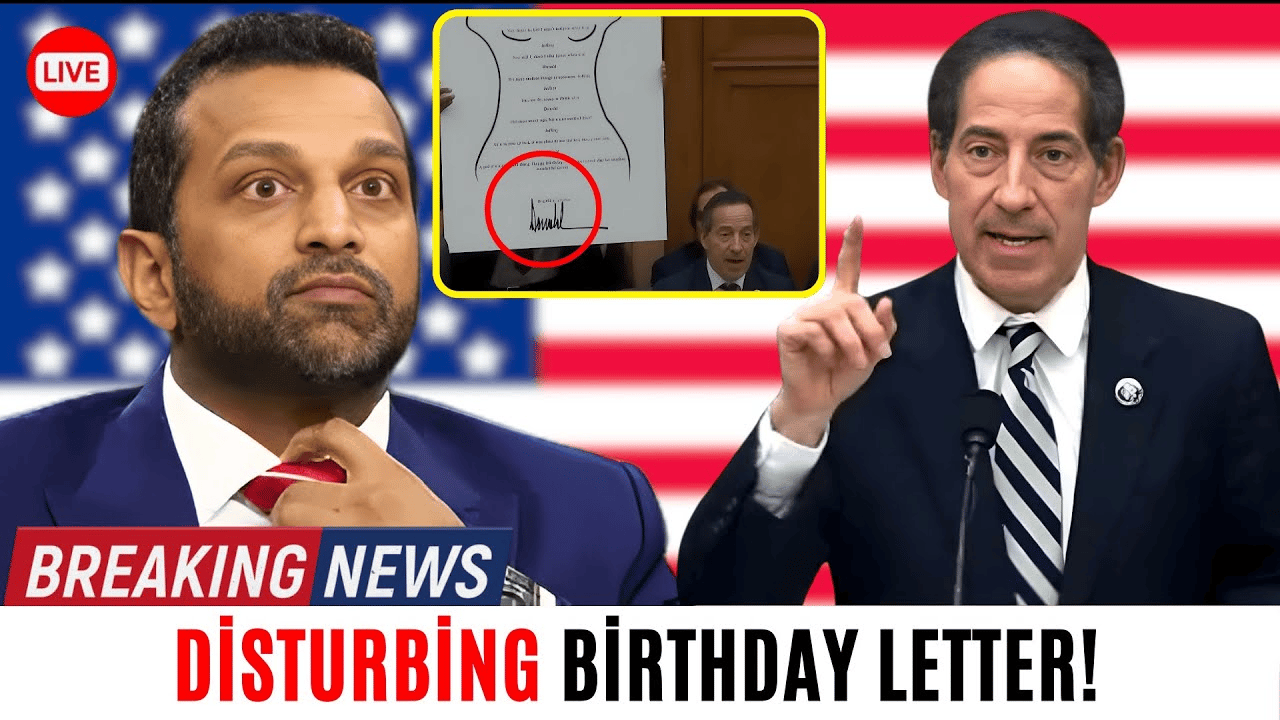
Just a minute ago, Cash Patel completely floundered on live TV. He literally stumbled. Words wouldn't come out. Sentences trailed off. His eyes panicked as he searched for his lawyers. But they too were frozen, unsure what to do. And Jaime Rascin, Jaime Rascin sitting right across from him, continued to press relentlessly without mercy, without pause, without compassion. The subject was a letter sent to Epstein, a birthday note written on a woman's naked body, and the owner of the signature beneath that note, one of Washington's most powerful figures. When Raskin asked about that letter, you should have seen the change on Patel's face. The confidence was gone. Control was gone. That I know everything attitude suddenly evaporated. In its place was only pure, unadulterated, palpable panic and anxiety. His hands and feet were tangled, and his eyes, those always sharp, always ready eyes, were now staring into space. You have to watch this video to the end because you need to see how Patel crumbled. How Rascin ruthlessly crushed him. These moments will go down in history. If you're new to this channel, subscribe and turn on notifications. This file is being opened piece by piece and every event that follows will be explained in detail here on this channel. House Oversight Committee today live broadcast. Patel sat at the witness stand as usual, navy blue suit. An American flag pin gleamed on his lapel. Five lawyers lined up behind him, more than usual. Lately, he'd been bringing an army to every hearing. That familiar I'm in control attitude was right there as always. He took a sip of water. He tested his microphone. He looked ready. In the first part of the hearing, he rattled off the numbers as usual. The numbers he had memorized, the numbers he repeated at every hearing. We arrested 23,000 violent criminals in 7 months. That's twice as many as in the same period last year. We collected 6,000 weapons. 6,000 weapons that are no longer in the hands of criminals. We found 4,700 child victims, a 35% increase. We caught four of the 10 most wanted individuals. We caught as many in 7 months as the previous administration caught in 4 years. We caught one of the people responsible for the Abbey Gate bombing in 2 weeks. They couldn't do it in four years. We submitted 33,000 pages of documents to Congress. The previous director submitted 13,000 in 7 years and the one before that submitted 3,000 in four years. The numbers were impressive. Patel was confident. He seemed prepared for every question. He made eye contact with his lawyers, signaling everything is fine. He smiled at the committee members, relaxed, confident, in control. He felt as if nothing could go wrong today, but his feelings would deceive him greatly. Then it was Jaime Rascin's turn and everything changed. Rascin walked to the podium holding a poster. It was large, white with writing on it, but he wasn't showing it to the cameras yet. The moment Patel saw that poster, his expression changed. His brow furrowed, his eyes narrowed. He was trying to figure out what it was. He looked at his lawyers. They didn't know either. Director Patel, Rascin said, still not showing the poster, his voice low. Last week as the oversight committee, we released a document, a birthday note sent to Epstein. Patel swallowed. You should have seen the look on his face the moment he heard the words birthday note. He was genuinely horrified because he could guess what might happen to him. And the worst part was that everyone, the entire room, even the entire country had now heard and knew about it. Do you know where we got this note? Silence. A heavy, suffocating silence. We didn't get it from the FBI. Rascin's voice hardened. Each word was like a knife, and those knives were piercing Patel's heart. We got it from Epstein's estate, from the estate administration after his death. The FBI never presented this document, this critical game-changing document to Congress. And then he lifted the poster slowly, dramatically for the cameras, the room, all of America to see. I need to describe the image on that poster in detail because it's at the center of everything. The silhouette of a woman's naked body. The head, neck, shoulders, breasts are clearly drawn. The waist curves inward. The hips protrude outward. This is not an anatomical medical drawing. It is deliberately chosen. A provocative, disturbing drawing. You know how someone specifically chooses this shape and then attaches their message to it? It's exactly that kind of drawing. And on top of this silhouette, around it, inside it, a dialogue is written in handwriting, not typed, handwritten, personal, intimate, a conversation between two people. On one side is Jeffrey Epstein. On the other side is Trump. Yes, the American president. You know, the dialogue goes like this. There must be more to life than having everything. response. We have a lot in common, Jeffrey. Yes, we do. I don't even want to think about it. And at the very bottom, I found something wonderful. Happy New Year. And very soon, another wonderful secret. At the bottom, a signature, recognizable, stylized, and belonging to a name everyone in Washington knows. Yes, the same name again, Trump. Rascin turned the poster toward the cameras slowly so everyone could see. The whole room saw it. All of America saw it. Reporters started taking pictures. Cameras zoomed in. And that naked silhouette, those handwritten notes, that signature appeared on every screen. This note, said Rascin, holding the poster steady, was written on a woman's naked body in handwriting, and it mentions a wonderful secret. Now I ask you, Director Patel, was the FBI aware of the existence of this note? That was the moment Patel faltered. And that faltering, that collapse was an unforgettable sight. You really should have seen the helplessness on Patel's face. Representative Rascin, I this document, specific details. The sentence didn't finish. It hung in the air. Patel's mouth hung open as if he was going to continue, but the words didn't come. I'm not asking for specific details. Rascin cut him off ruthless. I'm asking a simple question. Did the FBI know about this note? Yes or no. The FBI reviewed thousands of documents as part of the Epstein investigation. Again, it didn't finish. Again, it hung in the air. Patel couldn't form a sentence. The words poured out of his mouth, but they didn't make sense. That's an evasive answer, director. Rascin shook his head. You said you submitted 33,000 pages of documents. I heard the numbers, too. Was this note among those pages? Silence. 10 seconds. 15 seconds. 20 seconds. The room seemed to hold its breath. I need to verify that. You need to verify it. Rascin's voice rose. For the first time, there was genuine anger in it. This document made national news last week. It was shown on every television channel. The Washington Post ran it on the front page. The New York Times ran it on the front page. And you, as the FBI director, as America's top law enforcement official, don't know if it's in your files. Patel couldn't respond. He just sat there, beads of sweat forming on his forehead. He froze, as you know. A quick break. If you've watched this far and the content resonated with you, please like the video and subscribe. I know it sounds cliche, but it really helps. Likes help YouTube recommend this video to more people. Also, write in the comments, why do you think Patel was so flustered? What was he really hiding? What exactly was his goal? I trust and value your comments. Rascin didn't stop. He saw Patel's moment of weakness and pressed it. He pressed it mercilessly. Let me remind you of your own words, director. He took a piece of paper from his desk. It was prepared in advance with highlights in yellow marker. This is the transcript of the podcast interview you did with Benny Johnson before taking the job. You said this and I'm quoting directly. The only reason the Epstein list wasn't published is because of who's on it. That's why the DOJ and FBI aren't disclosing it because of who's on it. He pointed to the poster, that naked woman's silhouette, those handwritten notes, that signature. Now, do we understand why it wasn't published? Now, do we understand who is being protected? Patel's lips twitched. The context. Context. Okay, I'll give you context. Rascin took another piece of paper. The transcript of your testimony during your Senate confirmation process. There will be no cover up. There will be no missing documents. Every stone will be turned. Anyone who obstructs this will be swiftly pursued. He placed the paper on the table. His voice was firm. It echoed in the room. You said this seven months ago. You said it under oath. Every stone will be turned. Was this note a stone? Did you turn it? Patel couldn't answer. Or did you see what was under that stone and sit on it? Rascin now began reading the dialogue on the poster word for word aloud so that the entire room, all the cameras, all of America could hear. There must be more to life than having everything. He paused, calculating the impact. We have a lot in common, Jeffrey. Yes, we do. I don't even want to think about it. He looked around the room. He looked at the cameras. Then he looked at Patel. A dialogue between two people written on a woman's naked body. We have so much in common. What kind of common things, Director Patel? What kind of common things could there be with Jeffrey Epstein? With child traffickers? One of Patel's lawyers tried to stand up. A gay-haired man in his 50s. Representative, my client is this document. Sit down. Rascin's voice was officially ice cold and he was genuinely angry. I've never seen this man like this before. I'm asking the director, not the lawyer. The lawyer sat down. He sat down helplessly. Rascin continued to assert his authority born of righteousness. And at the very bottom, Rascin continued, raising the poster again, it mentions a great secret. Very soon, another great secret. What was that secret, director? What was this great secret shared with Epstein? And why didn't the FBI present it to Congress? What are you after? Patel attempted a final defense. He tried to gather himself and returned to his prepared answers, but his voice was trembling. He never knew what to say or how to speak. He was just mumbling something. Representative Rascin, the original sin in the Epstein case was not committed during my tenure. I want to make that clear. It began with the deal Aosta made in 2006 to 2008. There was a very limited window of investigation only from 1997 to 2001 to 2002 and from 2002 to 2005. And Aosta signed a deal allowing Epstein to leave prison on weekends and go home. a convicted child trafficker going home on weekends and an agreement was signed that blocked future investigations. You're blaming others. Rascin shook his head impatient. You're blaming 2006. You're blaming Aosta. You're blaming 10 years ago. But this note, he waved the poster, the naked silhouette dancing in the air, is here today in your time, and you didn't present it to Congress. We found it on the property. We went to the judges, Patel said. His voice was defensive, almost pleading. We asked for the court seals to be lifted. We asked for the plea agreements to be vacated. We applied three times. We were denied three times. And then you gave up. Rascin cut him off. What did you announce in July? You and Attorney General Bondi. Silence. Further explanation would not be appropriate or necessary. That was your official statement. From every stone will be turned to no further explanation in 7 months. What changed, director? What did you see that made you change your mind? This is where Rascin delivered his heaviest blow. Director Patel, this spring you assigned hundreds of FBI agents to comb through the Epstein files. We know this. Is that correct? Yes. And what were these agents looking for? Raskin leaned forward. He didn't take his eyes off Patel. More victims, more abusers, financial connections to the human trafficking network. Silence. Heavy silence. No. Rascin's voice lowered but sharpened. According to reports, these agents work to find specific names and images in the files, emails, texts, letters, photos, videos to find and mark the traces of specific individuals in all of them, wherever they appeared in an email, a message, a photo, to mark and black out. He lifted the poster one last time, not to find the criminals, to protect the criminals. Was this note, this great secret, one of those that needed to be blacked out? Patel was now completely broken. He couldn't form sentences. He couldn't defend himself. He just sat there, sweaty, pale, unresponsive. His lawyers frantically took notes, but there was nothing they could do. No note, no whisper could save this situation. Raskin delivered his closing remarks, but not with anger, more with disappointment. Director Patel, your Senate confirmation vote was 51 to 49, the closest FBI director confirmation in history. Opponents labeled you unqualified. They said you don't care about improving the job's requirements. You had zero experience at the FBI, but you had over 1,000 media appearances. You wrote children's books, books that portrayed you as a magical knight. He paused. I hoped they were wrong. I hoped that when you came into this job, you would deliver on your promises. Every stone will be turned, you said. There will be no cover-ups, you said. He placed the poster on the table. That bare silhouette, those handwritten notes, that signature still visible, still under everyone's gaze. Unfortunately, they weren't wrong. And this poster, this letter is living proof of that. The hearing then continued. Technically, other representatives asked questions. Patel tried to repeat his numbers. 23,000 arrests, 6,000 weapons, 33,000 pages, the usual numbers, the usual script, but no one was listening. Everyone's eyes were on that poster, on that naked woman's silhouette, on that wonderful secret phrase, and on that signature. Patel faltered. Live on air in front of millions. He completely faltered. And that faltering, that lack of answers, that panic, that sweaty face said it all. It said more than words ever could. Within minutes, the clip was everywhere. Social media exploded. Twitter crashed. Really crashed due to overwhelming traffic. Patel stumbles trended worldwide. Experts appeared on TV to analyze it. Law professors said it was like a confession and everyone was asking the same question. What's in that letter? What was that great secret? And why did Patel stumble so badly? Let's think about what this means. First, the FBI is withholding documents. That letter wasn't in the 33,000 pages. Congress found it on the property. What else is missing? Second, Patel's own words give her away. It's not being disclosed because of who's on the list, he said before taking office. He was right, but now he's the one protecting that list. Third, that stumbling told the whole story. If he were innocent, if he had nothing to hide, why would he stumble so much? Why would he become unable to form sentences? And fourth, the great secret is still a secret. What was meant in that letter? What kind of secret was shared between two people? And was this secret related to the victims? One minute. That was all it took for Rascin to completely fluster Patel. a letter, a drawing of a naked woman, a great secret. And Patel couldn't respond. He couldn't form a sentence. He just sat there helpless, speechless, broken. That poster is still there. That signature is still legible. That secret is still hidden. But now millions are asking. And Patel's stumble, that live broadcast collapse is recorded forever. If you want to follow this story, subscribe now and hit the bell icon. Every development will be here and share this video. Everyone should see that stumble. Everyone should see that panicked face. And now watch the two videos you see on the screen. Both are necessary for you to understand why this letter is so critical. Click on one right
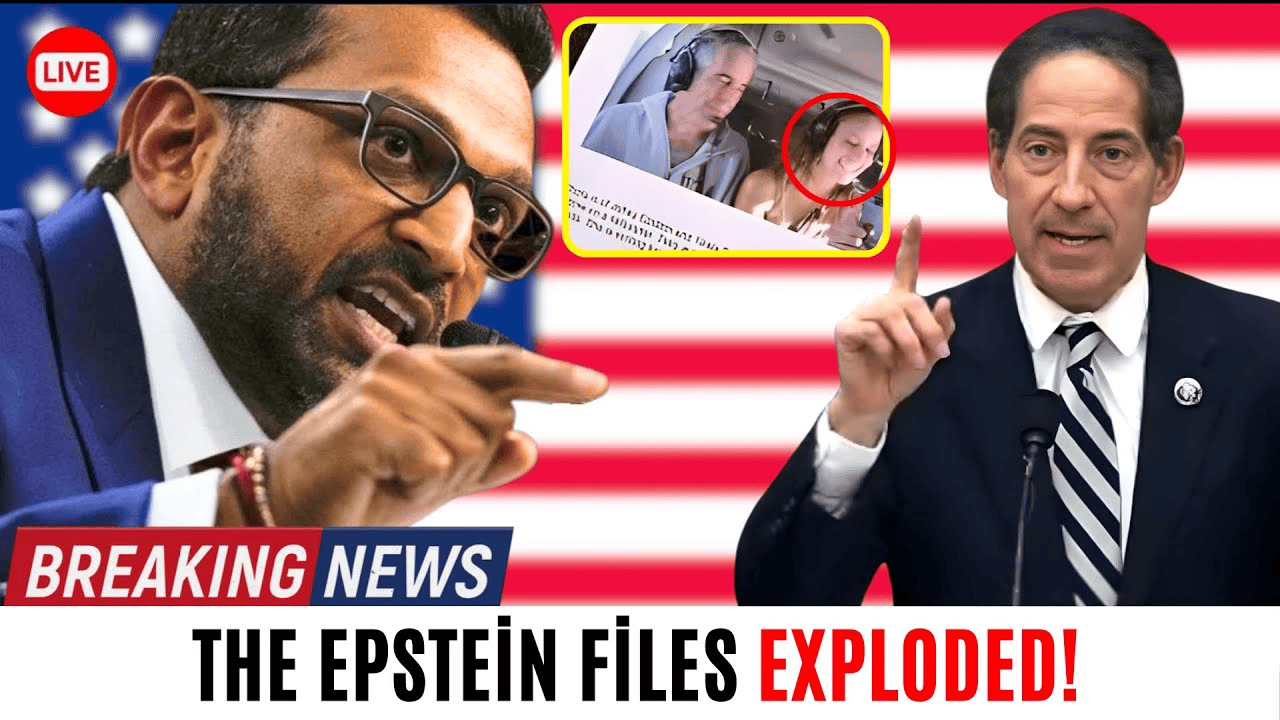
5 minutes ago, Jaime Raskin took the podium and delivered a sentence that will shake America to its core. I have, he said, holding up a file, proof of the Epstein coverup. It's not just a single document, a 2,300page internal correspondence showing a systematic conspiracy. And these correspondences reveal a chain that extends from the FBI to the White House. The salon froze. The cameras zoomed in and Cash Patel, Cash Patel sitting at the witness table visibly began to tense up. Jaime Rasin doesn't bluff. Everyone knows this. Adam is a constitutional law professor. She weighs every word and documents every claim. And today, with 2,300 pages of documents in hand, he was preparing to expose the greatest coverup in American history. You absolutely must watch this video to the end because what Rascin explains, names, dates, orders, changes everything. If you're new to this channel, subscribe right away and hit the bell icon. This event is now going in very different directions and you need to know every detail. Let me explain how we got to this point. Last night around 11 p.m., an anonymous source left a package at Jaime Raskin's office. There was a USB flash drive inside, and on that USB drive were 2,300 pages of emails, notes, and reports leaked from the FBI's internal communication system. Rascin's team worked tirelessly throughout the night. He verified the documents. He examined the metadata. He cross-cheed the dates, names, and events. And at 6:00 in the morning, Rascin made a statement. I will be making historic statements in today's hearing. The media went crazy. Everyone was curious. What had he found? Who was he going to expose? Now we know. House Oversight Committee. It's 10:00 a.m. The salon was packed. Every chair, every corner, every square centimeter was filled with people. The journalists were waiting on their feet. Cameras were filming from every angle. Patel arrived as usual, but this time something was different. His eyes were red. Hadn't he slept? His movements were slower. He had six lawyers with him. Six. He had never come with so many lawyers before. He knew. He knew things would go south, but he didn't know how big it was. The first hour went by as usual. Other committee members asked questions. Patel gave evasive answers. Everything seemed normal. Then it was Rascin's turn. For those unfamiliar with Jaime Rascin, he is a representative from Maryland, Harvard Law School graduate. He taught constitutional law at Georgetown University, the lead manager for Trump's second impeachment trial, one of the sharpest minds in American politics. And today, that sharp intellect was locked onto Cash Patel. Rascin walked to the podium. He had a thick black file in his hand. The file had confidential declassified written on it in red letters. Director Patel, Rascin said, placing the file on the table. Today we will be discussing the Epstein coverup, but this time there's no speculation. This time there's no theory. This time I have evidence. He opened the file. 2,300 pages. FBI internal correspondence from 2019 to 2025. And these emails show how the Epstein investigation was systematically sabotaged. Rascin pulled out the first document. This is an email dated June 14th, 2019. Sent from the FBI's Miami field office to Washington. Subject: Epstein high-profile targets. He showed the document to the camera. In this email, the Miami office asks Washington, "We have 34 high-profile names. It is supported by witness statements, flight records, and photographic evidence. We are requesting approval to open an investigation. He paused. 34 names. 2019, 6 years ago. And do you know what the answer was? He pulled out another document. The response from Washington. Not available at this time. Wait. Signature. Director of the FBI at the time. The salon roared. It's not convenient right now. Rascin repeated 34 names, child abuse suspects. And Washington says, "Wait, but this was just the beginning." Rascin began pulling out documents one after another. Each new document that comes out is more scandalous than the last. Things are starting to get really interesting. This is August 2019, a week after Epstein's suicide. FBI internal memo. The Epstein case will be closed. All side investigations will be suspended. Signature deputy director. Another document. This is January 2020, six months before Maxwell was arrested. An FBI analyst writes to their superiors. We have enough evidence on Maxwell. Why aren't we taking action? Answer: Political sensitivities. We are waiting. And one more. This is March 2021 after Maxwell was convicted. FBI internal report. Maxwell named 47 people. Investigation is recommended. A handwritten note is scribbled on it. Not approved. Highlevel decision. Raskin looked at the living room. Tople decision. Who made this decision? Which highlevel official blocked the investigation of 47 child abusers? Now, I need to stop for a second and say this. If you've watched this far, please like the video. I'm serious. This isn't just for the channel. The YouTube algorithm looks at likes, and it's essential that this video reaches more people. And write your thoughts in the comments. Who do you think these 47 names are? Where did this high-level decision come from? Rascin hadn't finished yet. The heaviest bomb hadn't arrived yet. Now, he said, pulling a document from the back of the file. I'm going to show you the most disturbing document. It was a one-page note. FBI letterhead. Date on it, February 3rd, 2025. 2 weeks after Patel took office. This memo said Rascin was sent from the FBI director's office to all field offices. Subject: Epstein investigation, new directives. He started reading. Everyone in the salon became twice as attentive when they heard the topic. From today, all active files related to the Epstein investigation will be transferred to headquarters. No field office can initiate or continue an investigation without central approval. All witness interviews have been suspended. All document requests will be rejected. He paused. He looked at Patel and at the very bottom, "Director Patel, your signature is there." The salon was shocked again. People were shouting. Journalists were jumping to their feet. The cameras couldn't capture people. The committee chairman was banging the gavvel and shouting, "Order! Order!" I looked at Patel's face. "Adam, how can I put it?" He was devastated. His lawyers were leaning toward him, whispering something, but Patel seemed not to hear. Raskin waited. He waited until the salon calmed down. Then he continued, "Director Patel, do you recognize this document?" Silence. Director. Patel's lawyer interjected. My client needs time to review this document. Time? Rascin raised his eyebrows. This document bears your signature, director. How much time do you need to recognize your own signature? Patel finally spoke. The session is quiet, almost inaudible. This document is taken out of context. Context. Rascin pulled other documents from the file. Let me give you some context. After this directive, after the directive you signed, the FBI's activities related to the Epstein investigation decreased by 94%. Witness interviews have stopped. Document analyzes have stopped. Fieldwork has stopped. He put the documents on the table. You started your job and the Epstein investigation effectively died. Is this your context? Patel couldn't answer. And another interesting coincidence, Raskin said, "We know that on the day you signed this directive, February 3rd, 2025, there was a meeting at the White House on the same day, you attended that meeting, and 2 hours after that meeting, you signed this directive." He looked at Patel. "What was discussed at that meeting, director?" Here's where something unexpected happened. The most senior of Patel's six lawyers, a gay-haired man in his 60s, stood up. Mr. Representative, my client is exercising their fifth amendment rights. He will not answer this question or any subsequent questions. The salon roared again. Raskin shook his head, but he didn't seem surprised. He seemed to be expecting this. Fifth Amendment, he said. The right not to testify against oneself. The FBI director believes he would incriminate himself if he answered questions about the Epstein investigation. He returned to the salon. American people, are you hearing this? The FBI director, the country's top law enforcement official, cannot answer questions about the child abuse investigation because he would incriminate himself if he did. Rascin closed the file. This is no longer a doubt. This is no longer a theory. This is a cover up collapsing before our very eyes. But Jaime Raskin wasn't finished yet. He pulled out a final document. This time it was in a different format. It was like a table. This, he said, is the list of people the FBI marked as not to be investigated as part of the Epstein investigation. Official FBI document created in 2021. In 2025, during Director Patel's tenure, it was given the status of permanently closed. He showed the table. There are 47 names on this list. And next to these names, there are codes explaining why they won't be investigated. He started reading. Code A, political sensitivity, 12 names are marked with this code. Code B, diplomatic relations, eight names. Code C, national security, 15 names. And code D, he paused. Code D, executive branch protection, 12 names. He looked at the salon. Executive branch protection. Do you know what this means? This means the White House is protecting these names. This means the highest levels of the American government are protecting child abusers from investigation. Patel's lawyers were now in full panic mode. They were looking at each other. They were writing notes. They were whispering. But they had nothing to do. The documents were there. The evidence was there. And in 15 minutes, Rascin had pieced together the entire coverup scheme. What else could he have done anyway? Raskin said his final words. Director Patel, I wanted to speak with you today, but you hid behind the fifth amendment. This is your right, but this is also a confession. He gathered his file. These documents will be shared with the public tomorrow. 2,300 pages, every email, every note, every directive. The American people will see it with their own eyes. He looked at Patel one last time. And those 47 names, those names will also come out. Maybe not today, maybe not tomorrow, but it will come out because the truth always comes out. And this cover up, this massive, disgusting coverup cannot remain hidden forever. He moved away from the microphone. My questions are finished, Mr. Chairman. The hearing effectively ended after that. It continued technically. Other representatives asked other questions, but no one was listening. Everyone had only one thing on their mind. Raskin's documents. 2,300 pages, 47 protected names, and a directive signed by the FBI director. Stop the investigation. The news broke within minutes. # rascin47 became the top trending topic worldwide. Within an hour, the televisions went live, experts spoke, and everyone asked the same question. Who are those 47 names? We don't know the answer to this question yet, but we have what we know. First, Rascin's documents are real. It matches FBI metadata. The dates are consistent. The signatures have been verified. These aren't fake documents. These are the government's own records. Second, the Epstein investigation was deliberately sabotaged since 2019. First, they said, "Wait, then it was said it's not suitable." And during Patel's tenure, it was officially halted. Thirdly, 47 people are being protected. Political sensitivity, diplomatic relations, protection of the executive branch. These people are being protected by someone at the highest levels of the government. And fourthly, Patel knows this. His invoking the fifth amendment is proof of this. If he were innocent, he would speak. If he wasn't part of the cover up, he would have made a statement. But he remains silent because he can't speak. He doesn't even have the right to speak. Five minutes. This was all it took for Jaime Rascin to expose the entire cover up. 2,300 pages of documents, 47 protected names, and an order from the FBI director himself. Stop the investigation. This is no longer a conspiracy theory. This is no longer speculation. This is a documented proven fact that is recorded in the congressional record. And Patel, Patel sat at the table, hid behind the fifth amendment, and couldn't say a single word because he had nothing to say. The documents said it all. The truth is coming out slowly, but it's unstoppable. If you want to follow this event, subscribe now and click the bell icon. Tomorrow, Rascin will share the documents with the public. 2,300 pages. Each of them will be analyzed here. And share this video. Send it to everyone. This pressure should continue until 47 names are revealed. And now, if you missed the previous episodes of this scandal, watch the two videos you see on the screen. Both are critical to understanding today's explosion. Click now.